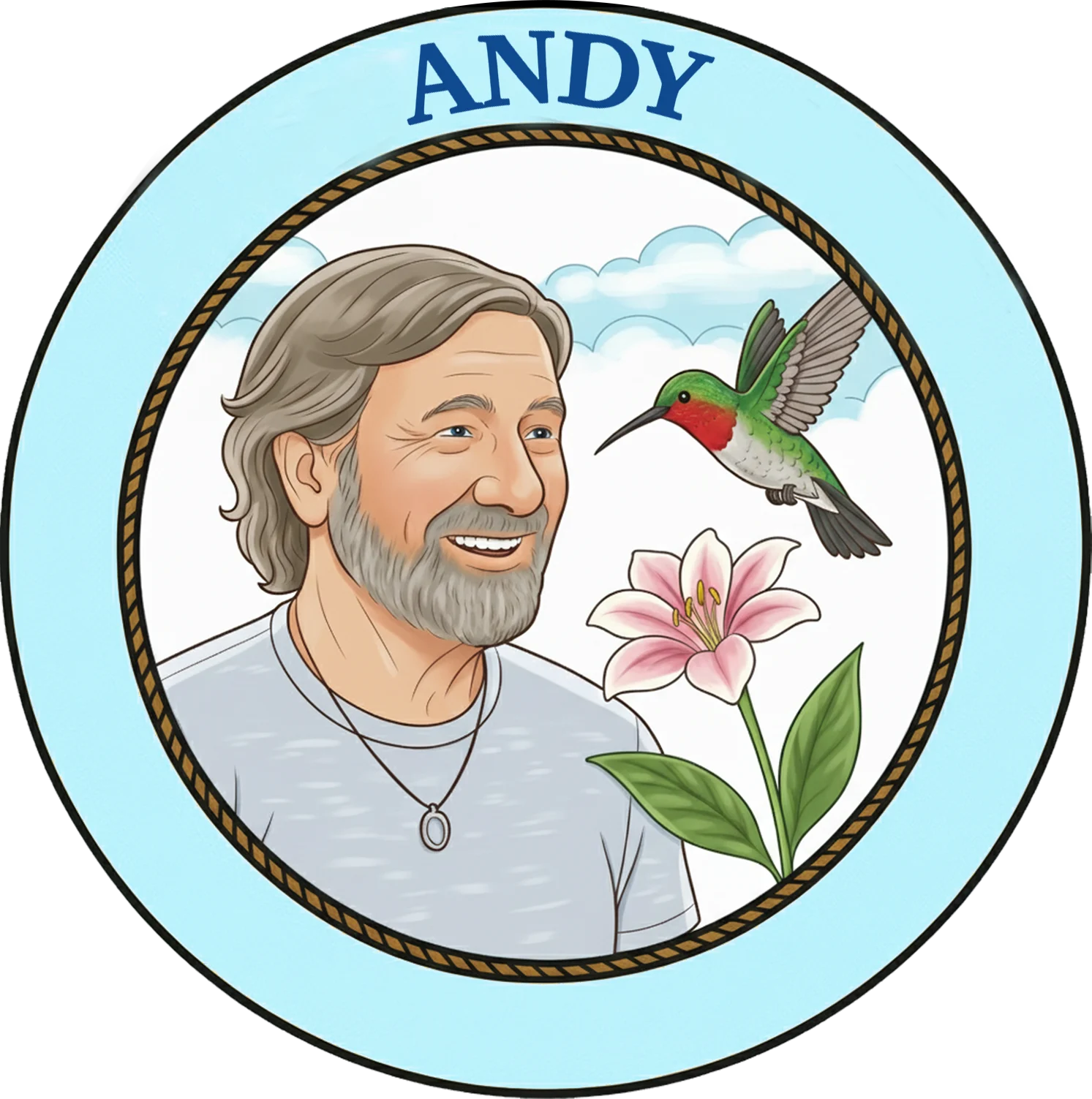
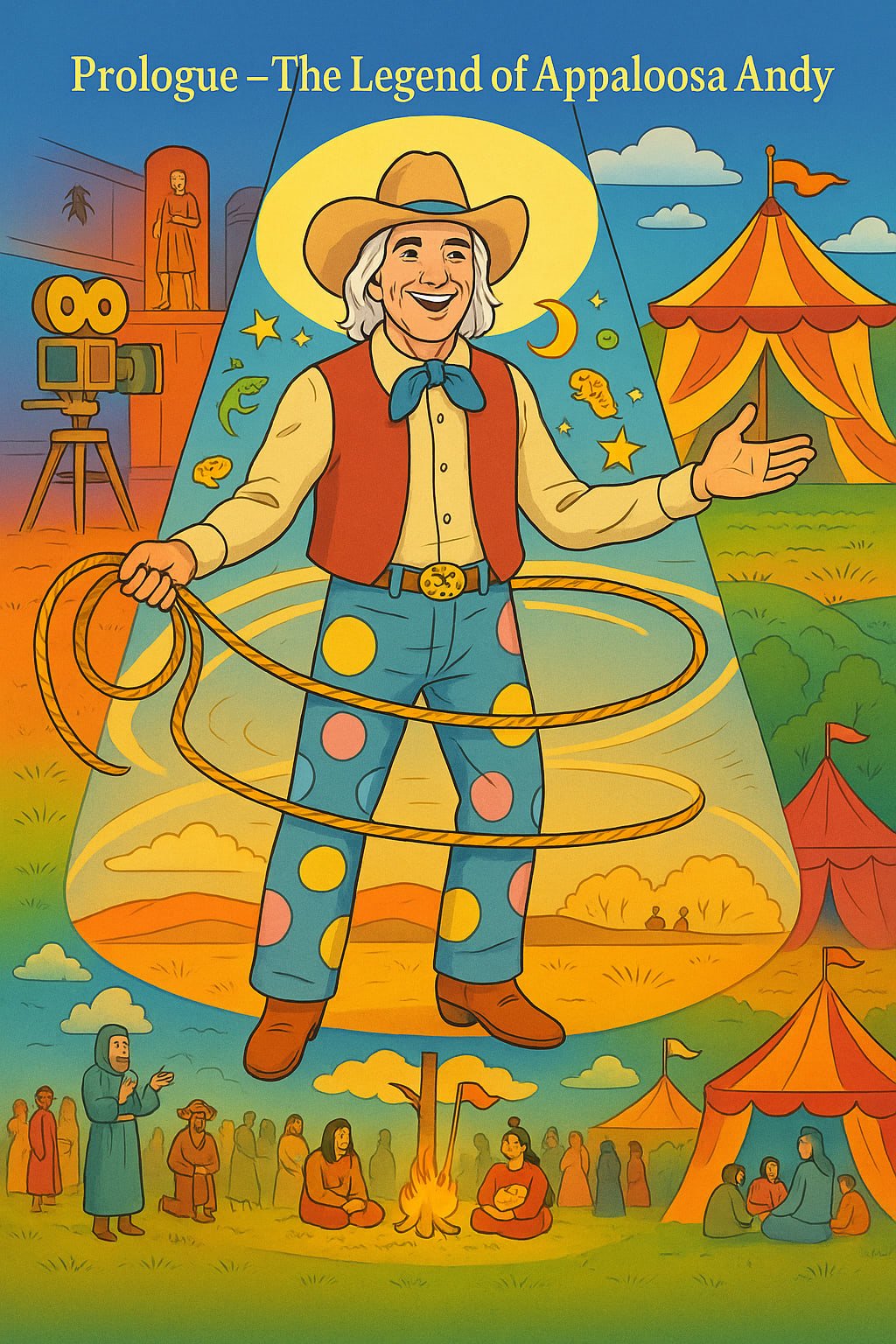
 The Legend of Appaloosa Andy
I never set out to live a straight line. My life bent itself into circles, spirals, loops that doubled back on themselves. Some were mistakes, some were survival, and some—if I’m honest—were the only way I knew to get to the truth.
I’ve been many things: actor, farmer, dreamer, troublemaker, prophet, and fraud—sometimes in the same week. I’ve sat at tables with Hollywood stars and old medicine men on the prairies. I’ve shoveled compost at dawn, sung opera on roller skates, invented thirteen flavors of rice cakes I sold across Europe, and once sold gold and silver I didn’t own over a phone in Los Angeles.
Every one of those scenes is true. But the only through-line that ever mattered was vision—not the kind you read on eye charts, but the kind that comes in dreams. Dreams are unruly. They arrive in images, fragments, half-spoken sentences, and they don’t care about your plans. Sometimes they whisper, sometimes they roar. And if you follow them, they lead you places no mapmaker ever thought to draw.
That’s how I’ve lived—following whispers and thunderclaps. Making a life out of detours. Sometimes finding joy, sometimes landing in a ditch. This isn’t a straight line; it’s a spiral. Not a sermon, but a record of the strange routes that brought me here.
Thanksgiving weekend, Vineland, New Jersey, 1986. The Wild West—buffalo riders, sharpshooters, a gunfight staged around a false-front town. The Fraternal Order of Police sponsored it. I produced it. I starred in it. Clayton Moore—the Lone Ranger himself—showed up. Two thousand seats filled fast. It was theater, circus, ritual—half-scripted, half-chaos. When the lights hit the false-front town, the boards seemed to breathe.
Clayton walked out—mask gone, sunglasses on—and the crowd erupted. To them, he wasn’t an actor. He was The Lone Ranger.
A year later, in Westport, Connecticut—old money, farms, Paul Newman country—I wrote a musical about immortality and true love with my friend Joe Bailey, one of The Muppets writers. We called it The Legend of Appaloosa. It was about a carnival barker who finds the elixir of life, only to give it up for love.
In the American West, legends are made of outlaws and lawmen. Into that world I came: a showman named Appaloosa Andy. The name was given by an old medicine man, Fire Owl. He said the Appaloosa wasn’t the fastest horse—but it was the one that endured. The one that went the distance.
What you’ll find in these pages are the moments that marked me—the people I followed, the visions I chased, the truths I stumbled into, the spirits that tracked me down, and the strange luck that kept me alive long enough to tell on myself.
This isn’t the story of a man who found the path. It’s the story of a man who walked off every path he was given and still managed to arrive somewhere that feels like now.
If there’s a thread through all of it, maybe it’s this: I never stopped believing the world was stranger, wilder, and more possible than the version we were handed. I tried to live inside that possibility, even when it broke me. Especially when it broke me.
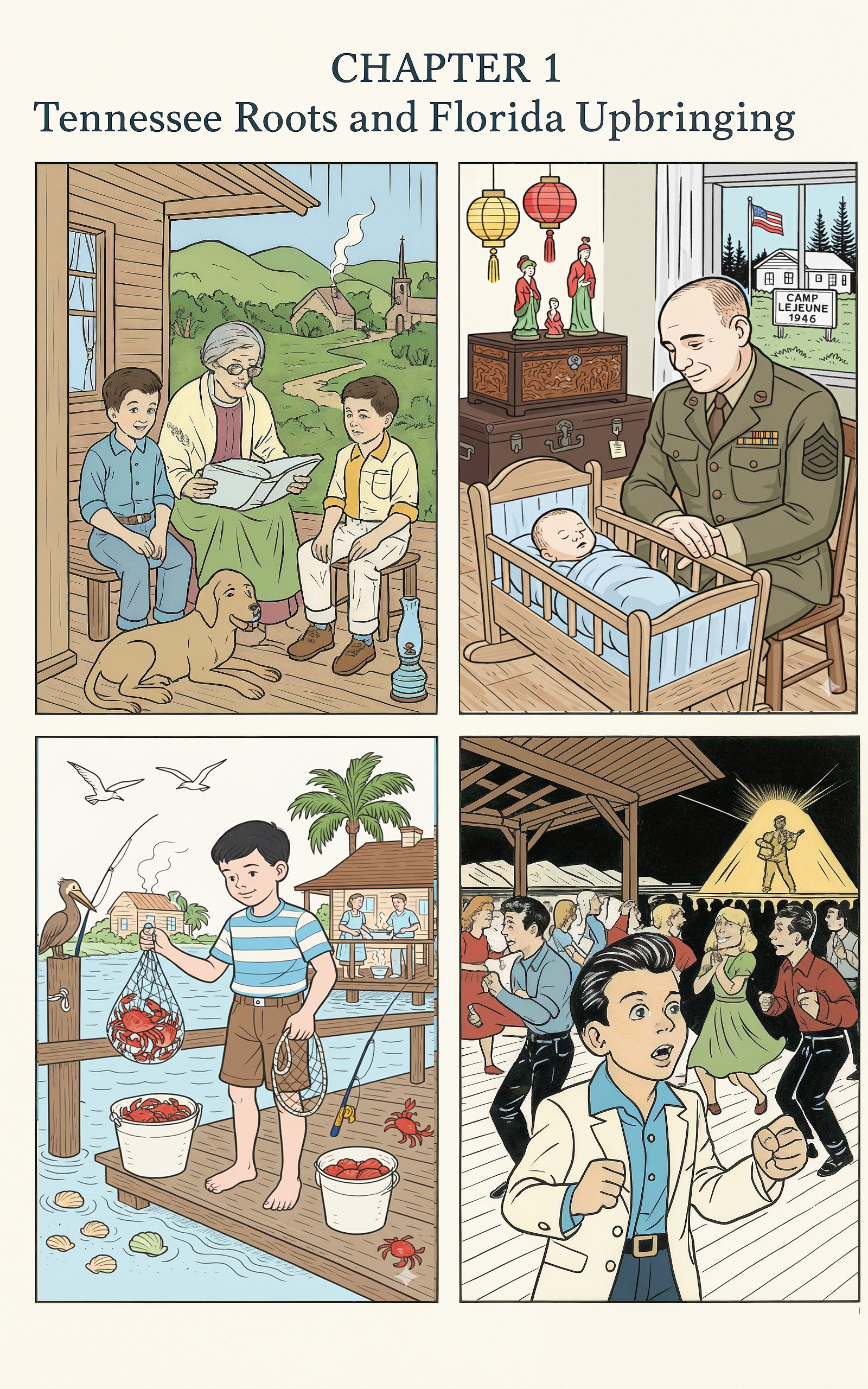
I was born in 1946 at Camp Lejeune, North Carolina. My name carried its full weight — Andrew Jackson Cooksey IV — a name already worn by three men before me. My father, Andrew Jackson Cooksey Sr., was a Sergeant Major in the First Marine Division. He had landed on Guadalcanal, Okinawa, and Iwo Jima. A war hero.
Before that, he had spent six years in China with the Marines. He brought those years home in fragments — the sound of street markets, the red paper lanterns. He also shipped back carved chests, ancient porcelain figurines and dishware. He loaned it to the Tennessee State Museum. They “lost them” and never gave it back. The stories remained as my inheritance.
When I was a year old, we left Camp Lejeune and moved to Tennessee, to the family’s ancestral home on Yellow Creek in Houston County. Our family’s graveyard was close by with the first Andrew Jackson Cooksey buried there. My parents enrolled in college, and my grandmother took charge of me.
My parents were young and still finding their footing, both in school and in life. They were strict in principle but gentle in practice, believing curiosity could teach as much as discipline. My grandmother kept a steady hand on me, but my father balanced her firmness with play. On long drives through the rolling hills, he would speed up just before a rise, and as the car lifted and our stomachs dropped, he’d laugh and shout that we were on a roller coaster. My mother pretended to scold him, but even she was smiling. Those rides taught me that adventure could live in ordinary moments — a lesson that would follow me long after Yellow Creek.
The creek ran across the road from the house, the air thick with honeysuckle, the nights lit by fireflies. In the daytime, we swam in the muddy water, toes curling in the silt, the call of whippoorwills echoing at dusk. My cousin Jakey watched over me in those years. He was older, surer on his feet, and he had a way of keeping me out of the deepest water. He wasn’t much older, but to me he was a giant — someone who knew the creek, the woods, the hidden paths. Jakey was family in the truest sense: rough around the edges, but steady.
Sundays were the still point in that world. Granny’s hands smelled of biscuits and lye soap, and her hymns rose before dawn while the coffee percolated on the stove. The men shaved with straight razors and spoke softly until breakfast was cleared. Then came church—hard wooden pews, the whine of ceiling fans, and the preacher’s voice rising like heat. The women wore cotton dresses that rustled when they stood to sing, and the children fidgeted, waiting for the final amen so we could run outside into the bright Tennessee air. I remember the sound of the creek beyond the church, and how its shimmer seemed to carry the hymns downstream.
My mother was the eleventh of thirteen children, her head filled with plant knowledge and remedies, the kind passed down in a family where women worked the land and kept people alive. My grandfather was a farmer but also a scholar, insisting education was the only way forward. Granny sat every night with her Bible open, reading aloud. My father balanced discipline with lenience. Duty and curiosity braided together in that place. My sister Trudy was born a few years later.
My parents’ drive for education set the rhythm of our family life. Books piled on the kitchen table beside lesson plans and grade books, and the talk around supper was always about students, exams, or the next semester. I grew up believing learning was a kind of service—something you did not just to advance yourself but to pull others forward too. Yet even then, I sensed that my lessons would come less from classrooms and more from the road ahead. While my parents built careers of structure and order, I was already restless for the spaces between, for what couldn’t be graded or planned.
My parents moved us to Gainesville, Florida to finish their graduate degrees in education. We then moved to small towns in northern Florida every year as my mother took teaching positions and my father became the school’s principal.
Each new town felt like a fresh start and an interruption all at once. We’d unpack boxes, learn new streets, and I’d figure out where I fit in just as we were getting ready to move again. The schoolyards changed, but the rhythm stayed the same — new faces, new teachers, and the quiet understanding that nothing lasted long. Those constant moves taught me to adapt quickly, to read people, to become whoever I needed to be. Without realizing it, I was already rehearsing the art of transformation that would define so much of my later life.
When I was nine, we moved to Panama City, Florida. St. Andrews Bay, right in front of our house, was still unpolluted then. I could net blue crabs right off the pier, wade waist-deep and feel scallops brushing against my toes. I would head out at dawn with buckets and come back heavy with the day’s catch. At night, we ate what we pulled from the sea — steamed crabs and pan-fried scallops that tasted like salt and sunshine.
It was in Panama City that I discovered Elvis and rock ’n’ roll. I was nine years old, dressed like him in hand-me-downs cut to fit the style. My sister Trudy and I sang Everly Brothers harmonies together. For me, the music was freedom, rebellion in a voice that shook the walls. I wasn’t just watching Elvis; I was trying to be him. My older cousin from Tennessee, who stayed with us some summers, would sneak me into shows in Panama City Beach. I lived for the lights, the screams of teenage girls. I was only nine, but I felt sixteen. The concerts were noise and possibility — a door cracked open onto another world.
The sweat, the teenage girls’ cheap perfume, the boys’ Old Spice cologne, the stomp of feet on wooden floors — it was intoxicating. I wasn’t just watching; I was becoming Elvis. I imitated his moves, his swagger, and grew my hair long. At home I practiced in the mirror until my body found its own rhythm.
Those nights at the beach pavilions, Buddy Holly’s glasses would catch the light, the Everly Brothers’ voices would blend until they seemed like one sound. I stood in the crowd trying to see over their heads, but I felt taller than all of them. It was electricity. It was music that made me want to be someone and somewhere else.
I didn’t know it then, but those nights under the pavilion lights were rehearsals for the rest of my life — chasing the next stage, the next song, the next horizon.
The horizon, as it turned out, was not a line but a promise—one that kept shifting every time I thought I’d reached it. Florida’s salt air had given me a taste of motion, and I began to see the world as a stage waiting beyond the Gulf. I didn’t yet know its name—New York, Hollywood, the high plains of South Dakota—but I could feel it calling, the same way the music had: loud, electric, impossible to ignore.
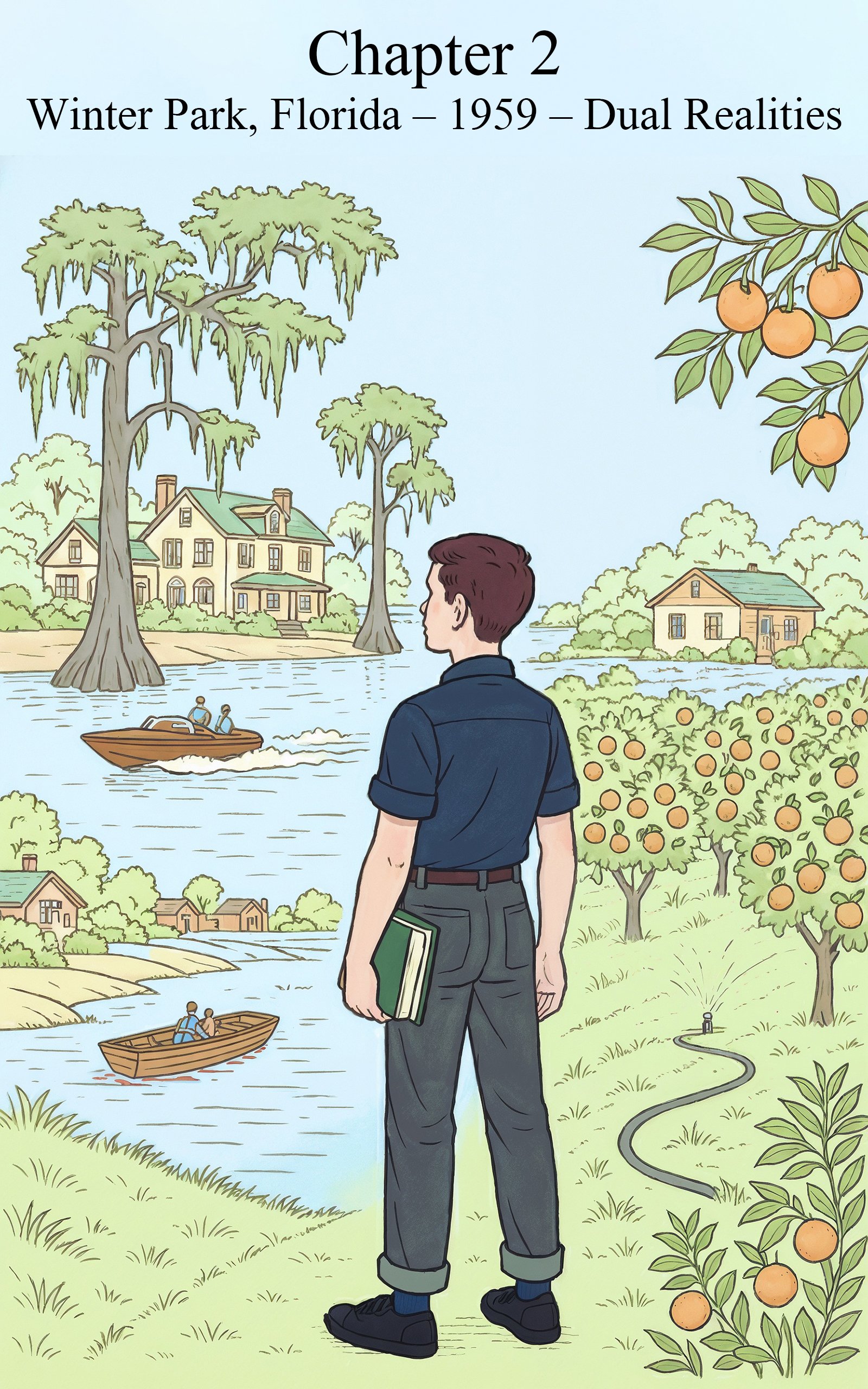
This chapter captures my adolescence as a balancing act between appearance and authenticity — the tension between the orange-grove suburbs and the polished world of privilege. It traces my initiation into performance, spirituality, and desire: learning to “pass,” reading the red letters of Scripture to my grandmother, and testing love’s boundaries with Susie before being sent to Forest Lake Academy — where a new friendship with Ricky begins to reawaken my sense of freedom.
After Panama City, the tides of childhood freedom gave way to something quieter, more contained. My father had taken a new position in Winter Park, and with it came a different kind of schooling — not just in classrooms, but in how to move through worlds that didn’t see each other.
After Panama City, we moved again, this time to Winter Park. The town had two faces. One belonged to the canals lined with moss-draped cypress and grand lake houses whose screened porches opened onto the water. Ski boats traced lazy figure eights across the connected lakes where old money lived, their wakes rolling toward manicured lawns that smelled faintly of jasmine and cut grass. The other face was ours — the modest subdivision carved out of the orange groves, where the air was thick with fertilizer and the hum of cicadas. The nights carried the scent of blossoms, the steady hiss of sprinklers turning rhythmically over clipped lawns, and the soft rustle of palmetto fronds against the windows.
At school, I met kids whose families belonged to the country club, who vacationed in Europe and wore shoes I couldn’t afford. One classmate, Warren, invited me to his birthday party on the lake. The water was clear, the docks polished, and their house seemed to float between glass and light. I remember realizing that if I was going to belong anywhere, I had to learn how to shift — how to fit. I didn’t see it as deceit then, just survival.
I played the part expected of me — jock by day, little league baseball and football. But inside I was still Elvis, still chasing the freedom of music and the stage. I passed between those two worlds seamlessly, never entirely belonging to either. Winter Park taught me how to pass. How to smile for the principal, shake hands with the minister at church, and then sneak out into the orange groves to daydream other places and other worlds. It was a mindset I’d carry the rest of my life.
Sometimes at practice, while the coach shouted signals, I’d hum rock tunes under my breath. Between innings, I’d imagine the crowd cheering for a concert instead of a ballgame. The Elvis in me and the boy in the uniform shared the same skin — one hidden, one performing. It was confusing, but it made me aware of the masks people wear, the small performances that keep life running smoothly.
My grandmother came to live with us in Winter Park. Her sight was nearly gone. Cataracts clouded her eyes, the world slipping away from her one shadow at a time. But she had her Bible. Every evening she sat with it open on her lap, the worn leather soft from decades of handling. The room smelled faintly of Vicks vapor rub and the liniment she used. The floor fan hummed as the lamp cast her Bible in golden light.
I would read to her because she was almost blind. She would say, “Read the red.” That’s what Jesus said. I read aloud, stumbling at first, then falling into the rhythm of the King James cadences. Jesus overturning tables in the temple. Jesus forgiving the prostitute. Forgive seventy times seven. Her voice cracked but it carried authority, guiding me through the words.
Sometimes, when the verses ended, we didn’t close the book. We talked. She told me about the prophets — Jeremiah, Isaiah, men who wrestled with God, who asked questions and weren’t struck down for asking. I didn’t understand the words then, but I felt as if faith was something you could lean against. I wanted to speak to God directly, without the preacher, without the church. To skip the middleman. To cut through the ceremony and hear a voice answer back in the dark.
Those nights planted something in me. Not certainty, but hunger.
Then there was Susie, my babysitter when I was twelve. By the time I was fifteen she was eighteen, already in college, and I was still just a boy trying to be older than I was. It wasn’t supposed to happen, but it did. She liked the way I knew her, and I liked the way she made me feel wanted. For a while, that was enough. It wasn’t shameful to us. It felt like love, or at least the closest thing I’d known to it.
Her father was a cop, but he never threatened me. He liked me well enough, though the whole thing embarrassed him. What unsettled my family wasn’t scandal or danger — it was that I was moving too fast, pushing past my years, testing boundaries everywhere I could. Still throwing myself at things I didn’t yet understand.
Sometimes after leaving her house, I’d look at myself in the bathroom mirror — crew cut, heartbeat still pounding — and wonder who that person was looking back. I didn’t feel guilty, just aware that I was crossing lines that couldn’t be uncrossed.
When my parents found out, they weren’t furious so much as concerned. Concerned that I was running too far ahead of myself, that I would fall hard. Their answer was to send me away — to somewhere that might slow me down, give me structure. That place was Forest Lake Academy, a Seventh-day Adventist boarding school. It was meant to straighten me out, to box in my wildness with Scripture, rules, and veggie burgers.
The first night there, the dorm smelled of Lysol and starch. They spoke of prophecy and end times that had its own kind of rhythm — and it was there that I met Ricardo Vásquez. Ricky.
I didn’t know it then, but Ricky would open another door — freedom of a different kind.
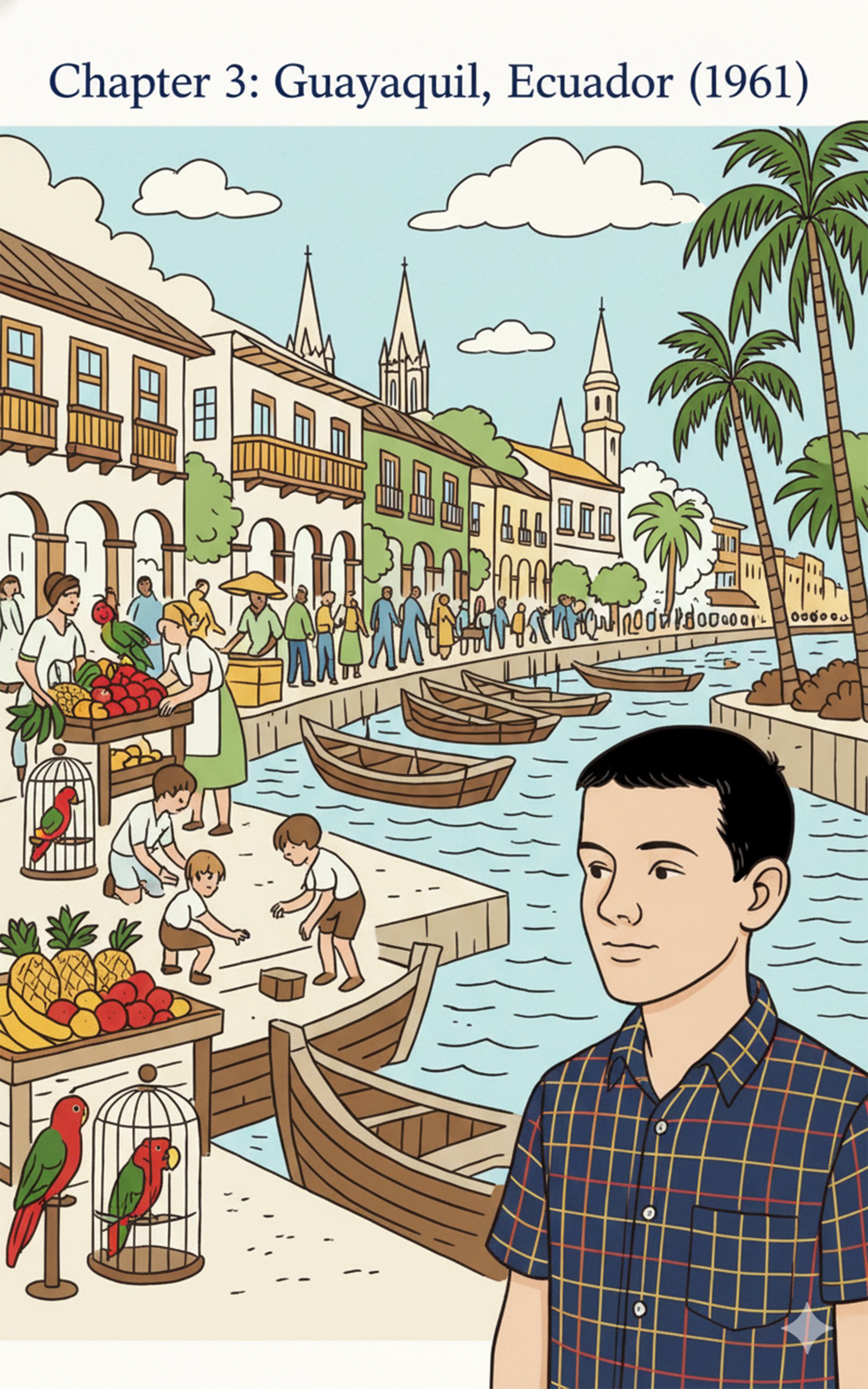
This chapter captures the summer I left the safety of home behind and sailed to Ecuador on a banana boat at fifteen, chasing freedom with my friend Ricky. In Guayaquil, I fell in love for the first time—with the city, with Muñequita, and with the feeling that the world was finally mine to lose.
He was from Guayaquil, Ecuador. Another boy who was sent away for being too wild. We were roommates and instant brothers. He was dark-eyed, fast-talking, and full of schemes.
At night we’d wait until the dorm fell quiet, the low hum of ceiling fans covering our whispers. Ricky would pull out his contraband transistor radio, the size of a soap bar, wrapped in a sock to muffle the sound. He’d tune to a faint Latin station out of Miami, and suddenly the room filled with forbidden rhythm — bolero, cumbia, laughter in another language. We’d lie there in the dark, the glow of the dial painting his face in pale green.
Once a monitor caught us and yanked the plug from the wall, shouting about “heathen noise.” Ricky only grinned, a cigarette tucked behind his ear. Later, when the footsteps faded, he struck a match, lit up, and blew a ring of smoke toward the ceiling.
I think that’s when I knew we were the same kind of restless — two boys pretending to be tame, already dreaming of the escape route.
At night we whispered about the world beyond school walls. Ricky told me about his city, a seaport alive with music and markets and banana boats. He painted Guayaquil in colors Florida never had. One night he said, “Why don’t you come back with me this summer?”
He meant it. He arranged it with an older friend who worked on the banana ships. Passage for me, free.
I packed my bag, slipped Granny’s red-letter Bible inside, and took a bus to Galveston, Texas, the last port of call. At the dock I boarded the Ballenita, a Norwegian banana boat under contract to United Fruit. Nobody asked why a fifteen-year-old boy was climbing aboard a cargo ship. Nobody stopped me. That was the irony — fifteen and freer than most men ever get to be.
The dock at Galveston had smelled of diesel and salt, the air thick with the cries of gulls. Men shouted in half a dozen languages, loading crates and cables in the dim yellow light.
The Ballenita’s hull rose like a black wall, streaked with rust and promise. I stood there gripping my small suitcase, Granny’s Bible pressed against my chest. Before I left, she’d placed her hand on my head and prayed in her soft Tennessee drawl, asking the Lord to keep me safe “wherever His winds may blow.” The memory followed me up the gangway.
A sailor with hands like rope knots squinted at me and muttered, “The sea doesn’t love anyone, kid. Remember that.” Then he turned and disappeared into the hold. When the ship’s horn bellowed and the dock began to slide away, I felt something break loose inside me — fear, maybe, or the weight of everything I was leaving behind.
The Ballenita was stacked with cardboard cartons, waxed so they wouldn’t collapse in the damp air. They lined the refrigerated holds, fans blowing night and day to keep the green fruit steady — fifty-five degrees below deck, cold enough to keep the bananas from ripening on the voyage.
The smell seeped upward — sweet, grassy, sour. It clung to your clothes and stayed in your mouth. The crew cursed it. To me it was the smell of escape.
Days fell into rhythm — the metallic clang of the galley bell, the scrape of mops on deck, the sing-song curses of men from Oslo and Bergen. I learned to keep out of the way, though not always fast enough. Once I slipped on wet planking and caught the edge of a sailor’s temper. “You trying to get yourself killed, boy?” he barked, shoving a mop in my hand. I learned fast.
At night I’d sit on an overturned crate by the rail, watching the horizon blur into nothing. The moonlight made the sea look like glass, and the slow hum of the refrigeration fans below deck became my lullaby. Sometimes I’d catch the faint smell of bananas and diesel together — sweet and bitter, like freedom itself.
That first night at sea, I cried into my pillow. Quiet, so no one would hear. I cried because I knew the cloak was gone — my parents, my grandmother, all their protection left on the dock. I was on my own. I had to dig down into my dreams, into my visions, into what Granny had taught me. If I didn’t, I knew I was lost.
By morning I walked the deck. Salt spray on my face. Sailors smoked, passed bottles, cursed at the sea. The galley fed us well. Norwegian stews thick with fish and potatoes. Dark bread with butter. Coffee strong enough to burn a hole in the hull. The cook folded in Ecuador: rice and beans, fried plantains, fish soup bright with lime.
I leaned against the rail and thought: This is what freedom tastes like — salt, diesel, and fear.
When we finally came into the Guayas River, the air hit me like a wave. Heavy. Salty. Alive. The harbor was lit with banana boats, little launches darting between them loaded with fruit, sailors, girls, radios blaring cumbia.
Ricky was waiting. He had a little gold Citroën, low to the ground, engine buzzing like a hornet. He hugged me, tossed my bags in the back. “Let the party commence, gringito.”
We tore through Guayaquil. The air was thick and wet, the kind you could drink. Radios blasted cumbia and merengue from open windows. Buses rattled, horns blared, vendors shouted from the curbs. The city didn’t walk — it rocked and rolled to a Latin beat.
We stayed out until dawn. Cafés with ceiling fans that barely stirred the heat. Streets where sailors drank with girls and musicians played until their fingers bled. Ricky knew them all. We drank big bottles of Pilsner, the beer sweating in our hands, and laughed like pirates.
One night we stumbled into a street carnival that seemed to have materialized out of nowhere — drums pounding, torches throwing wild shadows on the walls. Men in devil masks leapt and spun while women in bright skirts twirled until the air shimmered with color. Ricky grabbed a bottle from a passing vendor and poured it into two tin cups. “Welcome to Guayaquil, hermano,” he shouted over the music.
We danced until the sweat ran down our backs, the air thick with sugarcane smoke and perfume. In Florida, midnight meant danger; here it meant the world was just getting started. For the first time, I felt what it meant to belong nowhere — and to love it.
One night Ricky introduced me to Muñequita. Little Doll. She had dark eyes that watched you like you already knew the punchline. An enigmatic smile, quick and slow at the same time. She moved shyly through a crowd as if she owned it, slipping between arms and chairs with a grace that made the rest of the night blur around her.
When she laughed, I forgot where I was. When she kissed me, the room disappeared.
We walked along the harbor, lights flickering on the water. We kissed under ceiling fans that only moved the heat around. For the entire summer we slipped in and out of each other’s arms, the city humming in the background.
We spent long afternoons on the rooftop of her cousin’s house, a tangle of laundry lines and tin roofs glinting in the sun. She’d press her stomach against mine to teach me the cumbia, whispering, “Feel it, not count it.”
Her laughter came from deep inside, full of mischief and music. I taught her a few English words — “crazy,” “kiss,” “maybe” — and she used them like charms, each one a promise.
Sometimes we’d steal mangos from a backyard tree and eat them barefoot, juice running down our arms. Cicadas sang in the heat, ceiling fans turned lazily above us, and the afternoons stretched forever. I knew I was still a boy, but in her arms I felt like I’d already lived a lifetime.
The summer flew. Trips to Salinas on the coast, where the air was sharp with salt and the ocean beat itself against the sand. Nights of dancing the cumbia until my legs shook, Muñequita pressing her stomach to mine to teach me the rhythm. Days of heat, music, beer, and her hand in mine.
Florida felt far away. Boys back home were sneaking beers behind gas stations. I was riding in a gold sports car, drinking Pilsner, kissing a girl who looked like she had stepped out of a magazine.
I told myself I wouldn’t go back. Couldn’t. Ecuador was mine now. My spirit thrived on its rhythm and timelessness.
When the summer ended, Ricky’s family called in favors. There was no American school in Guayaquil, so they reached out to Quito. Ex-president Galo Plaza had founded Colegio Americano there. They got me admitted.
But before I left, Muñequita and I met one last time on the Malecón. The river was black, the city lights dancing on its surface.
We didn’t make promises. We didn’t pretend.
She reached into her bag and pulled out a small silver medallion, worn smooth at the edges. “For the road,” she said, fastening it around my wrist. “So you don’t forget where your heart began.” I didn’t realize then how often I’d touch it in the years to come — a token of a place that had burned itself into me. I would spend years chasing that same kind of heat, never finding it again.
She held my hand. “It was good, wasn’t it?”
“It was,” I said.
We kissed once more. Not like the first time, but softer. We both knew it was over. A summer, a song, already fading as the night closed in. Bittersweet. No regrets.
When the bus climbed toward the highlands, the air cooled and thinned. The coast disappeared behind a veil of mist, and I felt the world tilt from sea level to sky. The boy who had danced the cumbia on the docks was gone; another one was taking his place.
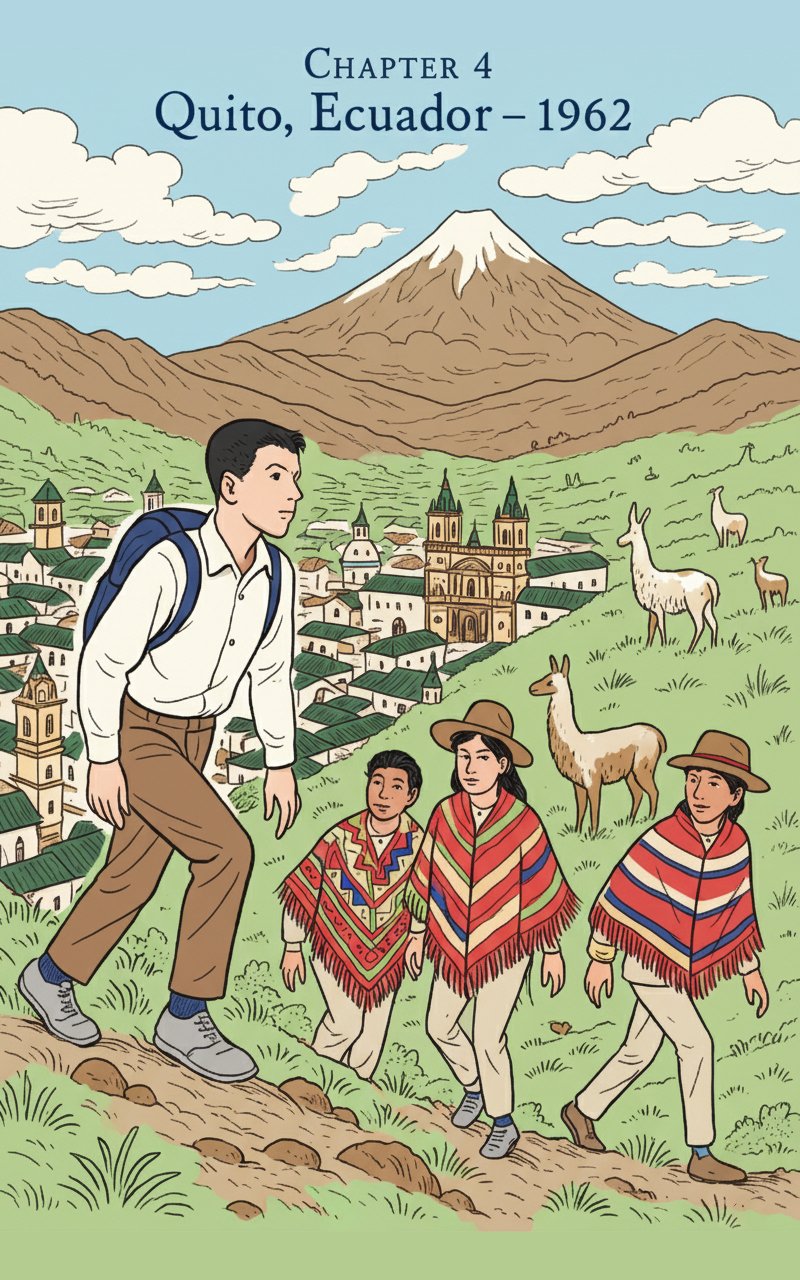
Chapter 4 captures my coming-of-age in the high thin air of Quito—how an adopted family, a city alive with festivals, and a new sense of belonging opened my world beyond the small borders I’d known. It traces how friendship, theater, and the spirit of the Andes ignited in me the certainty that I was meant to live as an artist.
■
Quito sat high in the Andes, a city of sharp mornings where your breath hung in front of you like smoke. Volcanoes ringed the valley, their peaks white with snow, their sides cut with green terraces. The air was thin, almost metallic, and it forced itself into your lungs whether you wanted it or not. I had never lived so close to the sky.
I climbed the mountain behind the city, the Pichincha, one weekend with a small group of classmates, the mountain rising like a gray wall above the city. The climb started in sunlight but ended in cloud, the air so thin it whistled when I breathed. My heart hammered as if trying to break out of my chest, and the wind tasted like metal.
When we reached the ridge, the world fell away in every direction—fields, rooftops, clouds layered like torn paper. I felt both small and invincible, as if the mountain had stripped me down and rebuilt me from air and light.
I lived with an Ecuadorian family—actually a Russian expat who owned a coffee-processing plant. At first I stayed with them while my parents were abroad.
The school was a compound of low white buildings, sunlight spilling through arched courtyards and echoing with a dozen accents—Texas drawls, clipped British tones, Spanish laughter. The flagpole clanked in the wind, and the classrooms smelled of chalk and eucalyptus polish. I kept to myself those first weeks, wondering why belonging always seemed to happen somewhere else.
Mike Hester, my best friend at school, started taking me home, and finally his mother said, “You might as well stay.” His father was the American Air Force attaché, a Texan, and his Puerto Rican wife ran the house with music and rhythm. They had eight children.
The house was loud in the good way—pots clanging, doors slamming, shoes everywhere. Dinner was often rice and beans, chicken pulled from a pot, fried plantains sweet and hot. The colonel said grace like he was giving a briefing. His wife ran the table like a conductor. They folded me into the noise as if I had always belonged. It was the first time I’d felt part of a family that wasn’t my own, and the music of the Andes—especially the rondador flute drifting through open windows—seemed to fill whatever silence I’d been carrying since childhood.
The kids treated me like a cousin. I learned to pass plates, clear dishes, and catch a baby on the fly when a sister shouted, “¡Cuidado!”
The kids at school were different too. Children of diplomats, military attachés, businessmen, Peace Corps directors—a colony of the United States tucked into the Andes. We went to school with the children of the Ecuadorian elite, kids who arrived in polished cars with chauffeurs, wearing crisp uniforms. Between classes we smoked cigarettes and traded stories from home, each of us a little bit foreign no matter how long we’d been there.
We were loud. Restless. Boys in crew cuts and jeans. Girls in skirts smuggled from Miami, bought in shops that catered to the “ricos.” We talked about American football games we’d never play, TV shows we missed, cars we wouldn’t drive for years. We smoked behind walls, tried to act older, and failed most of the time.
The Japanese ambassador’s son was in our class. Quiet, polite, polished shoes and pressed shirts. He had something none of us had: a chauffeur and a black limousine that gleamed like a mirror.
During Carnival he invited a handful of us to pile in. Buckets of water balloons stacked at our feet, dripping cold against our ankles. The chauffeur glanced back in the mirror. “Señores,” he said dryly, “try not to kill anyone.”
We rolled through the streets with windows down. Crowds armed with buckets and balloons of their own. I leaned out, picked my target, and let one fly. It burst across a man’s chest. He shouted, laughed, and shook his fist.
Another balloon. Another scream. Girls shrieked. Boys cursed. Then someone yelled, “¡A los gringos!” and the crowd turned on us. Buckets tipped. Balloons splattered. The limousine was streaked with water, the air full of laughter and shouts. The chauffeur gunned the engine, just enough to keep it fun. By the end we were soaked, clothes dripping, hair plastered to our foreheads. The leather seats squeaked under us. The chauffeur passed back towels like a weary uncle. For that afternoon, we weren’t outsiders or expats. We were kings of the street, drunk on our own laughter.
Once I traveled north to Otavalo. The town square filled with Indian vendors laying out their crafts—woven blankets, ponchos, carved flutes, silver jewelry. They wore their hair in braids, their eyes steady, their hands quick. Their dignity was a presence, not something you could miss.
I bought a small statue of the Virgin as Pachamama, Mother Earth, with what little money I had. It sat on the shelf in my room at the colonel’s house—half Catholic, half earth mother—as if the two faiths had decided to share custody.
It was in Otavalo that I first felt the difference in how the world could be seen. To the Otavaleños, the earth was alive. Mountains had spirits. Rivers had memory. Life wasn’t about conquering nature—it was about living with it, listening to it. That vision stayed with me, even when I returned to the noise of the school and the pull of the city. It also challenged everything I’d been taught about God. I began to imagine the divine as both father and mother, sky and soil, giver and receiver. Pachamama changed my sense of holiness—suddenly, God could be woman, creation itself a form of love that never stopped giving.
Theater found me. A ragtag troupe of expats called the Pichincha Players rehearsed in borrowed halls under bare bulbs. The paint was always still drying on the sets, the costumes stitched together from whatever fabric could be found. I joined them, and the work lit me up. Lines echoing off the walls, the smell of dust and sweat, the nervous energy of waiting backstage. Even in the chaos, it felt like home.
One night, during a rehearsal, I missed my cue entirely. The others froze, the room silent. Then one girl ad-libbed a line that sent the cast into helpless laughter. We stumbled through the scene, gasping for air, and when it ended we all cheered. It was imperfect, alive, and for the first time I understood that the stage wasn’t about pretending—it was about being completely present.
Then the Old Vic came through on tour, performing The Merchant of Venice. Their voices rolled over the Andes like thunder. They filled the theater, shook its rafters, carved Shakespeare into something raw and alive. I sat in the dark and knew: I wasn’t going to become an actor. I already was one.
Quito was cold, but the fire had caught in me. It burned through the thin air, through the nights of wandering the plazas, through the mornings when the mountains glowed pink with sunrise. I had found my tribe. That spark would carry me to stages I hadn’t yet imagined—to the Old Globe, to New York, and far beyond the Andes.
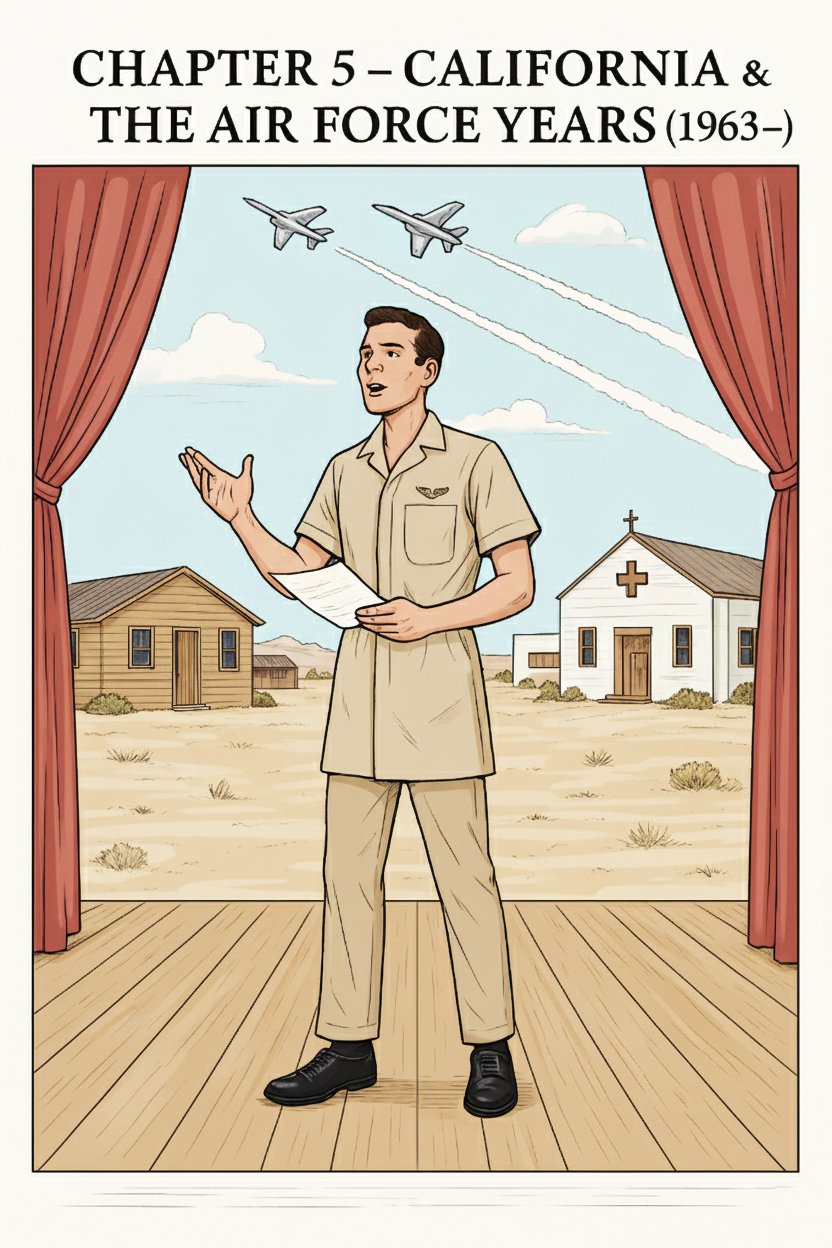
When I returned to the United States, the wide skies of Ecuador still clung to me. The world was tilting toward Vietnam, and my father’s quiet warnings carried the weight of battlefields he’d already survived.
Florida felt flat and small after the Andes. The plazas of Quito, the markets of Otavalo, the humid nights in Guayaquil—they stayed in my bones, and Winter Park seemed like a place I’d lived in another lifetime.
It was the early 1960s, and Vietnam was already casting its shadow. The draft board loomed like a thunderhead. I thought about following my father into the Marines. He stopped me.
Morning light filtered through the kitchen blinds, catching the steam from his coffee. My father sat at the table in his undershirt, the newspaper folded beside his plate. His hands—scarred, steady, sun-darkened—tapped the mug with that same quiet discipline he once used to keep his men alive.
“If you join,” he said softly, “join the Air Force. At least you’ve got a chance of not getting killed. It’s the only branch where the officers are the ones mostly in combat. This Vietnam business is going to get bad.”
He didn’t look at me when he said it. His eyes were somewhere far away—probably Guadalcanal, the steaming jungle and coral beaches that marked him forever. He’d once told me about the night his platoon was ambushed there. A boy from Indiana had died calling for his mother while tracer fire split the darkness. My father’s voice always went flat when he told that story, as if sound itself had gone silent.
He was right. He’d seen enough to know.
By 1963, Vietnam was no longer a distant headline—it was a fuse already lit. The United States had more than 16,000 “advisers” on the ground, soldiers in everything but name. Helicopters thudded over rice paddies. Villages were caught between the Viet Cong in the shadows and the South Vietnamese Army stumbling to hold the line.
American officials spoke in careful language—“counterinsurgency,” “nation building,” “strategic hamlets”—but the war had already slipped beyond pretending.
The world watched in shock when Thich Quang Duc sat in a Saigon intersection, drenched himself in gasoline, and burned without making a sound. What followed wasn’t resolution. It was unraveling.
The recruiter promised me language school. “Chinese,” he said brightly, like a salesman offering a discount. “Bright kid like you? You’ll end up in intelligence. Maybe overseas. Serve your country and learn something useful.”
I nodded, pretending to believe him. My father’s warning echoed in the back of my mind—the Air Force at least gives you a chance.
I signed the papers believing that was where I was headed.
They sent me to medic school instead. Then dental-technician school.
So I ended up at George Air Force Base in California—Victorville. A desert town strung along Route 66, the Mojave wind blowing grit across neon signs and motel parking lots. At dawn, the sky turned copper and pale gold, and the jets cracked the silence wide open.
The hospital smelled of bleach, metal, and the faint sweetness of ether. Rows of dental chairs lined the clinic like interrogation seats. Airmen filed through with chipped molars, bad breath, and the thousand-yard stare of men already counting the days until discharge.
One sergeant, Holbrook, used to sneak cigarettes behind the X-ray room. “Hell of a way to serve your country,” he’d say, exhaling toward the ceiling.
By day, I worked on teeth. I hated it—the antiseptic smell, the whine of the drill, the clamp of metal on gums. My hands in strangers’ mouths. Dental phobia carved into me for life.
But at night, I slipped away to Victor Valley College. I studied acting. I took the stage in student productions. I said the lines like they had been waiting for me all along.
My first role was Nathan Detroit in Guys and Dolls. The sets were wobbly, the costumes borrowed, the orchestra half-drunk—but the magic was real. When the curtain rose, the audience vanished into that pulsing stillness between breath and sound. For the first time since Ecuador, I felt exactly where I belonged.
The balance was absurd: airman by day, polishing fillings and fitting crowns; actor by night, speaking Shakespeare under hot stage lights.
The two lives bled together. Even in uniform, even with war gathering on the horizon, I carried Shylock’s words in my head and the music of Guayaquil in my blood. What the Air Force really had was an actor who could recite soliloquies while cleaning your teeth.
I became close friends with the base commander’s daughter, Sally. Nothing romantic. She studied drama, and her father, Colonel Trimble, came to our performances.
Sometimes Sally and I rehearsed late, sitting on the hood of her car in the desert after the theater went dark. We’d read lines under the stars, scripts fluttering in the wind. She laughed at my exaggerated accents; I teased her about her stage fright. Out there, surrounded by sand and silence, the military world felt far away.
After one show, the Colonel saw us standing together in the aisle. His cap was in his hand. “Good work,” he said simply. Back on base, whenever I saluted him, he’d pat me on the back—a private joke, a quiet acknowledgment. He saw something the Air Force didn’t.
I auditioned for the Old Globe in San Diego. They took me as an apprentice. It was a long shot—I still had two years left in the service—but I went anyway.
The theater felt like a cathedral. The smell of sawdust and velvet. The echo of footsteps. My palms sweated as I launched into Mercutio’s “Queen Mab” speech. The words lifted me, carried me past fear.
When I finished, the room fell silent. Then a voice from the back said, “Good one.”
Will Geer. He nodded slightly, as if to say: You’re one of us.
They accepted me. Just like that. A door opening.
Back at George, I kept the letter in my pocket like contraband. Proof I didn’t belong in a dental clinic. Proof I belonged under the lights.
Then I was summoned to the base commander’s office. Colonel Trimble.
Lowly airmen don’t get called to the commander unless something is wrong. I walked in stiff, saluted.
“Sit down, Andy,” he said.
He studied me, then smiled. “You know, I’m a pilot. A damn good one. You’re an airman—not a very good one. But you’re an actor. A really good one.”
He slid the discharge papers across the desk. “I’m giving you an honorable discharge and an early out so you can go to San Diego. Good luck, son.”
I stared at him. I’d like to claim I saw it coming, but I didn’t. Only the base commander could have done it.
Outside, the desert wind caught the edges of the papers and nearly tore them from my hands. I stood there, watching a jet climb into the sky. Its roar softened to silence, and I realized I was free.
Some parts of your life should remain unseen. Mystery is important. It’s what keeps us alive.
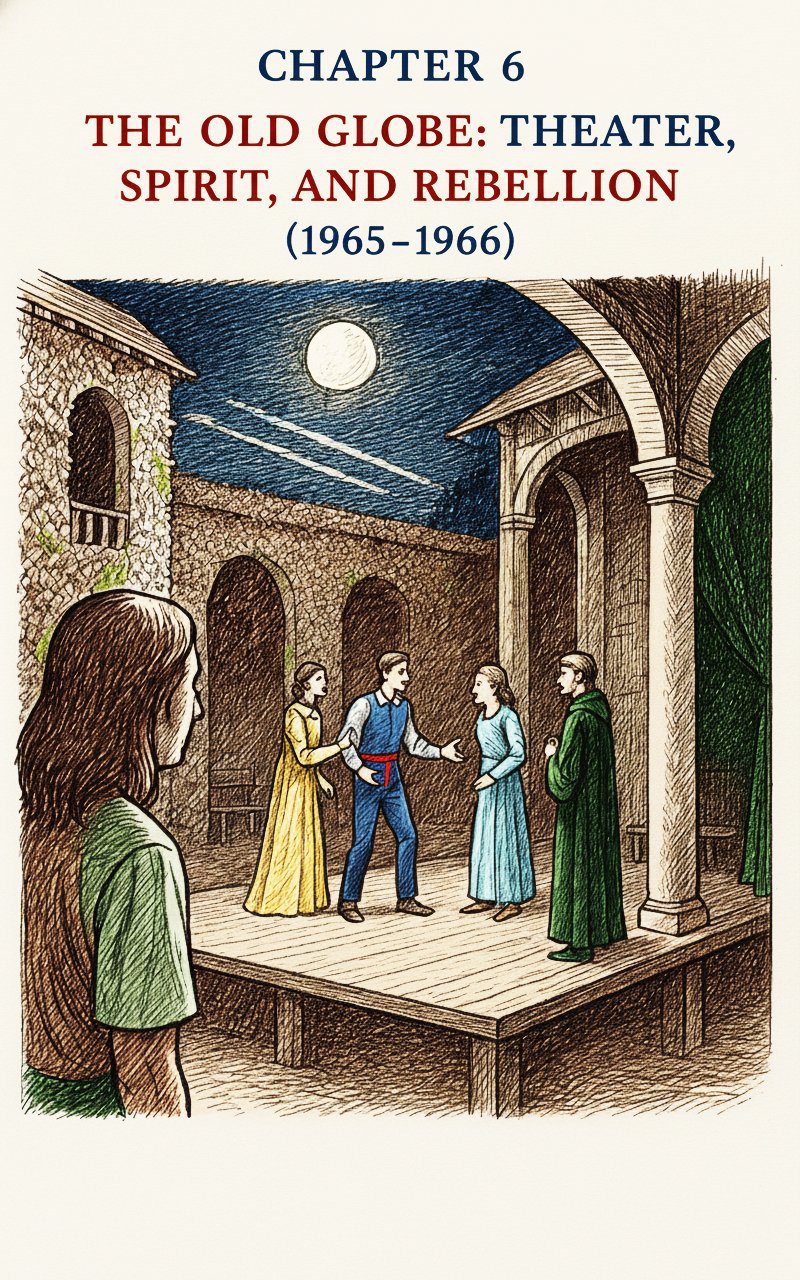
Balboa Park was my new cathedral, and the Old Globe its altar. The summer heat, the smell of wood and paint, and the echo of Shakespeare’s lines fused with the pulse of a country on the edge of war and change. Inside, we conjured spirits and love stories; outside, the world was marching toward revolution. Between Will Geer’s garden, Jon Voight’s intensity, and the laughter that filled those humid California nights, I found what theater truly was—a calling, a ritual, and a rebellion.
The Old Globe looked like Shakespeare’s stage dropped into California—half-timbered and whitewashed, tucked into Balboa Park’s greenery. Wood, paint, and the heat of summer nights curled in the air as if every board had a story to tell.
That season we were doing Romeo and Juliet, The Tempest, Two Gentlemen of Verona. Romeo and Juliet starred Jon Voight as the prince of broken hearts and Lauri Peters as his Juliet. They had recently divorced, so watching them have to fall in love and then die together in the play was powerful.
Will Geer played Prospero in The Tempest, magic in his voice, a shaman conjuring storms. Jon Voight, at six-foot-two, was unusually cast as Ariel, but a powerful presence under Will’s magic. Onstage, they summoned spirits and dreams. I wasn’t sure where illusion ended and reality began for me—it was all magic. The play was alive with spirits like the ones I had seen since childhood. I felt right at home.
I had small parts—servant, messenger, background spirit—but I learned by leaning back in the shadows.
Older actors like Jonathan Frid, who played Caliban and Montague, moved as if they were wearing robes of kings. That discipline felt different from what was expected of me in the Air Force. The stakes here were the power of spoken words, shared emotions, and reality shifting. Miss a cue, and the entire world onstage crumbled.
The other young apprentices at the Globe were already starting the look of the Sixties—long hair, denim, an unspoken thing: hippies in the making. Kiel Martin, Victor Eschbach, Cleavon Little, and others who went on to success in the ’70s started at the Globe. Victor was cast as Tybalt, quietly menacing. Every performance he sparked with something nuanced and dangerous. I envied his fire, the way he carried himself like heat radiating off him.
And when Will’s Prospero spoke of spirits summoned from the deep, a voice in me whispered: not just as actor, but as a conjurer of other worlds. Actor as shaman.
San Diego was a Navy town. Marines in uniform filled the bars, fighter jets screamed across the sky, and the Vietnam War machine rolled forward with the efficiency of an assembly line. Balboa Park at night felt like the world holding its breath. The air stayed warm long after the sun went down, carrying the smell of eucalyptus, dust, and orange blossoms. The Old Globe’s lights glowed like a lantern in the trees, and on performance nights the whole park seemed to lean in and listen. Couples strolled the pathways, shadows moving across the tiled fountains and stucco walls. You could hear the distant thud of drums from a rehearsal space, laughter from the Prado, and the murmur of actors running lines under their breath as they walked from the parking lot to the theater.
After the shows, we spilled out into the night like sparks shaken from a log. Some of us lingered on the steps of the Globe, feet propped on railings, still half in costume, unwilling to let the magic drain off too quickly. Others wandered across the lawn and down toward the reflecting pool, where the koi stirred the water in slow circles under the moonlight. Someone always had a bottle, someone always had a joint, and the conversations drifted from Shakespeare to the draft, from love to mysticism, from rebellion to art, all of it spoken like prayer and prophecy. The world felt bigger than our bodies, and the night had room for every version of who we were becoming.
Driving home through the canyons, the radio played surf rock and early psychedelia. Headlights caught the dust in the air and the silhouettes of palms bending in the breeze. San Diego was still a military town, uniforms everywhere, war humming below the surface. But in Balboa Park, under the Tudor beams and summer sky, we were something else—adventurers, misfits, believers in a world that could be rewritten under stage lights. Those nights didn’t feel like memories then. They felt like the start of a fire no one had yet named.
The theater was sanctuary and mirror both. Outside, students marched, bands wailed from garage doors, joints burned in the back seats of cars. Inside, we dressed in Elizabethan tights and spoke lines about power, betrayal, and madness. Somehow it felt like the same conversation.
The counterculture leaked into the Globe like fog under a door. Hair was longer. Beads appeared at throats. A stagehand passed a joint behind a flat during intermission. Someone hummed Jefferson Airplane backstage. It was just life seeping in, the old and the new mixing the way paint does on a palette.
Some nights it was hard to tell if we were performing Shakespeare or channeling the streets outside.
One night I came out of rehearsal to find a line of students marching past the park with placards. The chants carried through the night air and into our stage windows. Inside, Prospero was summoning spirits. Outside, kids my age were summoning a different storm.
The extraordinary wasn’t extraordinary—it was ordinary. Spirits weren’t confined to The Tempest. They lived backstage, drifting in the sawdust, clinging to the ropes that raised and lowered our worlds. We spoke of them casually, the way you mention a draft in a room or the creak of a floorboard.
Once, during a run of The Tempest, a stage light blew mid-scene. A flash, a shower of sparks, darkness. The audience gasped. Will raised his staff and kept speaking. Nobody moved to fix it until the scene was done. Later, we swore the spirit had answered his call.
Backstage was another kind of stage. Costumes hung on racks like ghosts waiting to be filled. Actors prowled the narrow hallways muttering lines, half-possessed. Makeup tables glowed under hot bulbs, powders and greasepaint scattered like battlefield dust.
Between shows we sprawled in the grass outside, the smell of reefer drifting through rehearsals. Nobody pretended theater was separate from the world. It was the world, bent and refracted. Lines about kings and tyrants became lines about Johnson. Betrayals in Verona became betrayals in Washington.
The extraordinary and the ordinary lay side by side. Protesters outside with signs. Prospero inside with a staff. Spirits summoned by actors and by crowds. The line between them was as thin as stage smoke.
This was theater in 1966: part rebellion, part ritual, part circus. All the same thing.
Will didn’t just play Prospero and Friar Laurence—he was Prospero and Friar Laurence combined. Like my mother, he always planted a garden wherever he was. He planted one behind the Globe, and you’d come into the theater in the morning to find him in costume, busily pruning and tending.
His rented home at the beach was more commune than house. Stray actors, musicians, wanderers drifted in and out. They ate at his table, slept on his couches, and never contributed anything but their presence. Nobody asked where you came from. If you were hungry, you were fed. If you were homeless, you stayed until you weren’t.
He and his wife took me in that summer, like family. Their son Thad became my closest friend. We were about the same age, restless, eager for something bigger than ourselves. We surfed together when the schedule gave us a morning free. Pacific cold enough to shock you clean. Salt water, laughter, the hard burn of paddling out—it felt as necessary as rehearsal.
At night we returned to the Globe, where Will shifted from the warmth of a father at the table to the weight of a shaman on stage. When he raised his staff as Prospero, I felt like he was conjuring not just spirits, but all of us. We were his spirits. His family.
Jon was different. Younger, sharp-edged, tall enough to tower over everyone else. He carried a discipline rare for our generation. While some of us floated through rehearsals, Jon worked. He cut his lines like stone, clear and exact.
We became friends. He wasn’t flashy about it—just steady. Offstage, we’d laugh about the absurdity of playing Elizabethans in the middle of a California Navy town.
Jon didn’t surf—too tall, too lean, awkward with the board—but he stood on the sand and watched, cheering when one of us caught a clean ride.
He was serious in a way that made me listen. He told me about New York. The Neighborhood Playhouse. His mentor Sandy Meisner and his “reality of doing.” He spoke like it wasn’t a choice—if you wanted to be an actor, that was where you went.
His words planted themselves in me. San Diego, for all its magic, began to feel like an interlude. New York was coming, inevitable as tidewater.
And in the middle of it all, Will’s house remained a place where the ordinary and extraordinary met without conflict. Dinner was beans, cornbread, a guitar passed around the table. Spirits were always welcome. Nobody blinked when the wind outside rose like a chorus, or when someone swore they saw a figure move through the garden at night.
For me, by extension, it was all the same thing.
Jon contacted Sandy Meisner and I got accepted at the Neighborhood Playhouse. I was following my dream. It was all falling into place.
On my last morning in California I paddled out past the break, the Pacific rolling heavy under me. The sky was wide and merciless. My arms burned, salt stung my eyes, but I kept pushing. For one wave, I stood and rode it all the way in. Spray on my face, the roar in my ears. It felt like the ocean itself was bowing me offstage. When I turned back, the sea leaned toward me like an old friend, whispering goodbye. I believed it. I had always believed water had a voice.
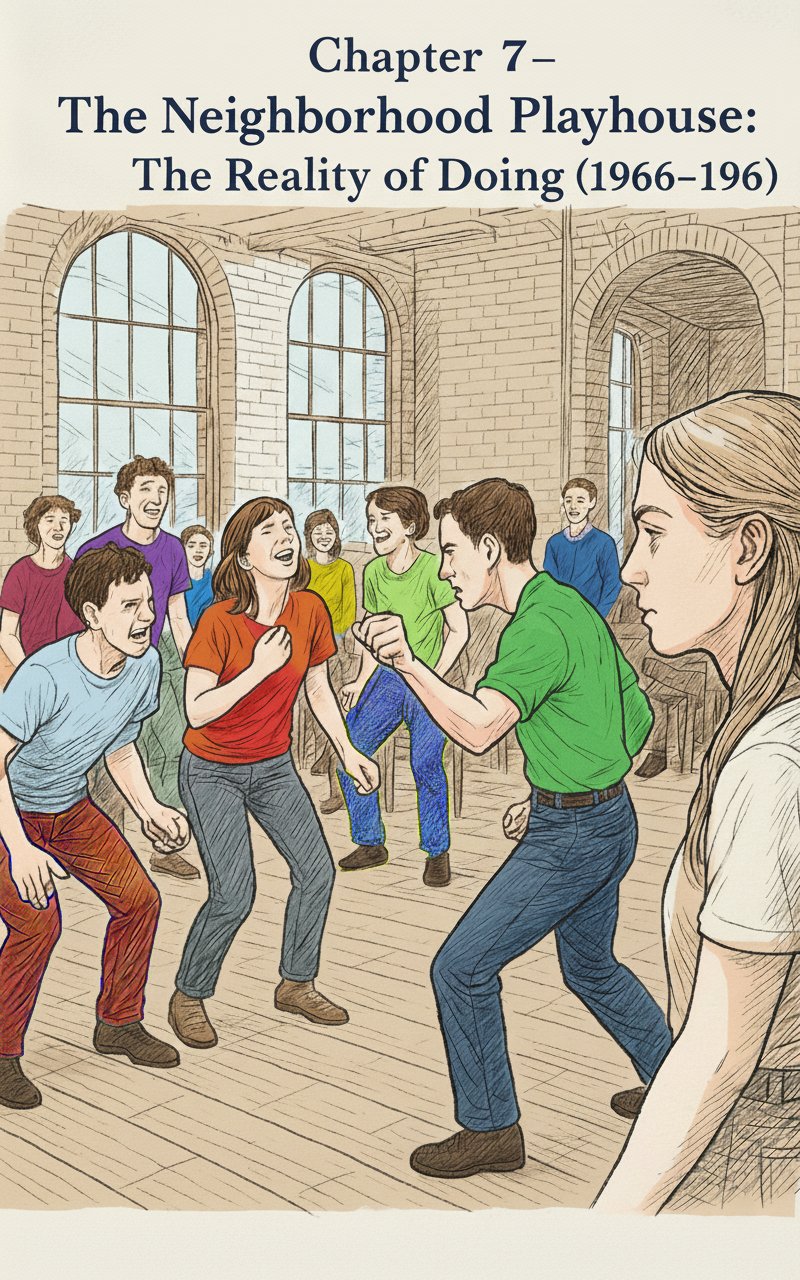
Manhattan hit me like a fist. The stink of hot asphalt. Steam rising from subway grates. Horns blaring in six directions at once. Neon flickering even in daylight. The sidewalks never empty, never still.
My first nights were in Jon’s apartment while he was out of town for a month. I ate cheap Chinese food out of cartons and walked the streets wide-eyed, taking in the bustle of the Big Apple. I took big bites.
The Neighborhood Playhouse sat on East 54th, plain on the outside, a simple brick building that held another reality for me.
The school wasn’t about appearances. You showed up, you worked, and you didn’t pretend. Classes started early and ran until you were wrung out. Nobody called themselves an actor—you were a student until someone better than you said otherwise. The teachers didn’t flatter and they didn’t explain twice. You were expected to be off-book, on time, awake. If you missed a beat, you heard about it in front of everybody.
They taught with the attitude that the craft was bigger than anyone in the room. You learned to listen before speaking and to drop whatever you thought acting was supposed to look like.
Martha Graham came through sometimes. She didn’t announce herself or hold court. She might step quietly into a movement class, watch for ten minutes, say nothing, and leave. That was enough. Her presence reminded everyone that the work had a lineage, and if you weren’t ready to meet the standard, someone else was.
Nobody cared where you were from—only how you worked. You didn’t audition for attention. You earned the right to stay in the room. That was the education.
Pearl Lang had danced with Martha Graham and later ran her own company. She wasn’t a visiting name; she was part of the lineage itself, one of the people who helped define modern dance. Matt Mattox came from Jack Cole’s school of jazz—sharp lines, clarity, precision. He’d danced in films and on Broadway, but at the Playhouse he was there to train bodies, not build egos.
Pearl taught like the body was an instrument you either respected or didn’t deserve to use. She didn’t raise her voice, but she could stop a room cold with one correction. Movement wasn’t decoration—it was intention. Matt’s classes were exact to the bone. No slouching, no half-speed. You kept up, or you stepped out.
Sanford Meisner was one of the original members of the Group Theatre alongside Lee Strasberg, Stella Adler, Harold Clurman, and Elia Kazan. He’d started as an actor in New York and Hollywood before shifting into teaching. His Meisner Technique—repetition, listening, truthful reaction—became one of the pillars of American actor training.
By the time I arrived, he wasn’t in every room, but his fingerprints were everywhere. The repetition drills, the focus on impulse, the demand for honesty—you felt it in how scenes were run and how teachers corrected you. You didn’t perform emotion; you pursued action. You didn’t chase laughs or tears; you told the truth and let whatever happened be enough.
I was lucky. Many of my classes were with him directly. Even if you never worked with him, you were learning in his house, and everyone knew it.
Sandy was blunt as a hammer. His eyes burned through pretense. He didn’t want performance. He wanted truthful, spontaneous reaction under the given imaginary circumstance. Nothing less.
“The reality of doing,” he said, over and over, until the words etched themselves into your being.
Repetition drills: one student says, “You’re wearing a red shirt.” The other repeats it. Back and forth until the artifice cracks and the truth shows itself—the frustration, the joy, the hunger underneath. Acting wasn’t pretending. It was being.
One day we did an exercise where I played a commando dragging a body from another classroom. I was so absorbed I dragged it straight into a class Sandy was teaching.
“Drag that body out of here before you’re caught.”
When I left, he told his class, “Now that’s what full absorption looks like.”
Praise from Sandy was rare. If you got it, you lived off it. It was an aphrodisiac for the girls. Paula—the wet dream of every guy in school—started coming on to me after that. The sad truth was I was so shy she practically had to get me drunk to seduce me.
Dance classes under Pearl Lang were their own kind of baptism. The floorboards trembled under her sharp commands. Breath pulled through every movement until it felt like the earth itself had entered your body. Voice classes stretched sound out of your throat until it hurt, then broke, then soared.
When Jon came back to the city, I left his place and moved to Greenpoint, Brooklyn. A classmate, Ken Burns, needed a roommate. We found an apartment with cockroaches that owned the kitchen. At night the radiator clanged like a steel drum. Drafts cut through the windows like knives. I slept in socks and two sweaters. Rent ate everything.
We lived in the shadow of legends. Steve McQueen, Joanne Woodward, Gregory Peck—they had all walked through the Playhouse before us. Their ghosts haunted the hallways.
Bravado covered hunger. Everyone believed they were destined for greatness. Nobody admitted the odds.
Diane Keaton was there then too—sharp, electric, already rising toward something larger. I had a quiet crush on her, but she felt galaxies away from where I stood.
Nights stretched late in cheap cafés where we argued about art, theater, politics. We smoked too much weed, drank cheap wine and strong coffee, and dissected the world like it was ours to rebuild.
The city itself joined in. Subway tunnels throbbed like veins. The streets whispered like a restless beast. I felt tested at every corner, as if Manhattan needed to know if I could survive it.
Survival meant odd jobs: sweeping floors, waiting tables, hustling for tips. Carrying plates, folding chairs, doing anything that bought another week’s rent.
The truth was I was broke most of the time, though never starving. My diet was pizza and junk food. But none of it mattered, because I was alive. San Diego had been magic—but New York was realism. A dream turning into a life.
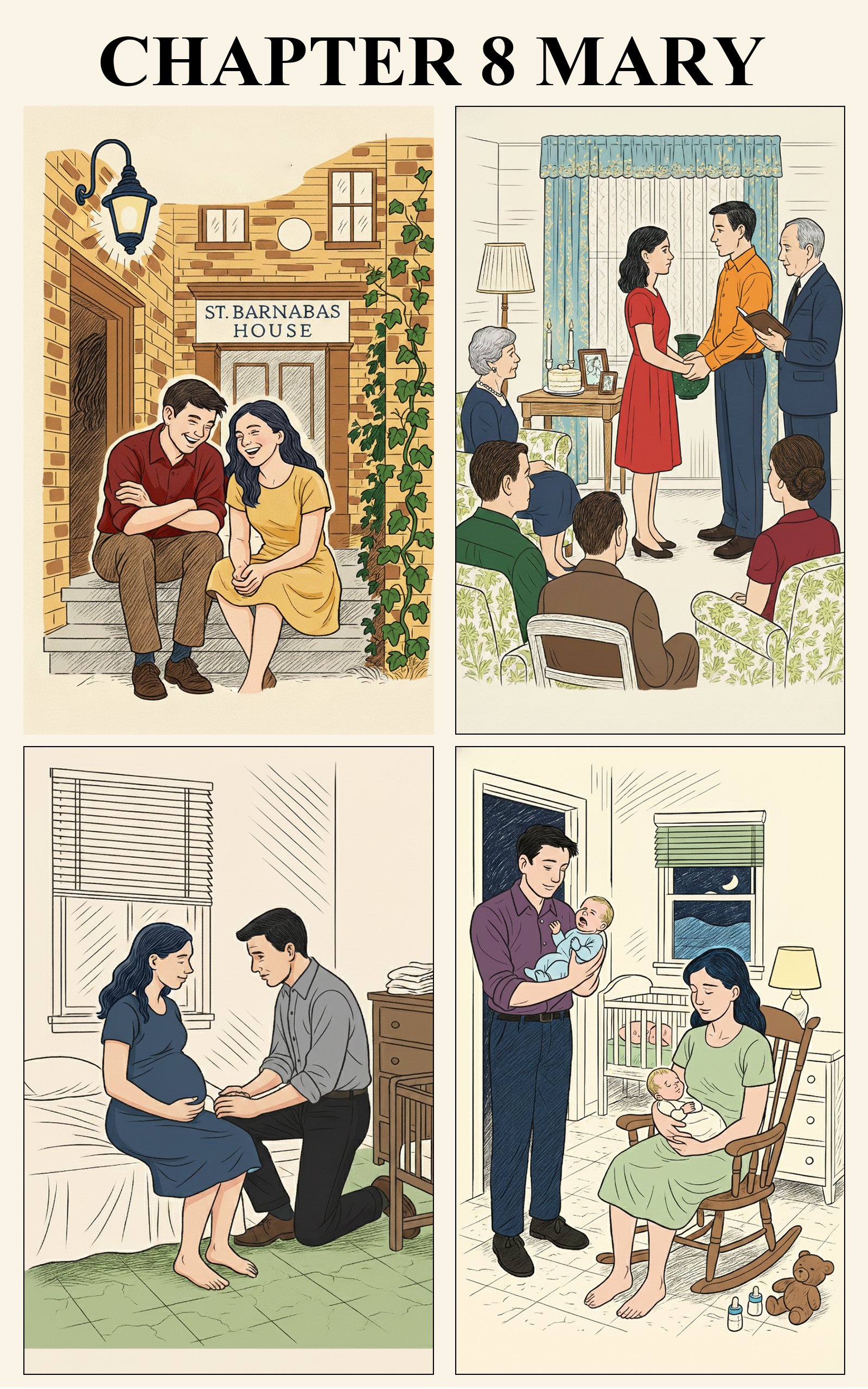
The Village softened the edges of everything. After the discipline and fever of the Playhouse, St. Barnabas House was another kind of stage—its audience the sleepless and the forgotten. The nights there moved slower, the air heavy with disinfectant and crayons, the muffled hum of the city outside the barred windows. That’s where I met Mary. She was steady where I drifted, careful where I improvised. Between night shifts, whispered conversations, and shared toast at a children’s table, a quiet love began—less a performance than a surrender to something real.
St. Barnabas House on Mulberry Street in the Village was a children's shelter that housed abandoned and neglected kids, though most were asleep by the time my shift began. I was the night watchman, working for room and board. The place had its own kind of silence—the shuffle of small feet, a door creaking somewhere down the hall, the hum of pipes that never quite stopped. The smell of milk, disinfectant, and the faint sweetness of crayons hung in the air like something permanent.
That's where I met Mary. She was a junior sociology major from Michigan, doing her work-study at the shelter. She carried herself with quiet assurance—organized, on time, no wasted words. Where my energy scattered like sparks, hers gathered and focused.
The first spark came during my nightly rounds. I'd stop at her room, pretending it was part of the job. We'd talk—about politics, the war, the kids, the state of the world as if we were its exhausted caretakers. One night she passed me a cigarette, and I offered her a joint in return. She hesitated, then smiled. We smoked by the open window, watching the streetlights flicker on the wet pavement below.
We didn't call it anything. It was easier to pretend it was convenience—two people in the same building, awake when the rest of the place was asleep. But something in her steadiness drew me. She asked about rehearsals like it mattered, listened when I talked about Meisner's classes, about the way truth could be stripped bare in performance. 'That's not so different from what I study,' she said once. 'We both look for what's real—only in different languages.'
After my rounds we'd sit in the kitchen, eating toast off paper napkins at a metal table meant for children. The fluorescent light hummed above us, soft and cold. She'd talk about home—snow on the lake, her mother's voice calling her in from the yard—and I'd picture it as if I'd been there.
Eventually I stopped going back to my own room. I'd finish the rounds and end up in her bed without either of us calling it a change. Some nights we talked until one of us drifted off. Other nights silence did the talking. Sharing a bed didn't make things clearer, only closer.
I still woke before dawn for class or a shift, and she still stacked her books in neat piles by the bed. We didn't name it. The shelter wasn't a place for declarations. You just went on until something made you stop.
Being with Mary didn't cancel the rest of my life, but it softened it. The noise of the city, the pressure of ambition, even the ghosts of the stage—all of it quieted when she was near. I told myself it was company, but I knew better. I was choosing her, and she was choosing me, quietly, without promise.
When summer came, Mary went home to Michigan and I went south to Alabama to stay with my cousin Bill. The air there was heavy and still, the nights long. I lay awake replaying her laugh, the way she listened, the calm that settled over me when she spoke. The distance felt physical, like gravity pulling the wrong way.
I didn't know it then, but something had already taken root—just as real as the roles I chased or the dreams that sent me east. I thought I had left New York behind for a while. I didn't understand that part of me had stayed with her. And that was how the next chapter began—quietly, with distance, longing, and the first outline of a life I didn't yet see coming.
Not long after I came east, I got the call that changed everything: Mary was pregnant. The world tilted. The noise of New York blurred into a single, quiet certainty—I was going to be a father.
We were married quietly. No grand audience, no spotlight, just my Uncle Jimmy and her family, vows exchanged under the weight of something bigger than either of us had expected. There were rings, a few witnesses, and the sound of our own voices promising something we didn’t yet know how to live.
Mary was steady, determined. She believed in building a life, in family, in me—even when she must have already seen the chaos flickering just beneath my skin. I didn’t know how to deserve that kind of faith.
We moved back to Victorville, where the Air Force base still cast its long shadow over the desert. The town hadn’t changed much since I’d left—just the same windblown motels, the same gas stations humming under the heat. We rented a small stucco place with cracked linoleum floors and one good window that looked west toward the Mojave. It was barely enough for two, and yet we began preparing for three. Then came the news. Twins.
I remember one afternoon when the desert light slanted through the blinds and caught her just right. She was sitting on the edge of the bed, one hand resting on the swell of her huge stomach as if holding something fragile from the inside. She was calm in a way I was not. She took my hand and placed it on her belly, and for a moment the world stopped its noise. One of the babies kicked—sharp, certain—and she smiled without looking at me, as if the child and she were sharing a private joke I had not yet earned the right to hear.
In that moment she looked ancient and impossibly young all at once. Like a fourteen-year-old girl pretending at motherhood, and like a mother who had already lived a thousand lives.
Before they were born, I imagined fatherhood as a role I could rehearse my way into. I pictured myself holding a baby in one arm while reading a script in the other, charming and unshaken, stepping in and out of responsibility the way I stepped on and off a stage. But the real thing didn’t wait for my cues.
It was two babies crying at once, nights that bled into mornings without applause or intermission. There were moments I stood in the hallway holding one child while the other wailed in the next room, and I knew—without a doubt—that the life I had pictured was a fantasy, and the one I was standing in belonged to men much steadier than me.
Mary was my anchor. She carried the weight of everything—feedings, exhaustion, a home that felt too small for so much life—and she did it without complaint. I enrolled full-time at the college, took leads in the school’s productions, and told myself I was building a future for all of us. But the truth was, Mary was the one doing the building while I was still chasing the light.
I remember one night after rehearsal, standing outside our little house under the desert stars. The air was so dry it seemed to hum. Through the window I could see her rocking one of the twins, the other already asleep. The blue light from the television flickered across her face. She looked peaceful and alone. I stood there for a long time before I went inside.
By the time the next season came, I had made my decision. I would return to the Old Globe. Mary didn’t protest. She just nodded, eyes steady. 'You have to do what you’re called to do,' she said. But I heard what she didn’t say. And that silence stayed with me longer than any applause ever would.
San Diego glittered like a mirage—sunlight, surf, and a growing darkness behind the laughter. Theater and counterculture blurred until there was no line between rehearsal and ritual, role and reality. The Old Globe was still my temple, but the prophets had changed. LSD replaced prayer, and the stage lights burned hotter than conscience. What began as curiosity became momentum. Love went north. Madness stayed.
The heat from the stage lights made every costume feel like armor. Sweat, makeup, adrenaline—it was theater as confession. When the curtain dropped, we didn’t come down; we just changed scenes. The line between stage and life was gone, and none of us wanted it back.
Marco St. John was there, bigger than life, full of the kind of swagger that made him unforgettable both onstage and off. A classically trained actor at the Royal Academy of Dramatic Art in London, Marco was a southerner, brash and magnetic, and lived like every day was an opening-night party—and somehow he always got away with it.
Then there was our stage manager, who became my best friend: Richey Mensoff. I met him my first day, sitting backstage in buckskin jeans, smoking a joint. I cautioned him that I’d heard the stage manager was around. He just smiled. “I am the stage manager.”
Marco roared through rooms like he owned the air. Richey balanced him—quiet eyes, dry humor, always fixing what others broke. Together they were a living metaphor for theater itself: chaos and control trying to share the same cue.
I had one foot in discipline and another in appetite. Between them, I learned that theater was both a religion and a circus, sometimes in the same scene. I was twenty, already a father of twins, when the madness started to creep in. The stage no longer satisfied the hunger. Something else called, something darker.
Enter Richard the Warlock.
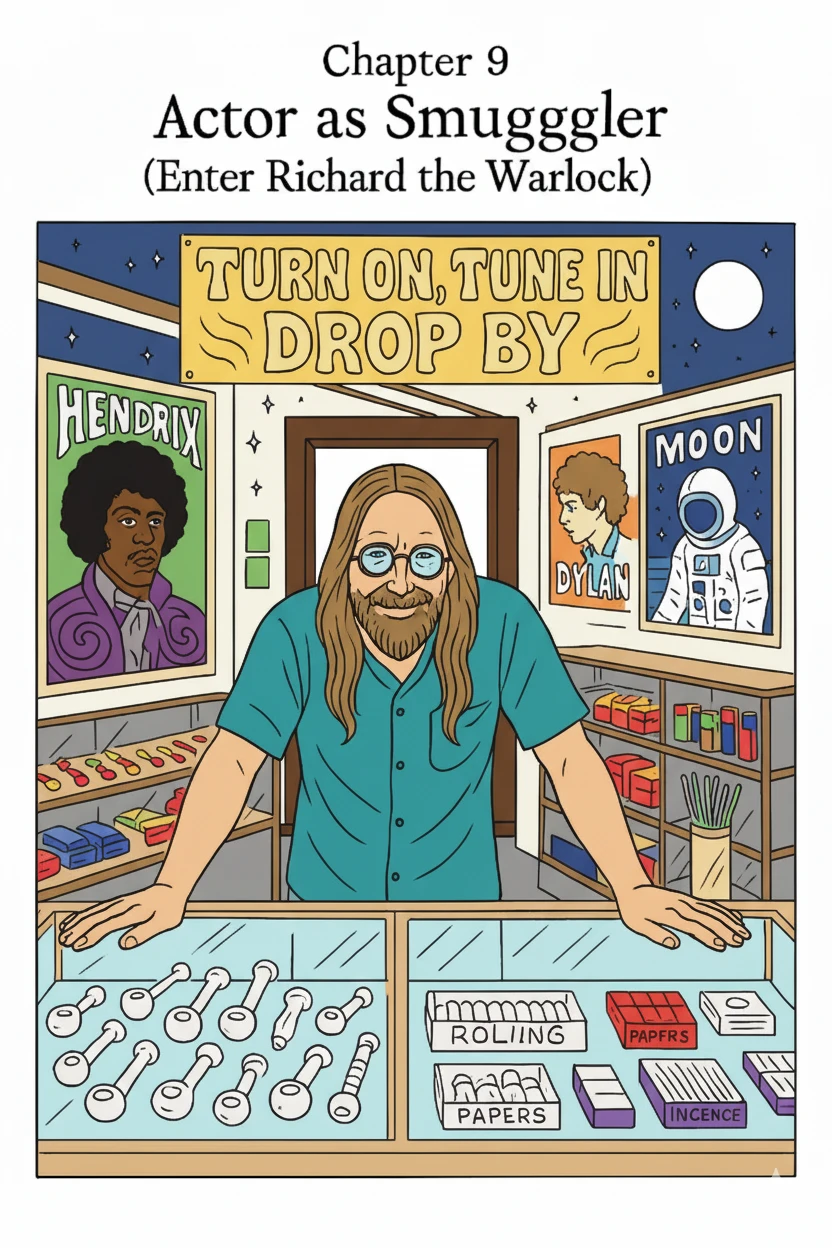
An old beatnik turned hippie who had fashioned himself into a guru. He ran the first head shop in Pacific Beach, a storefront that smelled of incense and hash, glass cases gleaming with pipes and papers. His shop smelled of sandalwood and revolution. Posters glowed under black light—Hendrix, Dylan, the moon landing beside a sign that read Turn On, Tune In, Drop By.
He wasn’t quiet. He spoke fast, sometimes in a whisper, flashing a grin that was more devil than saint. It was a performance, and it worked like a charm, sweetened with the weed and LSD he dispensed like candy. Young women orbited him, with names he gave them like Psychedelic Nancy or Sweet Sue—devotees to his guru act. He spun half-truths and cosmic promises, and they nodded as if he were Moses himself.
I knew it was manipulation. But I didn’t walk away. I became a smuggler.
Richard showed up at the Globe one night to see Hamlet, drifting in with Psychedelic Nancy on his arm like he owned a different kind of theater altogether. She was barefoot in a paisley dress that floated when she walked, pupils blown wide before the lights even dimmed.
He watched the play like it was being performed only for him, head tilted, smiling at lines no one else laughed at. After the show he slipped backstage, moving past actors and crew as if he had always belonged there. He didn’t ask—he announced that we were all going back to Marco and Barbara’s.
By the time we got to their place, Richard had taken command without raising his voice. He opened his satchel like it was a magician’s kit—tabs, capsules, a vial or two—and everyone gravitated to him the way drunks move toward music. Nancy curled up on the floor and stared at the ceiling like constellations were rearranging themselves just for her. Marco and Barbara didn’t host that night; Richard did.
He passed out the doses like communion, speaking in half-prophecies and jokes only he understood. I told myself I was just along for the ride, but the truth was I followed him the way I followed good actors—I wanted to see how far he would take the scene.
Nancy floated over to where I was sitting on the arm of the couch, moving like she didn’t quite believe in gravity. She lowered herself onto the floor at my feet and rested her chin on her knees, staring up at me like she was waiting for a line I hadn’t rehearsed. Her eyes were all pupil and wonder.
“You ever look at your hands on acid?” she asked, like it was the start of a religious text. Before I could answer, she took mine and turned it over in hers, studying my palm as if she were reading a script written under the skin.
“You have traveler lines,” she said, tracing them with one finger. “You’re not gonna stay where you are. People like you break things to see what’s inside.”
Richard overheard and laughed from across the room, said she was right, that I was already halfway gone and too stoned to notice. Everyone laughed with him. I did too, like it was a joke. But Nancy didn’t. She just kept holding my hand like she knew exactly where the night would end and how far it would take me.
Five hundred kilos a run. Packed tight, sealed, hidden. Enough to stone the entire fleet in San Diego for a day. That was the scale. That was the madness. And I stepped in—actor doing a role as a smuggler.
Mary and the twins went back to Michigan to stay with her mother. She hid her fear. I was blind to it. I had only the madness.
The load came at night. Don and I met Richard at his storeroom. The weed was pressed into kilo bricks, wrapped tight in plastic and tape. Heavy blocks, built for transport. We rented a moving van and piled boxes of clothes, cookware, and books bought cheap at thrift stores on top of the cargo. We drove straight through. One at the wheel, one asleep. Coffee for the driver. Joints and downers for the sleeper.
Somewhere in Arizona, dawn broke pale and merciless. I looked over at Don asleep in the passenger seat, his mouth half-open, and for the first time it hit me—if we were caught, everything was over. But the thought dissolved as fast as it came. The engine hummed like a mantra. The road pulled us forward.
We stopped only to eat. At a checkpoint we bought coffees and handed them to the patrol on the far side. They waved us on. We were invincible and invisible. The magic moved us forward and shielded us. No fear.
At night the road turned liquid. Headlights from oncoming cars stretched and bled across the windshield like paint dragged by a brush. The yellow lines on the highway pulsed and twisted, sometimes floating up and curling back toward us like ribbons. Don and I passed a joint back and forth without looking at each other, our hands moving on instinct. The hum of the tires sounded like chanting—low, rhythmic, hypnotic.
There were moments when I was sure we were gliding above the asphalt, not touching it at all, the van weightless and charmed. Every shadow on the shoulder looked like a figure watching us pass. I wasn’t afraid. I thought the universe had cleared the road just for us.
In New York the drop was fast. Ron Gold, a Globe actor and friend, had the connections. Money shifted hands. The bricks disappeared. The city swallowed them whole.
Money didn’t quiet the hunger. It only fed it. I told myself it was freedom, but it was just velocity—the kind that blurs everything you love in the rearview mirror.
Now I had money to fuel my madness.
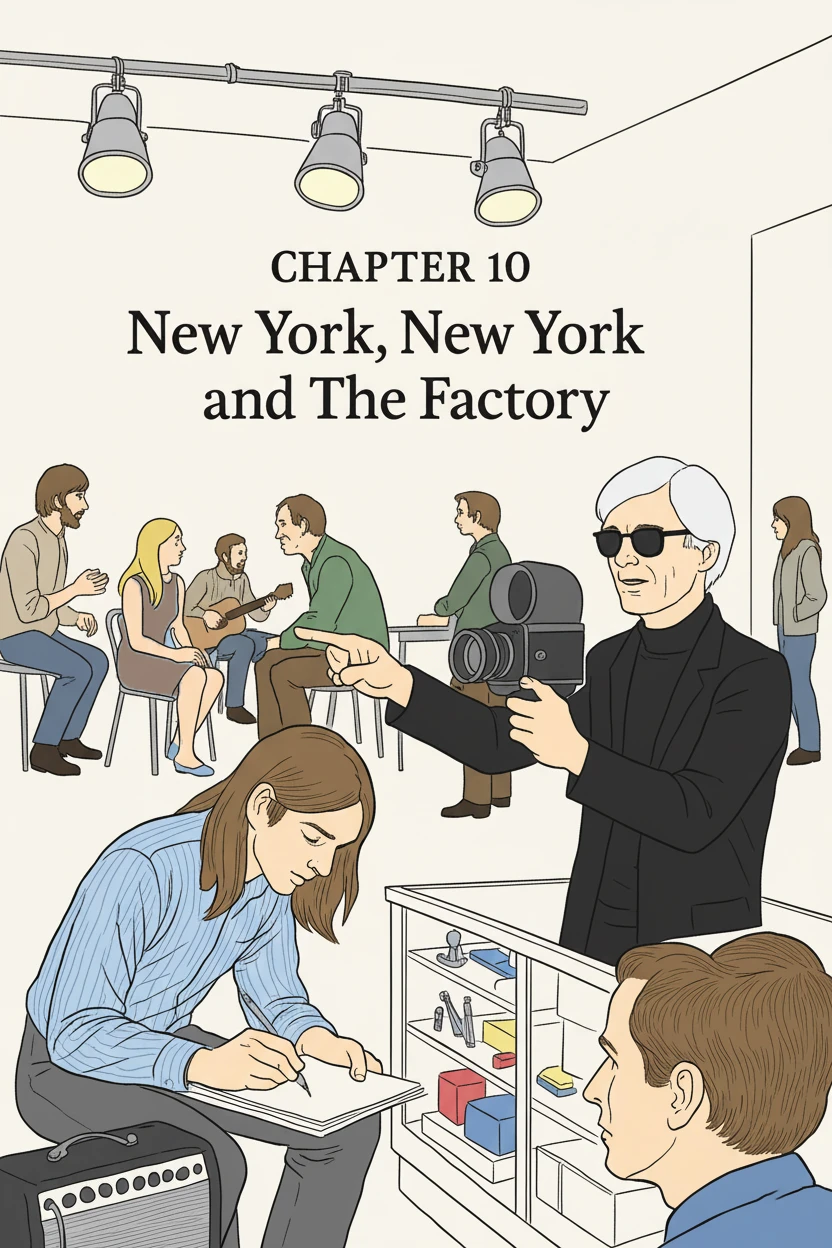
I took an apartment in Marco and Barbara’s building at 77 Perry. Richey Mensoff lived there too. A vertical tribe stacked on top of itself. The madness followed me, this time with money to feed it.
The Village pulsed. You could leave a midnight set at the Fillmore and still make last call at Max’s. Hamburgers up front, speed and smoke in the back. Factory kids floated through like silver-painted ghosts. Marco moved among them as if born under a spotlight. Andy Warhol observed the room like a cat watching a fishbowl—silent, amused, noticing everything.
Through Marco and Barbara I met Viva, one of Warhol’s superstars. Sharp, strange, beautiful in a way that made you think she already knew your ending. She had a philosopher’s nerve and a comedian’s timing. Everyone in Warhol’s orbit seemed to live on tape—every glance and stumble a possible scene for his next film.
One night I ended up at Bob Richardson’s loft, the fashion photographer who’d exploded out of Harper’s Bazaar and Vogue. His photos looked like confessions captured through smoke—blurred, erotic, dangerous. He was part prophet, part burnout. Norma, his wife and muse, radiated the same haunted beauty from his prints.
The three of us dropped acid and the night unfolded in slow motion. Curtains breathed. Walls shimmered. We drifted between words, laughter, and touch—intimate but tender, like trespassing at the edge of revelation.
When I finally returned to Perry Street, still buzzing, Viva was waiting. She looked once and asked, “Where have you been?” like she already knew. I started describing the night before she even asked. She listened without interrupting, head tilted, pulling the thread. Later I learned she was writing Superstar—and she recorded my story, turning my LSD confession into something that sounded like poetry instead of evidence.
The Living Theatre was its own universe—part sanctuary, part battleground, part commune. Julian Beck and Judith Malina had created a company that treated theater as a form of civil disobedience, where art wasn’t something you watched but something that collided with you. Their shows stripped away sets, costumes, hierarchy—anything that separated performer from witness. They believed the stage was a place to unlearn obedience, to expose the violence of society by refusing to mimic its rules. Walking into their world felt like stepping into a rehearsal for revolution, one where the script changed nightly because the real point was liberation.
Backstage at the Living Theatre felt less like a green room and more like a war room for a revolution disguised as art. Julian Beck and Judith Malina believed performance could dismantle power—that bodies could break laws just by refusing to be afraid. Paradise Now wasn’t a play; it was prophecy.
Richey and I sat cross-legged with three cast members, a box of Zig-Zags dumped like confetti, and a mountain of grass. Someone said the audience needed three hundred joints—equal parts communion and ignition—so we rolled. Smoke pooled under the catwalks. Actors drifted by naked or half-painted, whispering lines that sounded like prayers or warnings. Rolling joints there felt like building a set or writing a manifesto.
After the show, Julian and Judith led a small group of us to Ratner’s on Second Avenue. The restaurant was nearly empty, the kind of quiet that follows something unruly. Judith smiled across the booth, eyes still bright with stage fire. Julian spoke like a poet-conspirator, vibrating from the ritual they had just unleashed. They talked about theater as a weapon, the sacredness of breaking boundaries. Judith leaned forward like she was recruiting me without ever saying it. I didn’t know whether I was cast, converted, or simply passing through. I only knew I didn’t want to be anywhere else.
Mary and the twins finally joined me. We moved to Staten Island because that’s what families did—commute by ferry into Manhattan like adults with briefcases. I told myself it was a bridge between worlds.
The building was an old Irish pub with a tight two-bedroom above it. The apartment stayed the same. The bar downstairs, I gutted. I ripped out taps, rails, stools—everything that smelled like last call. What had been a pub became a loft with beanbag chairs where tables once stood and clothing racks along the walls. I turned the basement into a work zone—sorting, packing, cutting, whatever the next idea demanded. I paid cash for the entire building. It wasn’t a home; it was a staging ground. But Mary made it livable, and I pretended that counted.
The business took off. Mademoiselle and Glamour called. Editors came to my loft-showroom and told me the next trend. I learned how to sell without sounding like I was selling—let them touch the cloth, keep the pitch short, leave one thing they couldn’t have yet.
GlobalMart smelled opportunity. They offered to buy forty-nine percent with fresh IPO money. With my signature, I could buy a quarter-million dollars’ worth of goods anywhere in the world. Their marketing budget could run an entire campaign. We celebrated the way young people with money do—loud, constant, without brakes.
Then the establishment locked the door. NAMSB froze us out of the big show at the Hotel McAlpin—too brash, too new, too young. So we rented a loft across the street and turned three empty floors into a guerrilla showroom in seventy-two hours. Banners in the windows. Actor friends registered as buyers, dressed head-to-heel in the vest suits I cut for them—cheekbones sharp, hair too long for the old guard.
Security tried to toss us the minute they realized the game, but the buyers rallied. The old guard crossed the street out of curiosity and stayed out of hunger for whatever was happening. We sold out the first run on day one.
They called it guerrilla marketing. I called it opening night.
I was twenty-three and told anyone who asked that I’d be a millionaire before twenty-five. It didn’t feel like bragging. It felt like weather.
Then came the call from South America. Old friends. A whisper from a government office. Otavalo artisans needed new work; the poncho fad had died. Embroidery on new silhouettes. The idea cut through my haze like a bell. Ecuador. The mountains. The plaza that taught me to listen with my eyes. I said yes before the sentence finished. The designs were already in my head.
In Quito, life found a rhythm. Mornings of fruit, bread, black coffee, sometimes a line or two to clear the fog. Then to the cut-and-sew shop. We dyed rough cotton in ice-cream colors and sent pockets and yokes to Peguche, where Otavalo women embroidered them by hand. Lunches of beer or chicha. Evenings in bars, clubs, hotel terraces. Some nights the Peace Corps doctor and I ended up at the Hotel Quito casino, gambling on acid, dancing when we won. Nobody cared. I made too much money. I was interesting. Even the embassy people laughed it off.
In Peguche, I was a guest. The women worked slowly, quietly, as if time had to earn their trust. Designs bloomed under their fingers—birds, suns, lightning. Each unique. Men dyed threads in tubs steaming under the mountain sun. Earth, woodsmoke, wet cotton perfumed the air.
I named the trade lines Sundance and Inca Terra. They sold before they shipped. Buyers loved the story—indigenous craft with modern cut. But what I loved was the process. The rhythm. The color. The mountains turning silver at sunset.
For the first time in years, I felt something close to peace. It didn’t last.
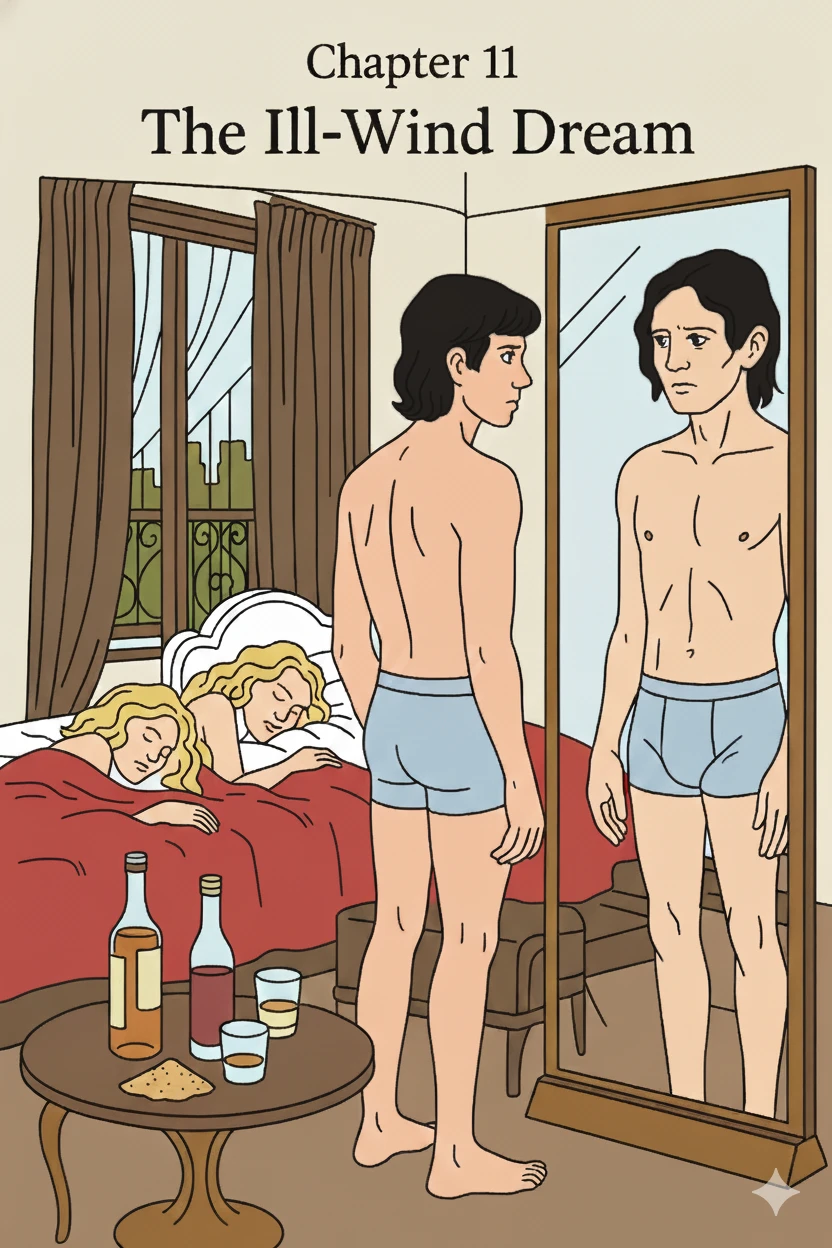
Ecuador shimmered between vision and illusion. In the thin air of the Andes, success began to sound like prophecy, and dreams spoke louder than reason. Mama Rosa warned that the wind had shifted, but I mistook her wisdom for poetry. What followed was written in the same invisible ink as the dream itself—its meaning clear only in hindsight.
I set up production in Ecuador. My trade names were Sundance and Inca Terra. We embroidered western-style shirts and jean pockets. Mama Rosa, the matriarch of Otavalo, became my Indian mother. She organized the women who did the embroidery, and together they set trends that still echo in markets today. I paid cash for everything. The work, the materials, the silence.
I woke to the thin light that always came late in the Andes. Quito sat high above the world, cool and sharp, with clouds that moved faster than reason. My days began the same way. A breakfast of fruit and bread, sometimes a cup of bitter coffee that tasted of smoke. I would visit the cut-and-sew shop by midmorning, check the dyes, and argue about details. The rough cotton cloth we used was dyed in Quito in the colors of sherbet—mango, mint, guava, and pale lilac. From there, we sent the pocket pieces for jeans and the yokes for shirts to Peguche, where the Otavalo artisans embroidered them with thread so fine it looked painted.
By noon, I would meet friends for a long meal—always rice, always soup, sometimes trout if the market had been good. The afternoons were for siesta, a habit I adopted easily. By nightfall, the city changed. There was music from every doorway, laughter spilling into the streets, the promise of a long night. I had fallen into a rhythm that felt like success and escape at once.
The Peace Corps doctor and I became unlikely companions. We met at a party and ended up gambling at the Hotel Quito, the kind of place where the lights stayed bright no matter how late it got. Sometimes we played on LSD. When we won a hand, we would stand and dance like lunatics while the dealers looked away. It was absurd, but that was the point. Everything in those days had a feverish glow, a sense that the rules had stopped applying.
Then came the dream.
I woke in an exotic hotel suite, sunlight cutting through curtains that smelled of perfume and dust. Fashion models lay tangled in the sheets. Bottles of liquor littered the terrace table. On it, a mound of white powder as absurd as it was obscene. I walked to the mirror. My face stared back hollow, disillusioned. It was prescient. I had dreamed of my own destruction.
When I told my party friends in Ecuador and New York, they laughed. “Bad coke dream,” they said. “Take a Quaalude.” When I told Mama Rosa, she grew grave. She called it wayrashka—an ill-wind dream. Prophetic. She told me to stop, to stay in Peguche, to let the others handle the business until I was clean. “Your work is done here,” she said. “You must heal first.”
An ill-wind dream. Not imagination. Not accident. A warning from the spirit world that death had already started circling. “This dream is not about fear,” she said. “It is about time.”
She told me I had to stay in Peguche, that if I went back to New York without cleansing what was inside me, the dream would happen piece by piece until there was nothing left to save. She said Mary and the boys should come to Ecuador for a while, that my partners in the States could keep the business running without me. “You live here,” she said. “Simple. Quiet. With the people who make the work you sell to the world. You heal before you destroy yourself.”
That night she brought me to a clearing behind one of the adobe houses at the edge of the village. The air was already cold, the kind that bites the lungs and keeps you awake. A small fire burned in a charcoal brazier, fed with palo santo and eucalyptus until the smoke curled sweet and sharp through the dark. Two curanderos were waiting—an older man with hands like roots and a woman with a shawl over her head and eyes that didn’t miss anything.
They sat me on a woven blanket laid over a low wooden stool. No ceremony of welcome, no questions. One of them took aguardiente in his mouth and sprayed it in a fine mist over the crown of my head and down my spine. The other brushed my shoulders and chest with bundles of ruda, marco, and chilca, whispering prayers in Kichwa I couldn’t understand but felt anyway.
The smoke from the fire was pulled toward me like it had been given orders. They passed an egg over my arms, my stomach, the back of my neck, pressing it into the heat of my skin. Then they circled me again with herbs, soft chanting, and the smell of alcohol and earth and something older than language. My vision swam. The ground shifted under my feet even though I wasn’t standing. Sweat came up from somewhere deep and cold. I couldn’t decide if I was going to faint or wake up.
When they were finished, Mama Rosa stood in front of me and said it again: stay in Peguche. Live simply. Work with us and let your partners handle the States. We are your family. The land will hold you if you let it. If you don’t, the dream will come for you the way it showed you.
I told her I had to go back—that there were deals in motion, people depending on me, money on the line. I said I could come back later, after I tied things off in New York. She looked at me the way elders look at children who think they’re men.
“You think you still make choices,” she said. “But the dream has already chosen.”
Back in New York, the dream unfolded like a script. Jealousy. Violence with Mary. Barbara was murdered in the late light of a summer day. GlobalMart squeezed me, cutting my credit lines, maneuvering to seize control of my company. My partners pressed harder for smuggling. The energy that had once been creation turned into collision.
Barbara was not a lover, and that was part of why we stayed close. In a world where every relationship seemed to carry a hidden transaction, she was one of the few people I trusted without calculation. She had the kind of beauty that drew attention, but she wore it like something borrowed. We were friends in the truest sense of the word, not because we tried to be, but because the chaos around us made honesty into a kind of refuge.
When the call came about her murder, it did not land like a headline. It landed like a stone in the chest. Just the fact of it. She was gone, taken by the same madness that had circled her for years like a shark that finally decided to bite. Marco was shattered. He tried not to show it, but men who try not to break always crack around the eyes first. He did not cry in front of me, but he did not have to. The silence between us was loud enough.
I put a hand on his shoulder and did not say I was sorry. Instead, I told him the only thing that felt true in that moment—that she had never been alone in this, even when she thought she was. He nodded once, then covered his face with both hands. I let him have the space to come apart without bearing witness to the worst of it.
Her death was not just a private wound. There had always been danger in the shadows of how we were living, but up until then, it had stayed in the background, like a dog pacing the fence line. After Barbara, it was in the room with us.
And almost on cue, GlobalMart made its move.
They had been circling for months, trying to squeeze me the way they squeezed everyone else—with a product they wanted and a supply chain they could bully. They dressed their greed up as opportunity. The suits acted like they were doing us a favor while running numbers that would bleed us out by the quarter.
I could feel the pressure building on both fronts. One was grief with a name and a face. The other was a corporate noose with polite language and legal paperwork. Marco was still half in shock, and I was carrying the weight of his loss alongside my own. But the calls kept coming anyway. The meetings did not stop. The message was always the same: sign or be sued.
Barbara’s death made it clear what happens when forces you think you can outrun finally catch up. GlobalMart was not pulling triggers, but the result would not be so different if I let them take control.
I panicked.
I returned to Ecuador. Jim, an heir to a beer fortune, became my partner. His father had been kidnapped and murdered years earlier. He wasn’t chasing money—he was chasing ghosts. We set up a smuggling operation. I was caught in Miami.
I had fifty pounds of high-grade marijuana stuffed into a clothing sample bag tagged in Jim’s name. It could have ended differently a dozen times that day. I didn’t need the money. I was already flush. But I was circling the drain in a way only a man who thinks he’s untouchable can be—half hoping to get caught, half daring the universe to stop me.
I cleared customs clean. I was free. I could have walked straight out into the Florida sun and disappeared. Instead, I turned around and walked right back to baggage claim like I was picking up a forgotten sweater. Brazen wasn’t even the word—I was numb, reckless, running on some private suicide impulse that dressed itself up as confidence.
The agents were already waiting, though I didn’t know it until they closed in. One stepped forward and asked for identification like it was a formality. Another unzipped the samples bag and the smell hit the air before the flap was even down. Nobody raised their voice. No guns. No shouting. Just a circle tightening around a fool who had arrested himself.
They led me to a back room with fluorescent lights that made everyone look guilty. One of them kept asking why I came back for it if the bag wasn’t in my name, like there had to be an angle he was missing. I didn’t give him one. I just sat there, answering what I had to, letting the weight of stupidity settle in. It was exhaustion.
When they cuffed me, it felt almost like relief. I’d built a life on momentum and risk, and for a moment the chaos stopped moving. The sound of the metal closing on my wrists was the first honest punctuation I’d had in months.
Mary begged me to stop. My friend Richey Mensoff called from New Hampshire, telling me to bring Mary and the boys to the organic farm he had started when he got clean through macrobiotics. “Stop,” he said. I didn’t.
Legal bills drained what was left. Hopeless. No way out.
Then I remembered Mama Rosa’s words. I held the San Bernardo medallion she gave me. She had told me: You must believe in your own goodness. When we dream dark dreams, we must re-dream good ones. Think of your children. Remember why you came here. Remember the good you did. Then you will know what to do. I dreamed again. This time a path was clearer.
And then came the miracle. A deal. Three years probation. Less than ninety days in an honor camp—a slap on the wrist, considering the charges.
Mary had moved north to live with her mother in Michigan. I went there, hoping to mend what was broken. I took a job washing dishes. I was broke.
One afternoon I went into a store for cigarettes. On the magazine rack was a fashion magazine with a photo of my design—the Sundance jeans. My designs. My face.
That night Mary told me she loved me but knew me too well. “You’ll never stay here, Andy,” she said. “You won’t live the small-town life. You’ll move on, and I need to make sure the boys have a normal one.”
It was the last time I saw her.
Atonement has been a fifty-six-year journey since.
In the hills of New Hampshire, healing took the shape of work. Brown rice, kale, and conviction replaced chaos and cocaine. What began as a refuge became a stage for a new kind of experiment—one where farming was philosophy, miso was medicine, and belief itself was the script.
The road into East Alstead, New Hampshire was long, with few houses and a swimming pond. At the end of it stood the farmhouse, big and drafty but surprisingly well maintained. Richey was waiting, bundled in a wool coat, breath making smoke signals in the early April air.
There were close to twenty people living there then, split into two loose camps. The core crew had come up from Boston, the true macrobiotics who had studied under Michio and Aveline Kushi. Some of the men, like Richey Mensoff, had worked at Erewhon Trading Company. The women had been trained directly by Aveline and cooked like it was both science and scripture.
The rest were a mixed scatter of friends, wanderers, and idealists. A few were like me, pulled in by someone from the inner circle. Others had just heard rumors about a farm commune in New Hampshire and showed up looking for direction, belonging, or just a place to land for the winter.
He looked older than when I’d last seen him in New York, but the same restless energy sparked in his eyes. The Old Globe stage manager turned prophet of brown rice.
We’d come a long way since 77 Perry Street, where we’d lived stacked on top of Marco and Barbara, taking turns borrowing each other’s rolling papers and listening to Bob Dylan.
Back at Perry Street, everything had been stacked on top of everything else—bodies, guitars, smoke, panic, brilliance, and whatever pills or powders were floating through that week.
Nobody was trying to purify anything. We were living on coffee, dope, LSD, and borrowed time, calling it freedom while we unraveled in slow motion. The artists, the actors, the dope dealers, the visionaries—we burned through nights like they were matches.
My marriage was over and I had left Ecuador as a convicted smuggler. My life was in tatters. Now here we were talking about millet, miso, and saving the world with brown rice. It was the same hunger I had before but wearing cleaner clothes.
Now Rich was talking about miso and millet as if they were the new scriptures. He had gone all in on the macrobiotic life—one of the first, long before it was fashionable—and it had carried him north to this frozen farm.
Rich wasn’t just any recruit. He’d been the first general manager of Erewhon Trading Company, the country’s first distributor of natural foods. The guy who had gone from calling lighting cues at the Old Globe to trucking soy sauce into Boston. He carried that with him like a résumé written in idealism. Erewhon Farms was supposed to be the living embodiment of the movement. Not just distribution, but cultivation. A laboratory for the future, carved into New Hampshire granite and stubbornness. His wife Elaine gave me the tour: upstairs with futons thin as communion wafers, a meditation room no bigger than a closet. It was equal parts monastery, farmhouse, and crash pad.
Tom was one of the first I noticed—thin, sharp-faced, and calm in a way that made noise feel embarrassed around him. He had come out of Tibetan Buddhist study and claimed he could raise his body temperature through meditation. He taught me Tumo breathing outside in the cold air until I felt the heat move up my spine like someone had lit a match inside my ribs. I can still do it when I need to.
Sleeping arrangements were whatever you could claim. Futons were spread wall to wall, some on old braided rugs, others straight on the floorboards. The hallways smelled like damp wool, garlic, sweat, and woodsmoke. Boots gathered in heaps by the doors, sweaters migrated between bodies without ever being officially lent, and someone was always rolling up a blanket to make space for one more stray idealist or exile.
“You’ll see,” she said, leading me back outside. “We’re building something here. A way of life that’s bigger than us. The soil’s alive. The food heals.” Then Rich added, “The community—well, we’re still working on the community—but it’s coming. This is the future.”
His pitch had the same rhythm as calling stage cues: precise, insistent, like the whole production would collapse if he let a beat slip. He believed every word, and for a moment, standing there in the New Hampshire wind, I believed it too.
Almost.
Because underneath the sermon, I could see the cracks. And Rich, for all his conviction, had the same manic glint he used to get backstage when the actors missed their marks and he had to keep the play from unraveling. Erewhon wasn’t a revolution yet. It was a tech rehearsal.
And me—I was about to step into the cast.
The morning began before the sun, when the air inside was as cold as the air outside and the floorboards groaned under bare feet. Kathy Bellici and the other Aveline Kushi–trained women would already be in the kitchen stirring miso soup and dishing out brown rice in bowls, steam rising into the rafters like incense. The smell was half comfort, half ritual. You didn’t eat miso soup just because you were hungry. You ate brown rice and miso soup because it was medicine.
Then came the fields. Rows of kale and aduki beans pushed stubbornly out of the frozen ground, the dirt hard as iron. We worked with hands already numb, tools biting into the frost. Someone shouted instructions about spacing seedlings just so, about how compost piles had to be turned in a sacred pattern or the microbes would die. Macrobiotic farming sounded holy until you were ankle-deep in mud, cursing at a wheelbarrow with a broken wheel.
My real education in the fields came from a kid just a few years younger than me. Anton Elbers was seventeen and I was twenty-three, but he already worked with the confidence of someone raised in the dirt. His family owned the land where most of our rows were laid out. He didn’t waste words, but he noticed everything, and if you were doing something wrong, he showed you without judgment or speechifying. He taught me how to set seedlings without crushing the roots, how to read the soil by touch, how to keep working when your back locked up and your hands stopped feeling like hands. He didn’t talk philosophy—he just worked, and you learned by trying to stay alongside him.
We also planted an apple orchard on the Elbers’ land, hauling in saplings and setting them in rows against the wind. That orchard is still there, still producing, now tended by Anton and his wife Eleanor, who was part of the Erewhon crowd back then. Their children and grandchildren have kept it alive. Out of everything I did on that farm, those trees are what I am proudest of. An apple orchard that outlasted our ideals.
At the table, things were no less theatrical. Bowls of brown rice, cabbage, beans—the endless rotation of macrobiotic staples. The talk was always the same: who had snuck into Keene, the closest real town, to get beer and a sugar fix with a Hostess cupcake. Idealism, like the food, was rationed.
Rich presided over all this with the zeal of a director at the final dress rehearsal. I could almost hear him calling out from the wings: “Beans upstage. Cabbage downstage. Cue the burdock root.”
The whole operation was equal parts monastery and madhouse. One moment we were chanting for universal harmony, the next moment we were arguing over who hadn’t washed the dishes. People came for enlightenment and stayed for lack of bus fare. You couldn’t always tell the true seekers from the freeloaders. I was both.
Still, there was something magnetic about it. The soup, the fields, the cracked hands, the endless arguments—together they made a rhythm, a life outside of ordinary time. It was raw, unfinished, ridiculous, but alive.
Kale and garlic grew because they were stubborn enough to survive the climate, not because we had mastered anything. We dug, planted, weeded, and hoped. Every seed was a prayer answered only if the frost didn’t kill it.
I watched people crack under the weight of their own rules. A man who swore he could live on brown rice alone fainted in the rows. Another who lectured on the sacred energy of whole grains sneaked candy bars in town. The soil stripped us all bare. Whatever philosophy we carried had to pass through calloused hands and aching backs before it meant anything.
Still, there was a thrill to it. To say we were the first, to believe we were changing history with compost and daikon. It was ridiculous and beautiful, like rehearsing a play that might never open, but rehearsing it anyway, night after night, until the lines began to sound like truth.
Rich carried the burden of belief heavier than any of us. He was the glue and the whip, cheerleader and critic rolled into one. He knew how to make you feel like your work in the kale rows was part of a cosmic drama. But when the lights went out—when the soup burned, or the pipes froze, or the volunteers threatened to leave—he turned brittle, sharp-edged. His voice could lift you or cut you down depending on how the day went. He had blind spots the size of barns.
When fall came and the harvest was in, the rhythm of the place shifted for both of us. There were two neighboring communes—Stoneyfield Farm, where they were making natural yogurt, and Yellow House, where they turned out granola in bulk and philosophy in equal measure. Rich and I started spending time at Yellow House, and before long we were living there part of the week. By then he and Elaine had already split, though she had given birth to Corrina not long before. The break was quiet but final.
Life at Yellow House loosened the rules. We started smoking pot again, not like back in the city but enough to take the edge off the doctrine. People came and went, meals stretched late, and nobody argued over whether garlic was yin or yang. Eventually Rich began a relationship with Carolyn, who became my close friend. She too was trying to make sense of all the shifting ground. They would go on to have two children together, Alysum and Jonah. It was a new act in the same production, but the script kept changing faster than he could stage-manage it.
He had known me through all my turns, the high and the unhinged. He saw me onstage at the Old Globe when we were doing Hamlet, and he saw me unravel at 77 Perry Street when everything was smoke, speed, and confusion. He never flinched, even when I disappeared into my worst decisions. When I hit bottom and was doing my ninety days in the so-called country club, he wrote to me out of the blue. He said, “Indians mark time not by a clock, but by the events of their life.” That thought has stayed with me ever since.
For all of that, he was still my friend. He had pulled me into this strange experiment not out of duty but because he believed I belonged. He saw something in me—resilience, or madness, or just another actor willing to rehearse without a script. In the long New Hampshire nights, when the stove glowed and the wind clawed at the walls, we’d sit up talking like we had back at Perry Street. About food, theatre, revolution, and the possibility that maybe all three were the same thing.
He was trying to build a future. And for better or worse, I was helping him rehearse it.
After a year I was healed enough to return to being an actor and that meant one thing: return to New York.
I am writing this more than fifty-five years after it happened. Richard, Elaine, and Carolyn are gone now, and so are many of the others who held that time together with us. Eleanor and Anton are still there on the land, and a few faces come back to me clear as yesterday—Eric, Charlotte—but most of the names have slipped into the blur that memory and time create when you are not looking. What remains is gratitude. Whatever we built, whatever we botched, whatever we thought we were saving, I just want to say thank you.
Back in New York, the old restlessness returned. Behind the counter at Serendipity, I met the artists and mystics who would redraw my map — Alejandro Jodorowsky, the magician-filmmaker; Richard Erdoes, the ethnographer of the sacred; and, through them, the medicine man John Lame Deer. From New York cafés to Hollywood communes, from mythic meetings to real ceremonies, I followed the trail of dreamers and prophets — and found myself in the living story of the American Indian Movement.
My restlessness returned. There were more stories to tell. I drifted back to New York and landed behind the counter at Serendipity, the so-called first coffee shop where people came for cappuccinos. The lights inside were too bright. I served cappuccinos and sundaes to tourists looking to see Jacqueline Kennedy and Manhattan girls who tried to dress like her. They sat at small tables, unwrapping scarves, brushing snow from their sleeves, ordering cappuccinos in voices that carried. Some came for gossip, some for the illusion of belonging. The place was a stage. The waiters played their roles. The customers performed their own. I moved between them, a barista in a crowded play, watching for the breaks in the script.
That was where I met Alejandro Jodorowsky, a Chilean magician who insisted he was a filmmaker. He had sharp features, restless hands, and eyes that searched the room as if he were always directing an invisible camera. He spoke of film the way others spoke of dreams. Every detail was symbolic. Every gesture a ritual. He pulled me into his orbit and into talk of a fever-dream script based on Carlos Castaneda’s The Teachings of Don Juan. We ate magic mushrooms and dreamed it up. I would play Carlos.
Later, I met Richard Erdoes, a sharp-eyed Austrian who collected Indian stories the way some men collect stamps. He carried notebooks that bulged with fragments of songs, visions, and words that did not translate well into English. He was methodical, cautious, exact. Where Jodorowsky was chaos, Richard was order. He pointed me toward Lame Deer, whose life and visions he was already chronicling.
The two men never knew each other, but in my mind they became crooked signposts pointing in the same direction — one toward fevered imagination, the other toward earthbound tradition. Both led me into the next chapter of my life.
One night, after too many joints and a few midnight calls, Alejandro said Carlos had agreed to meet. That was enough. I bought a Ford Econoline van and packed my clothes into a wooden box shaped like a coffin. Richard handed me directions to Lame Deer and a fresh copy of Lame Deer, Seeker of Visions he had written about him. I traveled west with the feeling that roads are alive, that each mile listens, waiting to see what you bring.
The first time I saw Lame Deer, he was in the backyard of a sagging two-bedroom house on the edge of town. The paint peeled. The windows were patched with cardboard. The yard was a graveyard of weeds and rusted cars, the machines lined up like tombstones. His granddaughter Maxine told me to look there. I found him in the driver’s seat of one of those silent cars, staring straight ahead as if waiting for a green light that would never come. He didn’t move when I approached. He just sat with both hands on the wheel, his face turned toward the horizon no one else could see.
“Get in,” he said.
We sat in silence. The air smelled of rust and dry grass. I told him I was headed to Los Angeles to make a film about Don Juan, the Yaqui medicine man everyone was reading. I told him what Castaneda had learned from Don Juan. He laughed, sharp and sudden, like a crow in a tree.
“That’s buffalo shit,” he said. “He isn’t truthful.”
Then he turned to me with a grin that was part challenge, part prophecy. “When you’re finished, come back. I’ll show you something.”
I stayed with him for a week — long enough to see how his days folded into stories and smoke, into ritual and humor. One afternoon he took me to a clearing where a young girl was marking her coming of age. The family gathered quietly, eyes lowered, the air heavy with expectation. Lame Deer stood, lifted his sacred pipe, and pointed it to the sky. The sky was a clean blue, unbroken by cloud. For a moment nothing happened. Then the air shifted, cool against the skin. A light rain fell — just enough to darken the dust, just enough to bead on the girl’s hair and shoulders. It lasted no more than a minute. He lowered the pipe, looked at me, and laughed. “Indian baptism,” he said.
Before I left, he gave me his son’s name — Archie, a leader in the American Indian Movement. “You’ll need him,” Lame Deer said.
I drove west and landed at the Kushi House in Los Angeles, Al Jolson’s old mansion turned macrobiotic commune. The driveway was cracked, weeds pushing through, but inside the house the air smelled of miso soup and brown rice. Great vats bubbled on the stove. The kitchen clattered with ladles and the scrape of wooden spoons. I felt at home.
They were true believers. That the right food could balance the spirit, that miso could cleanse the blood, that brown rice held the secret of harmony. I ate with them cross-legged on the floor, chopsticks in hand, listening to talk of the body as a temple and the world as imbalance. The walls were marked with thumbtacks and hand-scrawled notes about karma and scheduling.
Next door, Ozzie and Harriet Nelson. I had watched their TV show as a kid. Their lawn gleamed like a television set, trimmed to perfection. The sitcom America on one side, the macrobiotic experiment on the other. Hollywood looking at its reflection in two mirrors — one polished, one cracked.
All the while, I was chasing Carlos Castaneda. His name floated through Los Angeles like smoke. People spoke of him as if he were both prophet and phantom. The man who had apprenticed with Don Juan, the Yaqui sorcerer. The man who had crossed into other realities. His books were stacked on counters and nightstands. Students carried them like gospels. I called numbers whispered in corners. Sometimes the phone rang forever. Sometimes a voice answered and hung up. Once a man told me to meet him at a payphone at midnight. I stood there with the receiver pressed to my ear, listening to nothing but static. He was everywhere and nowhere. People said they had seen him on the UCLA campus, or at a bookstore in Venice, or driving a beat-up car near Topanga Canyon. But just before I arrived, he was gone.
Each missed connection only deepened the myth. A shaman who could vanish at will. A teacher who appeared only to those chosen. A trickster who left behind only rumors and half-heard echoes. I began to understand what Lame Deer meant. The world wanted magicians, and when it could not find them, it invented them. Castaneda was less man than projection — a rumor disguised as a prophet. A true buffalo shitter.
When Wounded Knee erupted, Archie Lame Deer asked me to help raise money. His eyes burned brighter than his words. I was pulled in. Without rehearsal, I became the pitchman. The famous actors and rock stars of the sixties and seventies had been painted as revolutionaries. But the paint peeled. What lay beneath was the limousine waiting at the curb, the powder on the mirror, the bodies of their worshippers waiting in dark hotel rooms. The hunger for that was greater than the hunger for change.
Still, I had an idea. A concert, another Woodstock, staged at Wounded Knee. A tide of white kids on the highways, spilling into South Dakota, a human river too large for Washington to ignore. That was what I pitched.
Most gave excuses. But then came the checks. The AIM men thought it was strategy. Maybe it was. Maybe the spirits loosened the purses.
There were exceptions. Kris Kristofferson and his wife Rita Coolidge were all in. Kris was an old friend from New York days with Viva, and he hadn’t changed. He sat across from me with a guitar propped in the corner, nodding before I finished the pitch. “You don’t have to ask,” he said. “This one matters.”
Mama Cass was the same. She laughed big, her eyes full of mischief, and told me to quit looking so damned serious. “Of course, honey,” she said, scribbling a check on the back of a kitchen counter dusted with flour. “Let the cowboys deal with the Indians for once.”
In Laurel Canyon the folk-rockers offered joints with their checks. Nights blurred into guitar strings, incense, and the haze of conversation that never quite ended. They gave freely, some because they believed, others because they wanted to be remembered as the ones who had believed. David Geffen just handed me his credit card.
The money rolled in. And with it, a kind of momentum. AIM became more than headlines. It became something the stars whispered about in kitchens, on patios, by swimming pools. It felt like the prairie wind itself was carrying the story through Los Angeles.
One night, that wind carried us to Marlon Brando’s house. We stopped at two bars on the way up into the Hollywood Hills. By the time we arrived, we smelled of beer and whiskey, our voices too loud, our steps too heavy for the manicured quiet.
Christian Brando, his son, opened the gate. The house was dim, cool, shaded from the world. Brando sat barefoot in a loose shirt, heavy-lidded but alert. He knew why we had come. After Sacheen Littlefeather at the Oscars when she accepted his Oscar, he wanted strategy, not speeches.
Russell Means began strong. His voice filled the room. “The Movement is at a turning point, and what we need—” Then his eyes rolled back. He collapsed on the couch.
The room froze. The air went still. Panic rose in me like a tide. Russell was the voice. I was just the white fundraiser. But the others turned toward me.
For a heartbeat I thought of bolting. My mind raced with excuses: I’m not AIM, I’m not Lakota, I don’t belong here. Then I opened my mouth and heard myself talking. I spoke of Wounded Knee, of momentum, of the press circling like hawks, of the need for allies. I said “we” so often I became it. Each word felt borrowed, but Brando listened as if they were my own. He nodded. He asked questions. His eyes never left mine. I answered like a man with a plan. Inside, I was drowning. Outside, I was calm.
Then Russell sat bolt upright, clear-eyed, and finished my thought as if he had only paused for effect. “—and that is why we must have your support.”
Brando clapped once. “Good. That’s clear.”
We left with his blessing. In the car the AIM men laughed, slapping my back, their voices spilling into the night. I laughed too, though inside I still felt the weight of borrowed words.
We stopped in bars on the way down the hill and drank until the sun came up. The night blurred into neon, jukebox songs, and heavy glasses that never seemed empty. When dawn broke, Russell brought out the pipe. We stood in the pale light as he filled it, his hands steady despite the long night. He lit it, drew the smoke, and lifted it to the east — a ceremony to greet the morning, to remind us the night belonged to men but the day belonged to the spirits.
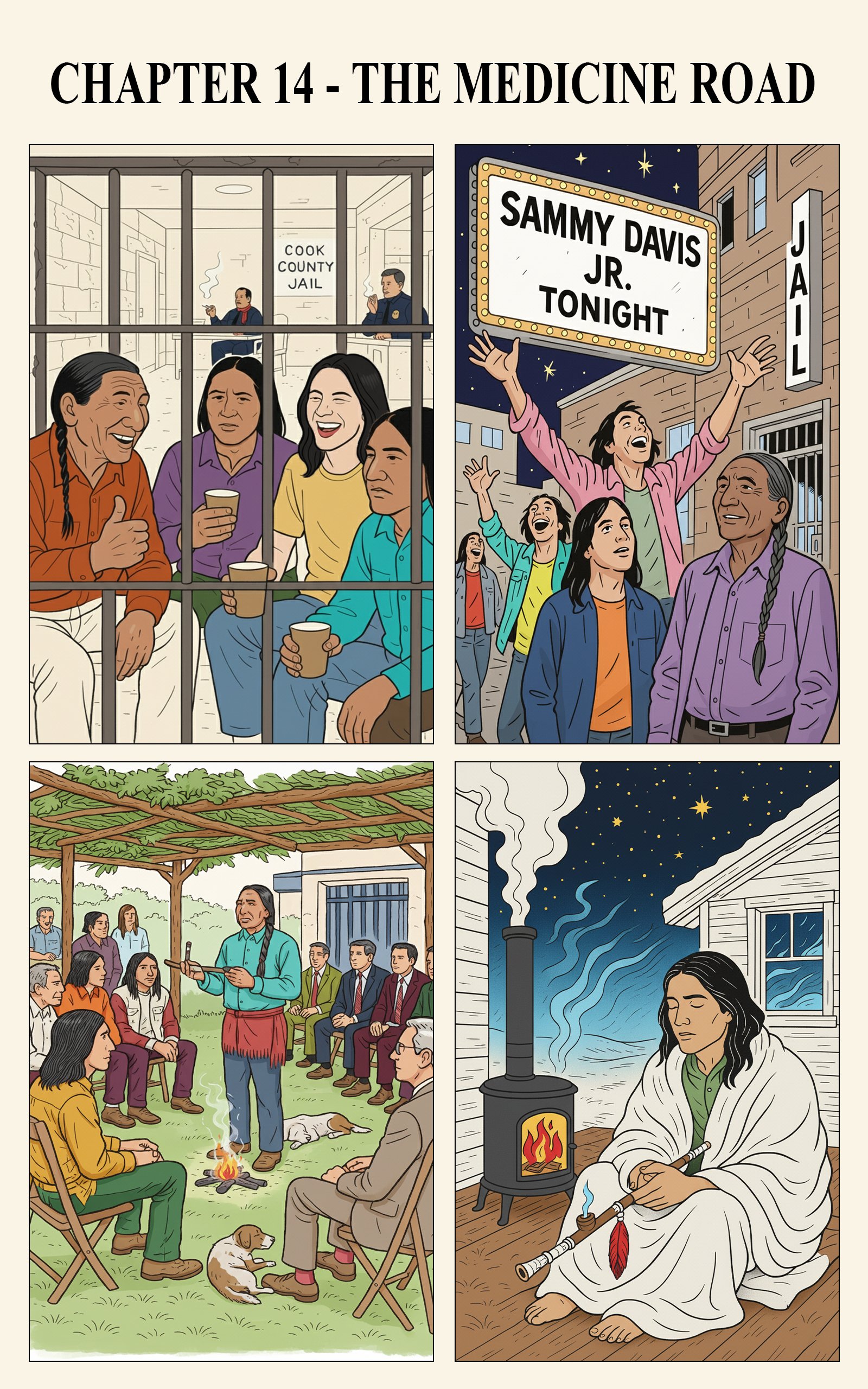
Wounded Knee cracked the world open. From the Nevada jail cells to the sacred circles of Rosebud, I followed the medicine road. Between arrests and ceremonies, I learned from John Lame Deer what no book could teach: that healing begins where pride ends. The road led me from the plains to Winner, South Dakota — and finally back east, toward another beginning.
Not long after, Archie and a group of us loaded supplies for Wounded Knee. Food. Medicine. Blankets. The prairie wind pushed us west.
The FBI and state troopers stopped us at the Nevada line. The charge: crossing state lines to contribute to a riot. They hauled us to Cook County jail in Las Vegas. The cells were concrete and steel, painted the color of old chewing gum. The air carried the stink of sweat, bleach, and fear. We were herded into a row of barred cages, the AIM men muttering in Lakota and English, their voices low and tight.
We were on the news daily and became celebrity heroes to the other inmates. They slapped our backs through the bars, whispered encouragement, passed us extra bread rolls at supper. For them, we were not prisoners but front-page headlines they could touch.
At night the guards smoked at their desks, laughing at jokes we could not hear. They looked at us like we were animals, like we had come from another planet. One of them called us “the roadshow,” and the name stuck for the week.
In the mornings they brought us coffee in paper cups, thin and bitter. We passed it from hand to hand, as if the warmth itself were medicine. Archie cracked jokes to keep the mood up. “Las Vegas,” he said, “the city of bright lights, and here we are stuck in the dark.”
At the arraignment the clerk read the roll. Lame Deer. Funmaker. Little Elk. Then my name. “Andrew Jackson Cooksey the Fourth.”
The judge peered over his glasses. “And what are you doing in all this, Mr. Cooksey?”
I didn’t think. “Making atonement for my ancestors, your honor.”
We made national headlines. Walter Cronkite’s voice carried us into living rooms across America. Six days in jail, six days in the news.
On the sixth night, a guard appeared at the bars, jangling his keys like a man with a secret. “Pack it up,” he said. “You’re going out.”
We thought it was another trick, another move to rattle us. But then we heard the name. Sammy Davis Jr. He had posted our bail. One hundred thousand dollars. Just like that.
We walked out blinking into the desert night, free men for the moment. The next evening we sat front row at his Vegas show, the stage lights hot on our faces. One day a cell, the next a reserved seat at The Candy Man. Sammy winked at us mid-song, as if the whole thing were just another part of the act.
Archie had me do most of the talking with reporters. His fire. My borrowed words. The cameras didn’t care who said them, only that they sounded true.
I wanted to stop all the talk and return to South Dakota. Dave Baker, who had been with me at Brando’s, flew with me to Rapid City. From there he drove me to Crow Dog’s Paradise on the Rosebud Reservation. The AIM leaders told me to wait. Someone was coming to bring me to Wounded Knee.
One day Lame Deer arrived. “You’re coming with me,” he said.
He drove an old car that rattled with every mile. One hand on the wheel, the other on a cigarette that never seemed to burn out. The prairie slid past in long flat strokes, brown and gray, the sky pressing down heavy. He did not speak much. He didn’t need to.
The negotiations were not in a courtroom or a hotel ballroom. They took place under a shade arbor at the home of Frank Fools Crow, the ceremonial chief. Elders and leaders sat in a rough circle, folding chairs and benches pulled from porches. The ground was dust and trampled grass. The air carried cedar smoke and sweat. Dogs wandered in and out, sniffing at pockets, curling in the shade.
The tribal leaders spoke steady, their voices calm but unyielding. They spoke of land, of promises broken, of treaties that had turned to dust in Washington’s drawers. “We are still here,” one elder said. “We are not ghosts.”
The AIM men leaned forward, fists tight on their knees. They spoke in bursts, fire and anger in their words. “You came with rifles,” one shouted at the federal men. “You came like cavalry. Nothing changes.”
The government men shifted in their suits, wiping sweat from their collars, the language of Washington heavy on their tongues. “We need to reach an understanding,” one of them said. “We need peace. We need this resolved.”
Lame Deer chuckled low, a sound like a crow in a tree. “You don’t want peace,” he said, not loud but clear enough for everyone to hear. “You want quiet.”
Nixon, drowning in Watergate, wanted it finished. Not solved. Not healed. Just finished. Wounded Knee off the front page, filed under handled. This was not just politics. Not just protest. Not even just ceremony. It was all of them at once. A stage with no script. History improvising itself in the open air.
That winter I stayed on the Rosebud Reservation near Crow Dog’s Paradise. My cabin leaned into the wind, the stove wheezing, the prairie earth frozen solid. Nights were long, and the wind pressed against the walls like a living thing as I dreamed what Lame Deer called medicine dreams.
Once a week I sweated with the old medicine men like Wallace Black Elk and his Uncle Abel Stone. I was healing. Lame Deer came by, told stories that balanced between joke and prophecy.
One night he said, “The spirits like you. You think you don’t belong, but they like that you try. You’re a man that thinks he is worse than others. Really conceited.” Then he laughed—his signature sharp, sudden, crow-in-a-tree laugh.
I chopped wood, hauled water, and listened. There was no audience, no applause. Just fire, snow, silence, and healing. After my winter on the Rosebud, I moved back into town to live with John in Winner, South Dakota.
There were three of us who lived with John: Bob Seid—we called him Bob White—and Bob Black Feather, we called him Bob Black, and Patti, a young woman friend of mine from back east who had come to help take care of John’s wife, Ida, who by then was blind.
To make money, the Bobs and I took jobs on construction crews and oil rigs. The work was hard and dangerous. It didn’t help that the white cowboys on the rigs didn’t like Indians or white renegades, which is what they called us.
We had a major incident on one rig when a careless driller whipped a chain so close to my head it nearly took it off. That started a huge fight which, although we won, got us fired.
Between stretches of work, we traveled with John, learning about medicine and herbs. I resumed my role as spokesperson, this time for John. His book had become a best seller, and we went to colleges where I would introduce him the way he liked. “You get up and talk me up,” he said.
John was funny. He would say the most outrageous things. At one county fair, speaking to children and their parents, he told the parents they should take their children to Sunday school so they’d be off the road and drunken Indians like himself wouldn’t run them over. No one laughed. He just laughed and kept talking.
Another time at a college we partied with my friends from back east, who had a film roll canister filled with Maui Wowie. We all got high and gave John some. After smoking it, he laughed and said, “I always feel this way.”
Another time I flew with John to New York City where, along with Mother Teresa, he was to speak at a spiritual conference at the United Nations. The conference room was filled with diplomats in dark suits, translators murmuring into headsets, the kind of setting where every gesture was measured.
Mother Teresa spoke softly, her words simple, direct, and heavy with the weight of her presence. The room leaned forward to hear her, as if holiness itself might rub off in the listening. John didn’t know who Mother Teresa was, but he whispered as she spoke. “That nun has spirit in her eyes.”
John was last to speak. He walked to the podium with a rolling gait, his long braids swinging, his eyes bright with mischief. He said the Great Spirit did not take notes, did not need a secretary, and the translators stumbled, unsure whether to make him sound like wisdom or comedy.
That evening at the cocktail reception, John got rip-roaring drunk. He took a liking to the Spanish ambassador’s wife, and she to him. They were about to leave together when the ambassador, embarrassed, tried to intervene. John began making bear growls at him until Richard Erdoes and I pulled him out to the car.
The next morning, I found him at Richard’s kitchen table, hungover and contrite. “My boy,” he said, “the Great Spirit came to me last night and said, sober up, respect yourself.” From then on, he didn’t drink again—save for a slip or two. He wasn’t perfect.
My life in Winner swung between extremes. Some days I was working oil rigs, fists ready. Other days I was standing in auditoriums, introducing John like a manager with a star. At night, we partied in bars, half-welcome, half-tolerated by the cowboys.
Among the Indian kids, though, we were family. They looked at us like rock stars from somewhere else, though we were just surviving the days like everyone else.
I had an Indian girlfriend.
One day John sat me down, serious, his face hard in the light. “You’re not going to make it here,” he said. “I see things. It would make me sad to see your face on some half-breed kid you would leave behind.”
John told me I needed to leave for a while. That when I came back, I would be married. That he would call for me when the time came.
So I packed up my van and headed back to New Hampshire. And there I met my future wife.
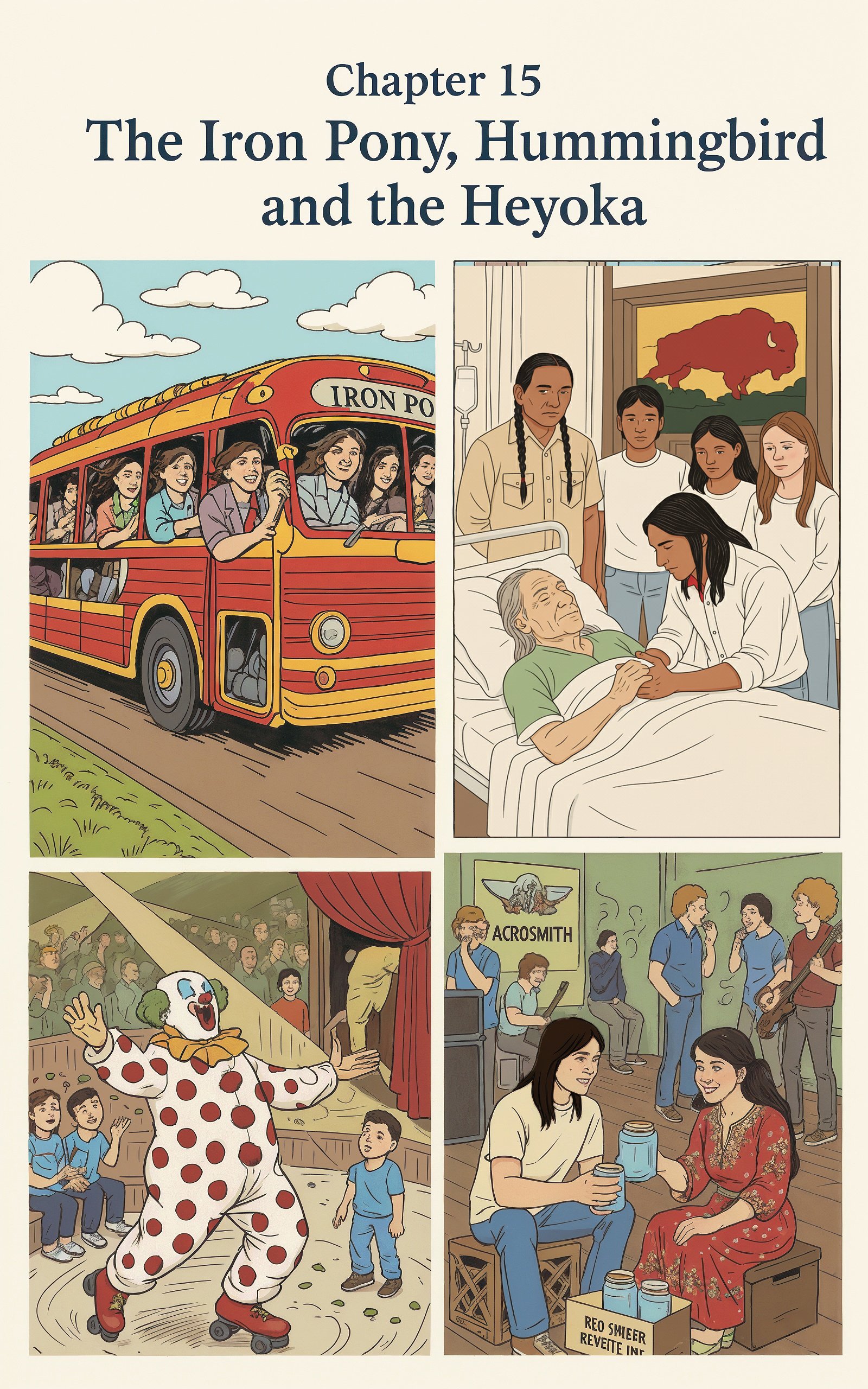
From apple orchards and peyote nights to rolling bus communes and circuses. Kim entered like a storm and stayed like destiny. Together we built the Iron Pony Express, rode the outlaw highways, and stood beside John Lame Deer at the end of his trail. In the high mountains of Colorado our son Quito was born. The road turned toward family and the laughter of the circus, where the sacred and the absurd danced side by side.
The orchard smelled of apples gone soft with rot. Rows of trees stretched out, red fruit dropping, bees drunk on sugar. I lived in a little trailer at the edge of the grove. It leaned when the wind blew. Three girlfriends had moved in with me—commune romance, nobody asking too many questions.
That fall I met Kim. Carole, a friend from the Kushi House back in Los Angeles, introduced us—she and Kim were studying at the Arica Institute under Óscar Ichazo. Kim was Italian American, Stamford tough. She had a look in her eyes that said she didn’t ask, she decided.
One night she came to the trailer and told the three girlfriends to pack up and leave. They left. She stayed. That was that.
When the apple-picking season ended, we slid down the coast to Wellfleet, Massachusetts. Cape Cod off-season: gray sky, salt air, houses shuttered for the winter. We were housesitting for an older lady Kim knew who went south for the winter. The town was half empty, but the oyster beds were full.
We ate oysters by the dozen—salty and raw or steamed—and washed them down with cheap beer. The house creaked in the wind, and the dunes stretched pale and endless to the sea.
Boston was close enough for weekend trips. Through our friend Johnny B—a famous record promoter with tickets and backstage passes to everything—we slipped into concerts and clubs. Boston bands, Boston itself, The Cars, and of course Aerosmith. We weren’t roadies or critics, just wanderers with a box of peyote tea in mason jars. That was our currency, and it opened every backstage door.
A box of peyote buttons fell into our hands, courtesy of a kid who’d heard I had lived with Lame Deer and figured I should have them. We took the frozen buttons from the freezer and put them in a pressure cooker, then added Red Zinger tea and poured the brew into mason jars. It came out delicious—earthy, holy in its own rough way—and it created a feeling of well-being; everything took on a pinkish hue.
Musicians loved it. We passed the jars around backstage, smiling like priests of a new sacrament. We never asked for or accepted money. It was a sacrament.
Kim had savings, and I had mine from apple-picking. We were fine until spring. When I needed money, I did what I always do—I came up with an idea: the Iron Pony.
The idea for the Iron Pony was simple: take an old Greyhound bus, gut it, fill it with bunks. A traveling party, east to west, coast to coast. For reasons still unclear, Greyhound gave us one to experiment with. Larry Taylor—a New Hampshire local and carpenter—and Rich Mensoff gutted the bus down to the ribs and wired bare bulbs along the ceiling so we could work at night.
Johnny B and some musician friends invested. We first used it as a crew bus for a four-week tour with Bruce Springsteen.
Then we converted it to sleep thirty-six: narrow aisles, stacked bunks, a rolling party on steel wheels. We called it the Iron Pony Express.
We weren’t the first. Out on the highways, other rogue fleets were already running. The Grey Rabbit, launched in ’71, ran San Francisco to New York, charging twenty-five bucks a head—no permits, no rules, just mattresses and music.
The Green Tortoise followed, buses painted green and gold, floor cushions instead of seats, passengers sprawled like a traveling commune. They cooked on camp stoves, stopped by rivers, and picked up strays. The buses smelled of sweat, incense, and hashish—part transport, part rolling hippie utopia.
We joined that wild tribe, the outlaw ride centers of the seventies. The Iron Pony was the premier bus—forty dollars a head. We filled it to the brim every trip. Berkeley became our base, running the San Francisco and Berkeley call center, patching together rides, filling bunks.
Phones rang, callers asked, “When’s the next bus east?” We scribbled names on paper, filled the bunks again, and sent another bus out onto the highway. On one run there was a French girl with no shoes and my Algerian friend Jamal, who acted as our porter, hauling baggage up to the big storage box on top of the bus.
We actually broke down once between L.A. and San Francisco. A California Highway Patrol officer called the local school district, and an hour later, up on the ridge, a mechanic on a motorcycle spiraled down to us. While he fixed the bus, the officer drove us to a liquor store so we could buy two cases of Colorado Kool-Aid—Coors.
Then the news came: Lame Deer had been in a car accident, lying in a VA hospital in Denver. Kim and I got married Halloween 1975. We had a rooftop wedding the night before we left, a kind of Halloween gathering disguised as a ceremony. Friends showed up in costumes—pirates, witches, drifters, vaudeville cowboys.
One couple brought their little dog and let it run loose around the roof while people drank and laughed. In the middle of it all, the dog bolted and went straight over the edge before anyone could react. There was a scream, then silence. It hit the street below and died instantly. The shock of it cut through the party like a knife—no moral, no omen, just death appearing without ceremony, the way it does.
We flew to Denver the next morning with that weight still in the air. We arrived in Denver the evening of November 1. Patti and Bob were already there. They told me he had been asking about me.
At night the staff tied John’s wrists to keep him from pulling at the tubes. It didn’t matter. He called in his Yuwipi spirits, and the knots untied themselves. He grinned at the nurses like it was a joke only he and the spirits got.
When I came into the room, he was awake. “My boy, I have been waiting for you,” he said. I bent down and kissed his forehead. I introduced Kim. She leaned in and kissed him too. He just smiled, as if to say he knew her already and she was part of the family.
The next six weeks I spent every waking hour at the hospital. Patti, the Bobs, and I rotated in shifts so he was never alone. He wasn’t getting better, and we all knew it, but we kept hoping we could take him back to Winner.
My birthday came on December 13. We held a party in his hospital room—balloons and paper plates with cake against the smell of disinfectant. He came alive that day, laughing and making jokes. John told Kim she was pregnant, even though she hadn’t missed a period. Then he turned to me and said he was going to come back as one of my kids because he could get away with things with me. He laughed hard.
We talked about taking him home to Winner. The next morning, early, he died.
John was my friend, my mentor, and my access to a way of communicating directly with and being guided by God, the Great Spirit. He was the crossroads of my life and direction going forward. He was buried wearing the Midnight Cowboy jacket that Jon Voight had given me and I had given him. It was fitting.
After John’s death we decided to stay in Colorado. Patti was with us, and we moved up into the mountains, to Idaho Springs—a mining town turned tourist stop, perched on I-70, where old brick storefronts leaned against the Rockies, lined with countless bars and world-famous Bojo’s pizza.
Our place was a three-room cabin built into the side of the national forest. Woodstove, thin walls, snow pressing at the windows in winter.
That’s where my son Quito was born, named for my favorite city, August 1st, at home. Kim in labor, the midwife and Patti attending her. I had a big frying pan full of cedar burning, smoke curling until I overdid it, the whole place choking with it.
I ran outside with it smoking and found the yard alive with hummingbirds, a swarm of them darting in and out, flashing in the sun. It felt like a sign, or a blessing—the spirits giving their approval. To the Andean Indians the hummingbird represents purity. The capital of Ecuador was named after the Quitu people—the People of the Hummingbird.
Hummingbirds, and the signs they carried, would appear again and again in my life. That morning outside the cabin wasn’t just a coincidence—it was the first time I understood that they were tracking me, marking thresholds I didn’t yet know I was crossing.
We have a picture of me holding Quito the day after his birth, looking me straight in the face with this intense gaze, as if to say: better listen up, Dad. Maybe, as Lame Deer said, he had come back. I believe that is possible. Who knows—but I have learned a lot from my kids, Quito in particular.
In Idaho Springs I had a wife, a newborn, and a cabin in the woods, but I also had bills. I decided to make money the only way I knew how: doing theater. I started with sponsored kids’ shows by promoting them.
Howdy Doody was still a name parents recognized, even though its golden years had ended back in the fifties. Buffalo Bob Smith, the man behind the cowboy voice and the checkered shirt, was still working the circuit. He’d built the show around a freckle-faced marionette and the Peanut Gallery of kids in the studio audience, but on the road it was mostly nostalgia and merchandising.
The Howdy Doody puppet would come out, the kids would yell, “Howdy,” and Buffalo Bob would grin like the country’s favorite uncle.
I slipped into that world, part sideshow, mostly paycheck. Kids’ matinees in malls, schools, auditoriums. Sponsored by local community organizations like the Kiwanis or Elks Lodge.
The work wasn’t art, but it was steady.
I made enough money to think about resettling, so we decided to move to South Florida. Kim’s folks were there, and her family mattered with a baby in the mix. Coconut Grove called us south: key lime trees, a neighborhood equal parts bohemian artists and old Bahamian families, near but not part of Miami’s glittering edges.
In Coconut Grove we settled in, but I needed more than kids’ matinees. I wanted to perform. It was a childhood dream—the circus. To become a clown.
Leonard Green was managing the famous tramp clown, Emmett Kelly Jr. He brought me in, and suddenly I was part of the tent. I did a duo act with Emmett. I was Basso Profundo—a roller-skating, opera-singing clown. Promoter, performer, co-producer, all in one.
Emmett and I became good friends. He had a quirky sense of humor and loved to pull pranks during the show—exactly the kind that broke tension, cracked me up, and somehow made the routines land even bigger.
Circus families are tight knit. They have to be. One of the families had multiple acts—a literal dog-and-pony act—and their fifteen-year-old daughter did a cloud swing without any safety net. She was an old soul and not shy.
One day she took my hand and said, “If you weren’t married I would marry you.” Her father just laughed.
The first show was in Miami, sponsored by the United Postal Workers’ Union. Sold out. Every seat filled, families cheering, the smell of popcorn and sweat thick in the Florida heat.
From there I took it on the road. New Jersey next, where the community sponsors were the police unions. Easy to sell tickets with cops behind it. A corporate sponsor always showed up too, usually a fast-food chain with its logo plastered on the posters. The circus rolled on, equal parts spectacle and hustle.
Francisco, like Quito, was born at home a year later. No hospital, no bright lights—just us. I helped deliver him. Another son, another spirit stepping into the world. He still carries that clown spirit, as if something from those circus years seeped into him at birth.
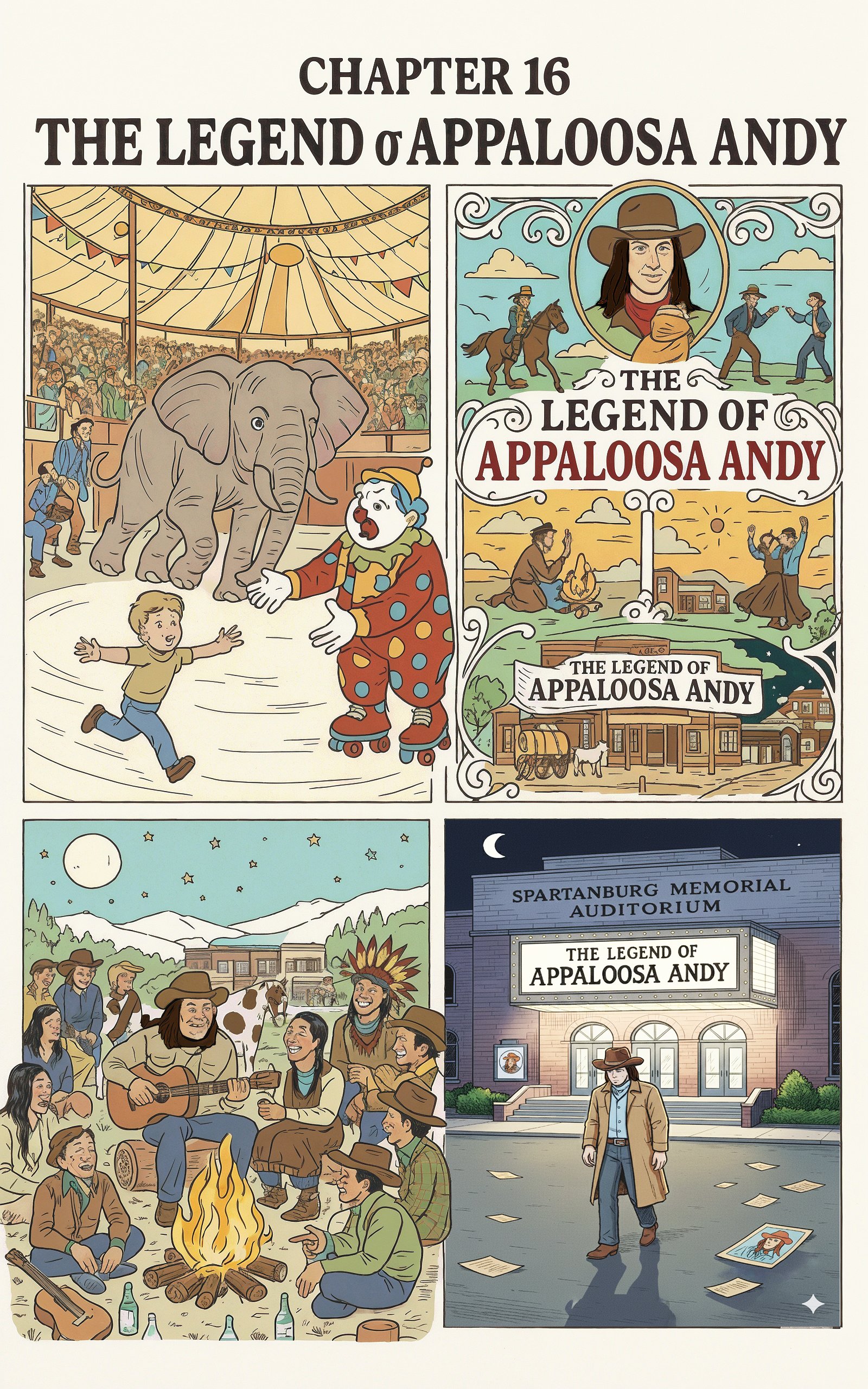
From circus floors to sacred fires, the fool’s mask turned prophet’s mirror. I carried the spirit of the heyoka into the birth of The Legend of Appaloosa Andy—a Wild West parable born of storytelling and song. Love unraveled, but the myth endured. I learned that sometimes the show itself is the prayer—and the only way out is through the door you entered.
I continued to do circuses, gone six weeks at a time. Before the shows, I ran the pre-sale ticket operations. Telemarketing from rented rooms with banks of phones, kids reading scripts into the night. The money for the tour came one call at a time, checks piling up on card tables.
We never used a tent. Always basketball courts with two to three thousand seats. Celotex laid over the hardwood so the elephants wouldn’t wreck the floor. The smell of popcorn, beer, cigarette smoke rising to the rafters. The bleachers rattled under the weight of families.
The circus was grind and glory. Sweat and illusion. We were clowns in greasepaint one minute, hustlers counting ticket stubs the next.
The greasepaint went on like armor. White base first, cold against the skin, then the red and black lines drawn sharp, carving the mask into place. Classic Italian clown. I laced up the roller skates, tugged the suspenders of the heavily padded suit, tested my voice with a low rumble that rolled out of me like thunder. When the Ringmaster called my name—Basso Profundo—I pushed off.
The arena was twenty five hundred seats filled to the rafters. Sheets of celotex covered the hardwood to protect it from elephants and crowds. The smell wasn’t sawdust but popcorn, sweat, and cigarette smoke curling toward the rafters.
I rolled into the spotlight, the floor humming under the wheels, and opened my mouth. The baritone came booming out, ridiculous and grand, bouncing off concrete walls built for jump shots, not arias. The absurdity hit the crowd just right—kids shrieking, parents clapping, the laugh wave rolling back like surf.
But for me, it wasn’t just a gag. The clown had always been more than slapstick. He was the fool who told truths kings couldn’t hear. The trickster who fell and rose again, carrying the laughter of the people like a blessing.
Every pratfall, every note sung too high or too low, was a ritual. When I tumbled across the celotex, limbs flailing, the bleachers shook with laughter. When I skated up singing opera, the crowd leaned in, delight and disbelief mixing in the roar.
A ramp to skate off of. Then Emmett would come out and make silent motions that he would catch me. More pratfalls.
The makeup let me disappear. The skates let me fly. And in those minutes under the arena lights, I wasn’t hustler or smuggler or seeker. I was the sacred clown, a heyoka like John had been. I was following in his footsteps. It was sacred.
Between the circus and the Wild West show, I learned how laughter holds a mirror. The greasepaint hid my face so the truth could show—just like Lame Deer said: turn the world upside down and you might finally see it. The arena taught me that performance and prayer aren’t opposites. Some nights the laugh was the medicine.
Quito was five years old, quick as a fox. One night he broke from my side and darted across the floor. The elephants were moving in, slow and heavy, their ears flapping like sails. The crowd gasped.
The trainer shouted. The band cut. For a second the whole place held its breath. Quito ran straight in front of them, just barely making it to the other side. I scooped him up, heart hammering, screaming what were you thinking? The crowd gasped and then cheered as if it had been part of the act. He said, “I wanted to hear them cheer me.”
The Vineland Wild West Show was the first test run—ragged but alive. Then came Westport. That was where I teamed up with my friend Joe Bailey, one of the writers from The Muppets and Sesame Street. At his kitchen table, we spread out legal pads and coffee cups and began shaping something bigger: The Legend of Appaloosa Andy.
It was a Wild West musical about a young Medicine Barker who finds the elixir of life in a mason jar of water that shines like the sun. He travels through history, meeting cowboys and shamans, outlaws and dreamers, always tempted by immortality but always chasing love. Joe had the wit, the punchlines, the knack for making a song stick. I brought the visions—the medicine, the myth, the sense that the West was haunted by spirits as much as six-shooters.
Together we made it a show. In Westport we sold out houses, the banner high, the crowd with us. But we were always over budget, drowning in receipts no applause or sold out houses could pay off. Still, Appaloosa Andy was alive, and I carried him with me from that point forward, as much a part of me as the clown or the seeker.
I remember the silence that followed her leaving more vividly than the fights that led up to it. A roadside motel in South Carolina, rain streaking down the window, her side of the bed empty. The neon from the sign outside flickered on the ceiling — VACANCY — as if mocking the emptiness that had taken up residence inside me. She wanted stillness. I only knew movement. I was still chasing the next show, the next flash of light, as if I could outrun the echo of the last goodbye.
That summer, the Cherokee dancers in our cast invited me south. They came from the Smoky Mountains—bright beadwork, eagle feathers, the stomp and sway of fancy dancing that carried both pride and defiance. Cherokee, North Carolina had two faces: the one the tourists saw—teepees for rent, toy tomahawks, the history flattened into postcards. And then the private Cherokee—the families who had resisted removal, who still held their ceremonies in the hush of the woods.
Away from the highway lights, I was welcomed into a clearing where cedar smoke curled low and the drum kept a heartbeat no amplifier could match. The women wore shell shakers at their ankles and moved in slow circles; the men stepped sunwise, the rhythm tightening like a prayer. An elder sprinkled river water from a sycamore gourd while another fed tobacco into the fire. A singer lifted a song in Tsalagi that I didn’t understand with my ears but felt in my bones. I recognized the same current I had known with the Lakota—the old road under every road. Lame Deer’s teachings drifted in that night air: the sacred hides in plain sight.
My friends Ginger and Denny from the University of Tennessee drove in, brushes in hand, painting a twenty-by-thirty-nine-foot banner in Old West style. We strung it high on the roadside out of Pigeon Forge, bold enough to make passing tourists pull over. That banner was a promise: the legend was alive, at least for a season.
Instead of Clayton Moore, we had Lash LaRue. Not the screen cowboy legend, but an older, beatnik version with stories as bent as his hat brim. One night we lit a bonfire, passed a guitar, sang cowboy songs, smoked grass with him. It was raw, unscripted, a communion of outlaws and dreamers. To this day, I think that night captured the show better than any stage ever did.
When the summer ended, I drifted east to Asheville. The Montford Players were mounting Shakespeare in the park. I signed on and fell into the rhythm of verse and Elizabethan tempests. That’s where I met Tarah. She was in college, kind, steady, young in years but with an old soul that looked right through my wandering. She steadied me in a way the road never could. I also met Richard Cicarelli, a young architect turned muralist, slapping color across walls big as barns. He had an eye for scale and spectacle. For my show he designed a giant rear screen, set pieces layered in front to create the illusion of depth. A three-dimensional mirage, the legend stepping off the canvas. Richard’s designs made the myth feel tangible, like you could reach out and touch the Medicine Barker’s coat.
We remounted The Legend of Appaloosa Andy one last time in Spartanburg, South Carolina. The themes we had scribbled in Westport—immortality, love, endurance—were already chasing me offstage, weaving themselves into the life I’d spend the next forty years trying to understand.
By then I was burnt out, and the buzzards were circling. Ownership of the rights to the show came up—they wanted me to sign them away. Lawyers, papers, even U.S. marshals waiting in the wings to serve me.
After the final curtain fell, I said a quiet prayer. Then I walked out the front door of the Spartanburg Memorial Auditorium—the same door I had walked in. No back exit, no scene, no papers shoved into my hand. Invisible. No one stopped me.
Walking out the same door wasn’t escape. It was acceptance. A heyoka’s bow. The legend would live in other forms, and I would keep moving—lighter for having carried it, changed by the carrying.
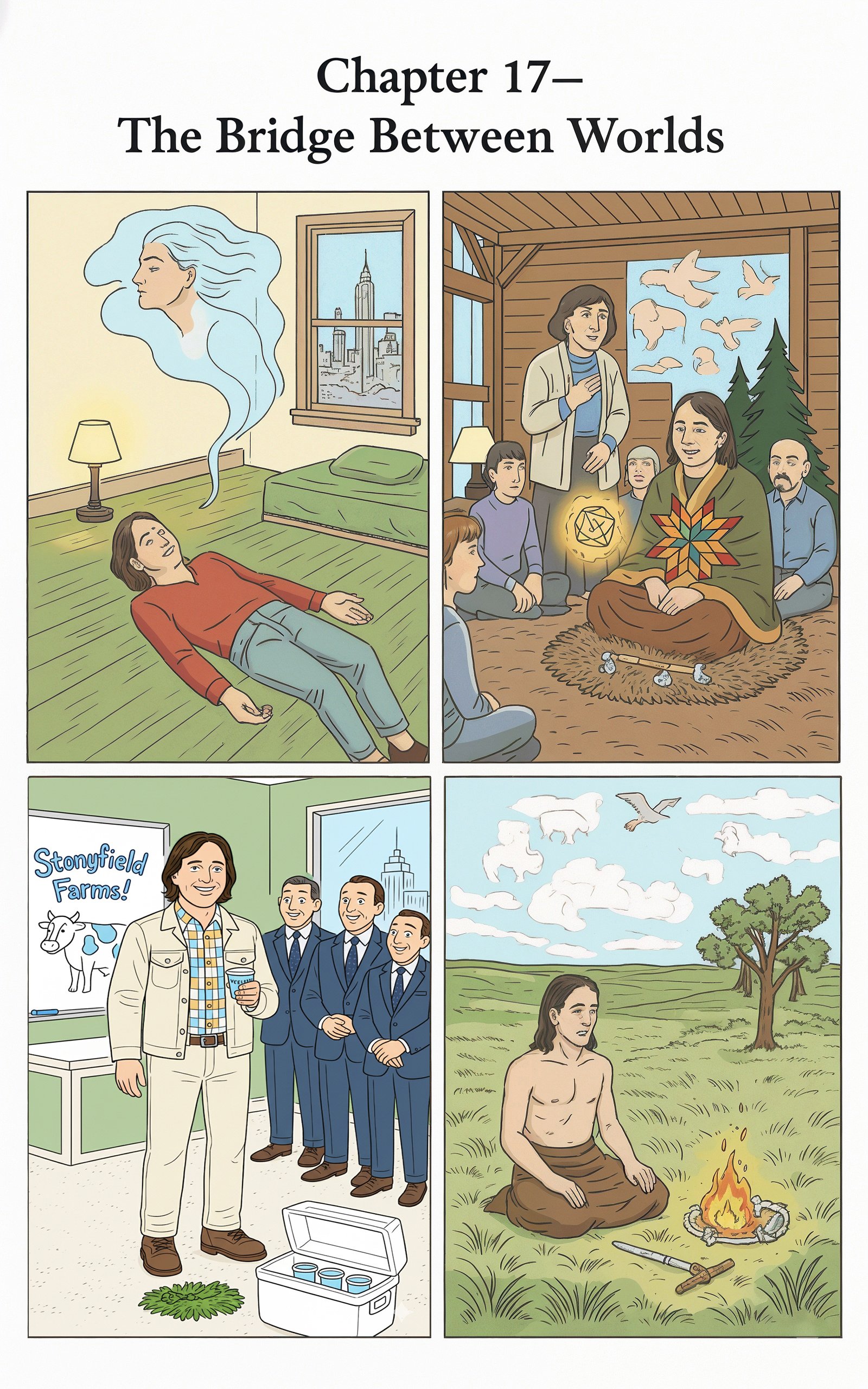
From buyers’ offices to sweat lodges, from New York’s concrete corridors to the firelit circles of the Lakota, I walked a double life—food broker by day, seeker by night. The road back to ceremony began in the most unlikely places: a supermarket chain’s authorization, often a prayer in the dark. Love fractured and remade itself through the sons who kept calling me home. I finally learned that the bridge between worlds is built by showing up—one breath, one prayer, one act of faith at a time.
Kim and I decided to give it one last shot. The move to Stamford felt temporary from the start. Kim and I tried to make it work, the boys still small, her days filled with a waitress job. But our center was already pulling apart. Domestic walls pressed in on us like a trap. After a while, the tension won. Kim stayed, and I drifted back into New York.
Johnny B had a spare couch in his apartment, and Johnny’s couch was better than any home I could have managed at that point. He was still the great gatekeeper of rock ’n’ roll, a man with a Rolodex in his mind. Free rent, food, and all the joints I could smoke—but that wasn’t going to pay the bills.
My Erewhon Farms neighbor Sam stepped in, and I got work with his Stonyfield Farms Yogurt and New England Country Dairy—names that would later carry weight in the natural foods world but then lived mostly in tiny health food stores.
They wanted to break into a thousand supermarkets in and around New York City. They wanted someone hungry, someone who knew how to hustle. Anyone who they figured could sell circuses could sell yogurt.
They gave me an apartment in the Village, not glamorous but central. My job as a broker was to sell yogurt into those thousand supermarkets in six to nine months. It sounded impossible. But impossible is not something I have ever thought impossible.
At night, the separation from Kim sat heavy. I missed the boys. Missed their small bodies curling into me when they were tired. Missed the weight of family, even though I had been the one to drift away.
That was when I turned to rebirthing meditation—a last resort, half-therapy, half-ritual, all desperation. I would lie on the floor of my Village apartment, the room dark except for a single lamp, eyes closed, breath pulled in and out in long, circular cycles, trying to push grief out through my lungs. Sometimes it felt like drowning; sometimes like surfacing for the first time.
There were nights when I thought I was floating outside myself, weightless above the floorboards, seeing my body still breathing below. Other nights I just wept, breath shaking, tears soaking the rug until dawn. It became my own private ceremony to work through the grief.
By day I promoted yogurt to the hard-nosed buyers of New York. By night I tried to breathe my way out of loneliness. The city didn’t care about either side of me. It was a machine. You fed it product, it gave you sales. You fed it breath, it gave you silence.
I kept showing up at buyers’ offices. They were the gatekeepers of shelf space, men who could make or break a product with the flick of a pen. They sat behind polished desks in rooms where the carpet was thicker than the soles of my boots. The other brokers looked like they had stepped off a runway in Milan—$1,000 Italian silk suits, cufflinks gleaming, hair slicked into place.
I walked in dressed like a farmer from New England. Plaid shirt, work boots, and a corduroy sport coat. The other brokers laughed when I walked through the door. The farmer in the big city. A hayseed with natural yogurt. It was my role. An act.
I opened the cooler I carried with me and put the product in front of the buyers. Thick, tangy, alive with cultures. Ben & Jerry’s flavors.
I told them about the natural milk, the farm, the process. I told them what made it real in a world full of imitation. I didn’t try to play their game. I played mine.
And it worked.
In six weeks I had authorizations across the board. A thousand supermarkets carried Stonyfield Yogurt and New England Country Dairy. The suits stopped laughing when I came through the door. Some of them even started dressing down, trying to mimic the act they thought had won the day. But it wasn’t an act. I was what I was—someone who had been through too much to be impressed by their cufflinks.
I had done what no one thought possible. In six weeks, I had put Stonyfield Farms on the map in the biggest city in the country. The hippie farmer had outfoxed the silk suits. And for a little while, that was enough.
Financially, I was now okay. Spiritually, I was drained.
One day Bob White called me from South Dakota and told me that Godfrey Chipps wanted to come to New York City and do the ceremony.
Godfrey Chipps was born into a powerful lineage — the fourth-generation descendant of Horn Chips, the revered Lakota medicine man who stood beside Crazy Horse in visions, in ceremony, and in prophecy. His father, Charles Ellis Chipps, carried the Yuwipi tradition forward, and his mother, Grandma Victoria, was keeper of the Sacred Pipe. In Godfrey you felt both inheritance and responsibility—ceremonies not just learned but given directly by the Spirit.
He became my brother, and Grandma Victoria my teacher.
We started by doing a sweat lodge in Long Island, then graduated to five-stick ceremonies in New England at my friend Jim Martin’s. Ultimately, when Grandpa Ellis and Grandma Victoria came back on one of his visits, we held a Yuwipi healing ceremony in New Hampshire with my friends from Erewhon times.
I went back to South Dakota and did my first four-day Vision Quest. My healing was only beginning.
I met Hedy Rosen at one of the sweat lodge seminars I was running with Godfrey. She was a pharmacist who leaned into natural healing and Native American tradition. Her mother was a concentration camp survivor, and Hedy’s childhood carried the scars of that. She would bring us unforgettable Hungarian dishes, rich and generous, and we welcomed her warmth.
I moved in with her in Riverside, Queens. We were together for two months before she got an offer to run a pharmacy on the Navajo reservation in Arizona. Within two weeks she was gone, and I stayed alone in the apartment.
My sons would come by to visit. One afternoon, about a month after Hedy left, a young girl in our building who had been battling depression jumped from the fifth floor. Minutes later I walked out and saw the ambulance and the crowd. She was pronounced dead. There was blood on the sidewalk. I fetched rags, wiped it up, and said a prayer.
The next day, and for days after, I began to hear her voice in my mind. She told me she thought the loneliness and pain would be gone once she jumped, but it wasn’t. She was stuck. I prayed for her every day. One day she whispered she was okay, that she could leave now. She thanked me. That was the end of it. The memory never left me.
Eight months later Hedy came back, missing me. By then I had gained thirty pounds, and a friend said I should try a yoga ashram in the Berkshires called Kripalu.
Kripalu had started as a small yoga retreat in Stockbridge, Massachusetts—part spiritual community, part health retreat, part boot camp for the soul.
That was where I met Puja, one of the instructors. A strong-minded yogini. She decided she wanted to be with me. I didn’t resist. Hedy was heartbroken. I regret the way I ended things with her. Years later I tried to find her, just to apologize, but never could. Hedy, wherever you are: you meant more to me than I ever showed.
I moved up to Kripalu. The yoga, the chanting, the vegetarian food—it worked. I was lighter in body, steadier in mind.
Puja left the ashram and followed me to Guatemala, where I had been invited to work with the indigenous artesanos. She struggled at first, but eventually embraced it. We set up the Earth Group to help develop and distribute artisan products. When we returned to the States, we moved to Becket, Massachusetts, near Kripalu.
We built a ceremony room, and Godfrey visited often. That was when I first met Sal Gencarelle, a sixteen-year-old helper with the heart of a seeker. Later he would write *A Man Among the Helpers*, but back then he was just learning.
The first healing was Niti, a Kripalu resident with advanced multiple sclerosis. After ceremony, she stood up and walked to Godfrey and hugged him. The room gasped. The next day she was in running shoes helping prepare the sweat lodge.
Ceremonies followed one after another—thirty in three months. I felt like my life was finally being steered by something larger than my ambition.
Meanwhile, Kim had moved to Los Angeles with Gordon, and the boys went with them. They struggled, and I felt helpless. The tension finally pulled me west.
Our parting wasn’t loud. No fights, no accusations. Just quiet understanding. I remember packing the last box and realizing that silence has its own sound—the weight of what won’t be said.
Leaving Becket felt like shedding a skin: the ceremonies, the smoke, the nights of miracle healings. But part of me knew that the bridge between the sacred and the ordinary had to be lived, not just prayed.
Puja stayed. I went west. My sons needed me and I needed them. That simple.
And that move to Los Angeles opened another chapter entirely.
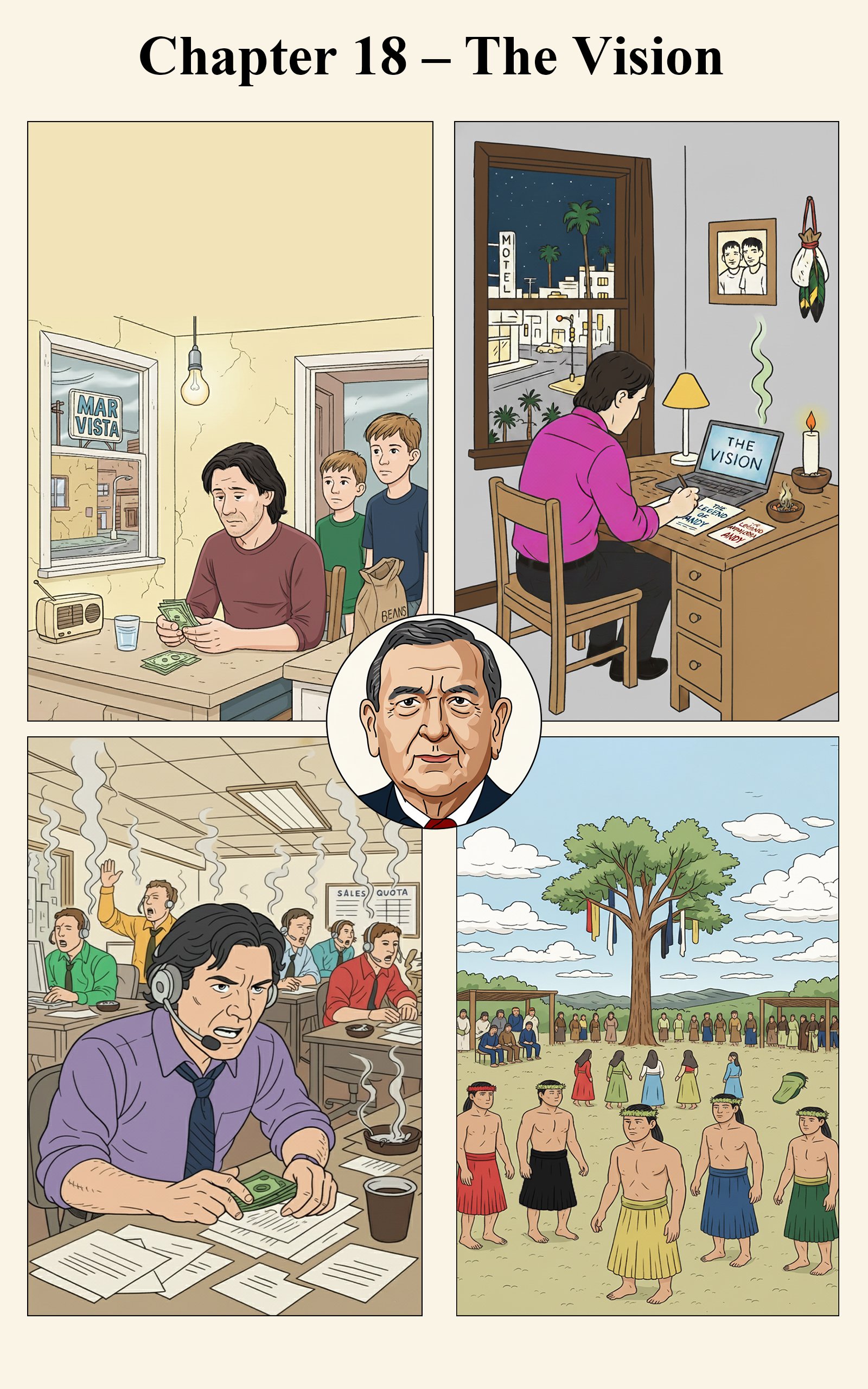
From Los Angeles’s hustles to South Dakota’s sacred grounds, I found myself caught between money and meaning. The Vision was more than a film—it was prophecy disguised as cinema, born out of loss, addiction, and rebirth. With Tony Spurgin’s faith behind me and the Sundance before me, I began to see that redemption doesn’t come from escaping the world but from spiraling deeper into it—one sacrifice, one prayer, one breath at a time.
I left New England broken, with nothing but debt and disappointment. Before I could face Los Angeles, I went north to San Francisco to stay with my friend from my Appaloosa Andy days, Richard Cicarelli. He had an atelier and was painting full time. It was a place to crash, and enough calm to give me two weeks to collect myself. Puja had frozen the bank accounts. I was broke. I borrowed from a friend at Kripalu just to reset my life.
Los Angeles wasn’t exactly waiting with open arms. I rented a small apartment in Mar Vista, then still a low-rent corner of the city. Cracked sidewalks, bars on the windows, neighbors who didn’t make eye contact, and gangbangers. The boys came to live with me, and the three of us scraped by on forty dollars a week for food. Beans, rice, three-day-old veggies, peanut butter and jam for dessert if we were lucky. It was survival. Nothing more.
The boys were wild. I tried to keep them in line, but I was stretched thin. One night, while I slept, Quito — thirteen years old, Francisco, and their friend Jeb tagging along — took my car. They drove up the coast to see the wildfires burning in Malibu, the hills glowing red against the night sky. I woke up to the voice of the sheriff’s office saying they had stopped them crossing into the fire zone, and then I realized the car was gone. My stomach dropped.
We were going under. I needed money. Fast. The quickest way was the city’s underbelly of phone rooms — “boiler rooms,” as they were called. You walked in and the air was thick with sweat, cigarette smoke, and shouting. Young guys in cheap suits shouted into headsets, reading scripts off stained cue cards. The mark on the other end was always “a valued client,” always “just one step away from turning their portfolio around.”
I became a closer — the senior broker they called in when the junior guys had the mark on the line but couldn’t seal the deal. My job was to talk fast, sound sharp, make the man or woman on the other end believe that if they didn’t buy gold, silver, or some exotic commodity right now, they would regret it forever. It wasn’t noble work, but it paid.
One month I cashed a commission check for over twenty thousand dollars. I moved us into a three-story apartment in Santa Monica, a block from the ocean. For the first time in months, we weren’t scraping. The rent was paid, the fridge was full, and I could breathe. I wasn’t proud of myself, though.
So I ate my loneliness and stress away. I didn’t drink when I was stressed, and I didn’t go back to drugs. And the food went in like cement. In eight months I put on a hundred pounds. The apartment had become a fortress of silence. Quito holed up on the top floor, Francisco somewhere between loyalty to him and confusion at me. Quito was smoking weed, and soon enough he was dealing. I confronted him one night, told him he needed a 12-Step program. He stared me dead in the eye and said, “Why don’t you go to one? I’m sure they’ve got one for fat people.”
It cut deep. But he was right. Addiction is addiction. Quito always told me the hard truths.
I found Overeaters Anonymous. Not the soft version — the hard-core HOW program. We weighed and measured food. No gray areas. Call your sponsor every day. My sponsor was Sue Gold. She became my golden rescuer. I stuck to it, meal by meal, phone call by phone call. In six months I lost one hundred pounds. Years later, I still work it. You never graduate.
Money kept rolling in. But money never fixed the hollow places. Each check was a patch over a leak that kept widening. I told myself I’d earned it, that the hustling was temporary. But the truth was harder: I’d learned how easily integrity bends when survival calls. Somewhere between the boiler rooms and Overeaters Anonymous, I began to understand what Lame Deer meant when he talked about the green frog skin world—money. That greed would destroy the world, not the Great Spirit.
I was actually quite good at picking winners, and one pick was silver futures, which tripled in one month. When I advised my clients to cash out instead of rolling their gains over into another investment, I was fired. I didn’t care because I had bought my soul back, and by then I was working on a script for a movie that had Lame Deer in it and dealt with prophecy and the riddle of human destiny on the planet.
It was then I met Tony Spurgin. He was a client. I had sold him the silver futures, and he had made money. Tony was unlike the hustlers, seekers, or clowns I had been running with. Born in England, trained as an aeronautical engineer, he was grounded in rigorous systems thinking. He saw people and machines not separately but as parts of the same dance.
His published work, Human Reliability Assessment: Theory and Practice, had made him a consultant to governments running nuclear plants. After Three Mile Island and Chernobyl, his work became gospel in safety circles.
He became my patron, mentor, and friend. Tony, along with other clients I had cashed out, offered to back me in making The Vision.
The Vision was never just a screenplay. It was prophecy dressed as cinema, a way to show that human destiny wasn’t a straight line but a spiral. The story asked: what happens when the old doomsday prophecies collide with the future? The Vision said prophecies are not predestined. They only show us what is likely if we don’t change. Change is the key.
We spent nights at Tony’s kitchen table, surrounded by open notebooks and cold tea, sketching out diagrams of the world as a living system. Tony said that the human mind was like a reactor, and every choice we made was a test of containment. “The next meltdown,” he told me, “won’t be nuclear—it’ll be moral.” Those words stayed with me.
The Vision became our shared blueprint for transformation, a film that could wake the sleeping parts of humanity before it was too late. I didn’t know if Hollywood would ever understand it, but Tony did. His faith was oxygen to my fire.
Tony believed in The Vision. He backed me, not with the bottomless pockets of Hollywood but with something rarer — faith. I sent treatments to producers. I took meetings where the suits nodded politely, eyes drifting to the clock. They wanted cowboys and gangsters, not visionaries. The prophetic didn’t fit their slate. The closest I got was a handshake and a let’s-have-lunch-soon.
Every summer I drove back to South Dakota to Sundance. The Lakota Sundance is a sacred commitment — a prayer in motion — where we give of ourselves for the healing of our families, our communities, and the Earth. As a Sundancer, I offered my flesh through piercing at the sacred tree, surrendering to the Creator in an act of sacrifice and prayer. Each step, each song, and each moment at that tree was guided by the spirits, reminding me that this path was not for myself alone, but for all my relations.
By then, the Sundance ceremony was drawing not only Lakota but Europeans — men and women from the Netherlands, Germany, and Switzerland. They had been touched by my brother Archie Lame Deer, who had carried the ceremonies across the Atlantic. They came to South Dakota with offerings, sweat pouring down their faces, rawhide bindings biting into their chests as they danced to the drum. Outsiders, yes, but sincere, and the spirits met them halfway.
Those Sundances blurred the line between nations, between languages, between prayers. I watched a Dutch man cry in gratitude after the fourth day, his chest scarred from piercing, his eyes shining like a child’s. The medicine men called it “the new hoop”—a widening circle where all could dance, if their hearts were clean. I carried that teaching home each year, a reminder that the sacred has no passport. Each Sundance stripped away another layer of the hustler, the salesman, the man chasing redemption through profit. What was left was simpler: a prayer with feet, trying to find its way home.
Back in Los Angeles, the city still pulsed with its electric fever—neon, noise, ambition dressed as light. But something in me had quieted. I began writing The Vision not as a project, but as a promise—to the spirits, to my sons, to every version of myself that had gone off course. The story was my offering, my way of dancing without the drum. I didn’t know if anyone would ever see the film. But for the first time in years, that didn’t matter. I had begun again—not in triumph, but in truth.
That was when I met Sibel from Switzerland. She was maybe eighteen then, though she looked thirteen — a tiny powerhouse with the kind of spirit that filled a room before she spoke. She had been doing seminars with Archie Lame Deer since she was fifteen, traveling across Europe with a small circle of seekers who treated the ceremonies like sacred science.
Sibel carried that same balance of reverence and rebellion I’d always been drawn to — unafraid to question everything, but never losing respect for what was true. She invited me to Europe, saying, “Come see what’s happening here. The medicine is crossing oceans now.”
I went. In Germany, Holland, and Switzerland, I watched as the same fire I’d seen on the plains burned in these new gatherings — not imitation, but translation. Europeans sat in sweat lodges, singing Lakota songs with accents, their hearts wide open. It wasn’t perfect, but it was real.
Sibel moved like a bridge between worlds — fluent in both the sacred and the practical. Years later she earned her PhD and joined the Swiss Red Cross, taking her strength into war zones and refugee camps. She sent me emails from places most people only read about in dispatches. Her handwriting always steady, her words never self-pitying.
I don’t have many heroes. But Sibel — she’s one. A reminder that courage doesn’t shout. It listens, acts, and keeps walking, even when the road is made of fire.
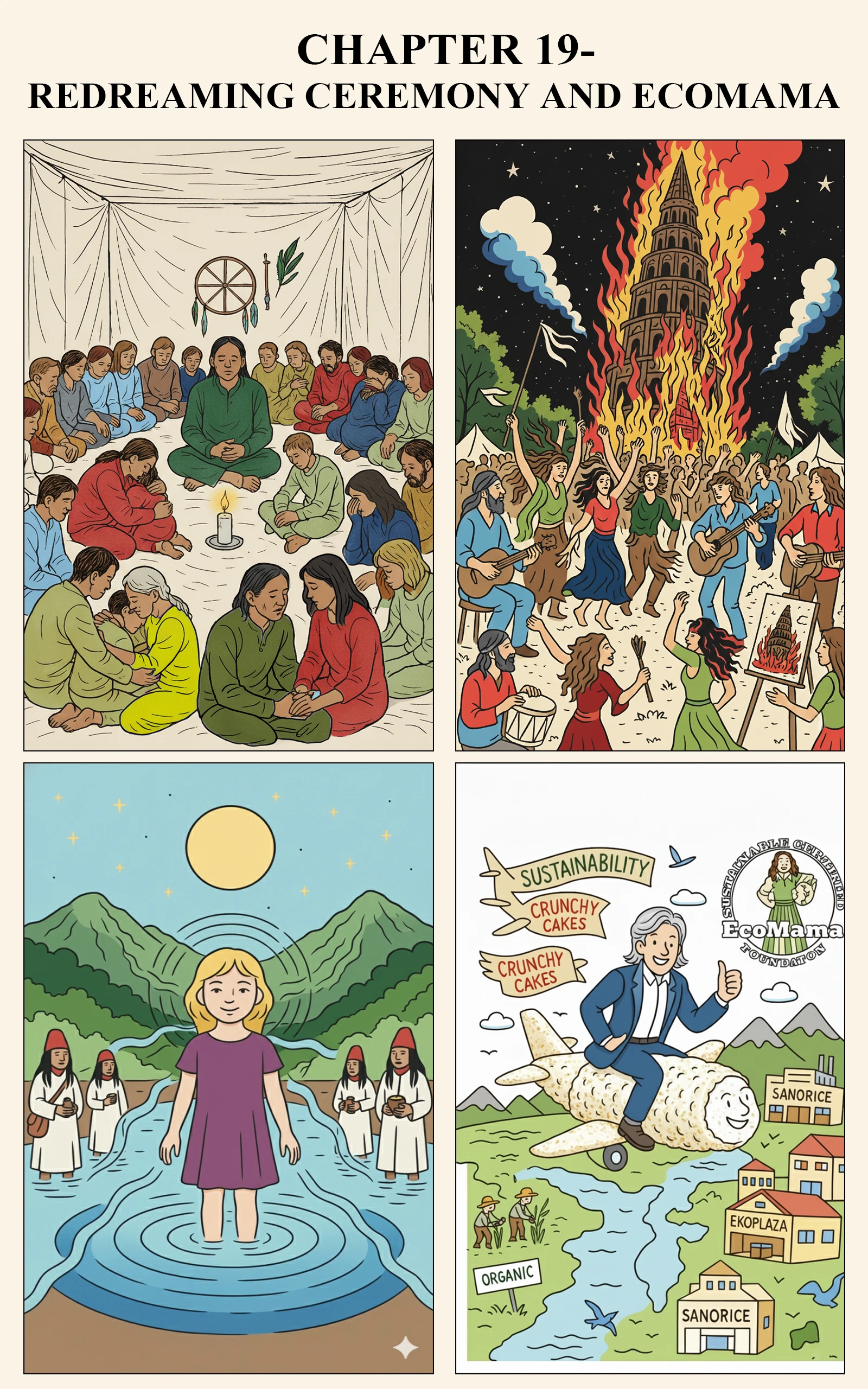
What began as a film that never reached the screen became something far more alive—a ceremony that moved across borders and into people’s hearts. Out of The Vision came the ReDreaming Ceremony, a ritual of transformation where art met spirit. From small European halls to the countercultural fires of Ruigoord, prophecy turned into participation. Amid those flames, love found me again in Wilma, and through her, my daughters Aluna and Marina—the true dreamers who taught me that love, once born, never ends.
Archie pulled me in again, this time as a bridge. The Europeans wanted me to bring new ceremonies back with them—to translate what they had seen into something they could live. Out of The Vision came what I called the “ReDreaming Ceremony.” It wasn’t Lakota tradition—I never claimed that. It was a ritual born of my script, a way of taking the medicine of dreaming and turning it toward healing.
The first time we did it, I remember the room: black plastic covering every window, every crack sealed until not a pinhole of light remained. In that absolute darkness the senses sharpened—every breath a whisper of truth, every shuffle of feet a confession. People will say things in total darkness that they never would in daylight. The air turned thick with raw honesty, and we were unlearning Hollywood’s kind of magic—trading illusion for revelation.
Still, I wondered if we were crossing a line, manipulating emotions too deeply. But the tears, the laughter, the trembling hands told me it wasn’t manipulation. It was release.
So I flew to Europe: small halls in Amsterdam and Antwerp, a borrowed farmhouse in Bavaria, a converted barn in Switzerland. We made the spaces light-tight by covering every window. People gathered in circles, eyes wide, waiting for a vision to land in the room. I told them what Lame Deer had told me—that sometimes we dream dark dreams, but we can re-dream them into light.
In those circles people began to speak the unspeakable—loss, abuse, the ghosts that followed them. One night a young German woman spoke to her deceased father, whispering apologies into the dark. Another night a man from Antwerp forgave a brother he hadn’t seen in twenty years. We played Eric Clapton’s “Tears in Heaven,” and the entire room dissolved—sobbing, rocking, holding one another. Each session stripped away pretense until only the trembling human voice remained. I left those nights shaking, unsure whether I was leading the dream or being led by it.
Gradually the ceremony became a bridge between the unseen and the visible, between story and soul. In The Vision screenplay one of the lines read: “The dreamer wakes not to escape the dream, but to change it.” That was what we were doing. I realized that prophecy doesn’t need cameras—it needs witnesses. Each person who came became a participant in a living script, an unwritten sequel to The Vision that existed only in breath and heartbeat.
One of the final scenes I wrote was about rebuilding the Tower of Babel and then, at midnight on December 31, 1999, burning it as a symbol of the unity of nations. That scene leapt off the page. In Ruigoord—a countercultural village near Amsterdam—the squatters and artists actually built a giant wooden tower and burned it in a millennium festival. Flames leapt into the night sky, fireworks exploding, the tower collapsing in embers while drums pounded and people danced. They had taken the vision straight from my script, made it flesh and fire. For me it was proof that prophecy works sideways—sometimes through a movie never made, sometimes through creative people.
The people there believed art was its own religion, that creativity was the last sacred act left in a secular world. I remember one organizer telling me, “We don’t need permission to dream.”
The millennium carried its own dual pulse: half the world afraid of apocalypse, half of rebirth. That night, standing before the burning tower, I felt both—and knew which one I chose.
After the fires of Ruigoord I found myself quiet again, wondering what vision would come next. The noise of drums and celebration faded, and in its place came a deep stillness. That’s when Wilma appeared—calm and rooted, like a pause between breaths.
I met her in Europe, at one of the seminars I gave while traveling for the ReDreaming work. She was Dutch, from Deventer—strong, steady, with eyes that asked more than they said. At first it was just a relationship of sorts, two people circling around each other. She wanted children. I didn’t. I told her so.
I went back to the States, back to The Vision. Then came the dream. I saw my daughter in it—Aluna. Her face was clear, her name certain. The dream was vivid: she stood in water up to her knees, silver light playing across her face. She laughed—not a child’s laugh, but something older, echoing. Around her drifted white feathers, and I heard the word Aluna whispered like a pulse. It felt less like a vision of the future and more like a remembering.
I had first heard about the Kogui—the people of the Sierra Nevada de Santa Marta in Colombia—through friends who had lived among them. They call their homeland the Heart of the World and themselves the Elder Brothers, guardians of the balance between living things. Their spiritual leaders, the Mamos, speak of Aluna, the invisible world of thought and spirit that gives rise to everything seen. When I saw my daughter’s face in that dream, I knew the name belonged to her. It carried that same meaning: the living pulse beneath all creation.
I flew back. Wilma became pregnant with Aluna almost immediately. We set up life together in Deventer, a small Dutch city with brick streets, bicycles everywhere, and OpStilz performers—stilt walkers in flowing costumes—turning festivals into living theater.
While she was pregnant, Godfrey came to Europe. We were traveling across borders with ceremonies and seminars. In the Ardennes of Belgium I went on a vision quest while a local student named Ravi—a young man adopted from India—tried one alongside me. He failed, came back early. Later, in a sweat lodge, he dumped a bucket of water on the hot rocks, scalded himself, and died. Instead of taking him to the hospital, they brought him to me and asked me to do a ceremony to bring him back. For a long moment no one spoke. The steam still hung in the air, heavy and sweet with sage. His body lay there, and everyone’s eyes turned toward me as if I could reverse what had happened. I knelt beside him, feeling how small I was. That night I stopped thinking of ceremony as something you conduct. It conducts you. The spirits decide what lives and what passes. All we can do is listen.
Wilma supported me through that time. She had worked as a counselor for the mentally challenged until she burned out. She lived on a small disability pension, enough to get by. She could be intense, and we both had strong personalities. Living together was difficult, but as a mother she was devoted. Aluna had her grounding presence. Later came Marina—sweet, steady, honest.
Our home was simple but alive. Mornings smelled of coffee, warm milk, and diapers drying by the radiator. Aluna would toddle around with Marina laughing behind her. There were moments when everything was chaos—bills on the table, half-packed suitcases, me writing between flights—but love threaded it all together. I often thought how strange it was that I could hold ceremonies in darkness for strangers, yet still be learning the ceremony of daily life at home.
We were always up and down—passion, drift, return, drift again. I spent stretches living in Belgium and then Amsterdam, on the Westerstraat in the Jordaan, just down from the Anne Frank House. I brokered for American natural-food companies—Lundberg Family Farms among them—and built distribution networks in a dozen countries. Some weeks I traveled to three countries in five days: planes, trains, warehouses, distributors, hostels.
When Lundberg pulled out of exports, I partnered with Sanorice, the world’s largest rice-cake producer. They let me create thirteen flavors of dense rice cakes called Crunchy Cakes. With my friend Jos Kamphuys we launched EkoPlaza, the first organic supermarket chain in the Netherlands. Out of that same spirit my friend Peter Pontiac created EcoMama as a certification symbol for sustainability.
Those years in Deventer grew into something unexpected—a kind of informal graduate program that never appeared on paper but changed the course of everything that followed. One by one, young people began showing up from the United States, Canada, and across Europe—at first a few, then more—drawn by the energy around The Vision, the ReDreaming work, and the idea that business, art, and spirit could merge into a different kind of life.
The city of Deventer helped by providing inexpensive student housing—bare, unused apartments with concrete floors and walls that echoed when you spoke. We furnished them with donated pieces from a local thrift store: heavy wooden tables, mismatched chairs, couches that sagged beautifully under the weight of too many late-night conversations. It wasn’t glamorous, but it had heart. Young people from all over the world ate soup from the same pot and mapped out a future no one else believed in yet.
Among them was Lisa Herty, a Bayou beauty from Louisiana with razor-sharp instincts and a sense of humor that could slice through steel. She quickly became one of the pillars of the group. Lisa was the inspiration for what would later become EcoMama—her warmth, her fire, her fierce sense of justice. When Peter Pontiac created the original EcoMama symbol, it was Lisa’s spirit he was capturing.
Then came Trent Rhode, fresh-faced from Canada with the mind of a strategist and the heart of a farmer. Trent could take a mess of ideas, sketches, dreams, and contradictions and turn them into something coherent. He was the first to see that what we were building wasn’t just a movement—it was a system.
And there was Blair, steady, perceptive, and committed in a way that felt almost old-fashioned. Blair worked behind the scenes, making the impossible practical, turning my flavors for Crunchy Cakes into real recipes. Together, they—and others whose names deserve their own chapters—became the foundation stones of what would evolve into Fair & Free.
They lived simply but intensely—days spent in workshops or writing sessions, nights cooking, debating, sketching, dreaming. I remember watching them once through the eyes of a dreamer: Lisa talking with her hands, Trent writing on a whiteboard, Blair cooking something up in the kitchen. In that moment I realized these young people weren’t following me. They were following the dream itself, giving it a shape I could never have built alone.
That little cluster of donated furniture in a borrowed Dutch apartment became the birthplace of an idea that would one day stretch across continents. EcoMama. Fair & Free. The Global Circle. The seeds were planted in those rooms.
Wilma and I reunited and drifted apart more than once. Eventually we separated. But she remains the mother of my daughters, and that bond can’t be unwound.
Looking back, I see how The Vision had foretold this pattern—destruction, renewal, transformation. Fatherhood became another form of re-dreaming. Aluna and Marina: spirit and water. One invisible, one flowing. Together they completed the spiral that had begun with the film, the ceremonies, and the fire.
By the time I was approaching sixty-five, I was homesick. I told myself I would return to the Netherlands after a visit to the States, but one thing after another—including my health—made it impossible. My love for the Netherlands and its people still burns bright: pragmatic, caring, straightforward. That is how I will always remember them.
No regrets. You don’t know unconditional love until you have daughters. I remember when I told Wilma I already had children; she said, “Yes, but you don’t have daughters.” She was right. Thank you, Wilma.
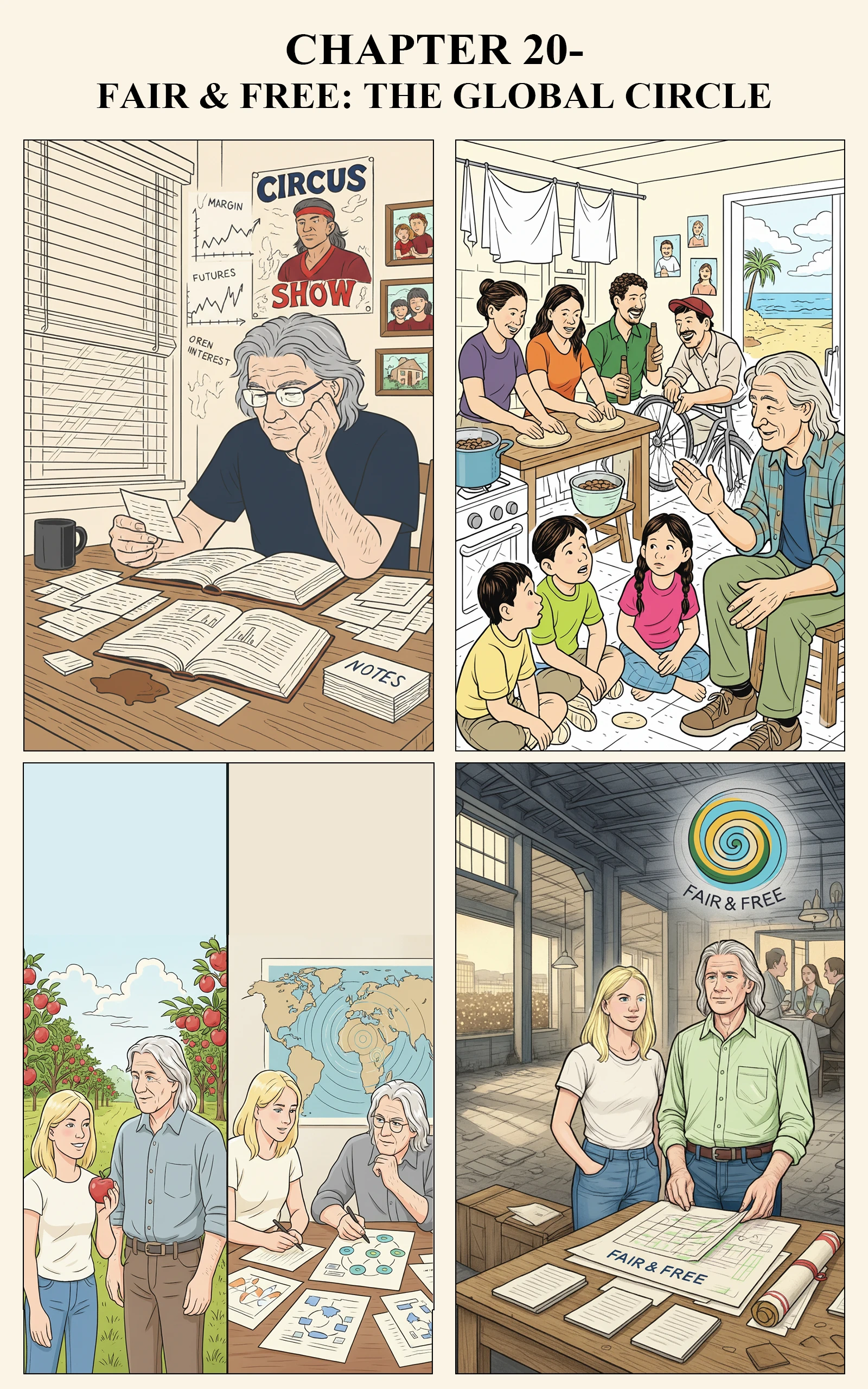
At sixty-five I found myself studying for an exam meant for twenty-somethings in shiny suits. The Series 3 commodities license. It sounded almost comical—after decades of wandering through communes, circuses, and ceremonies, I was suddenly memorizing margin calls and futures spreads. My kitchen table in Venice was stacked with textbooks and coffee-stained notepads, pages filled with the hieroglyphics of modern capitalism.
Every morning began with flashcards and ended with confusion. Candlestick charts looked to me like cave paintings from a forgotten tribe. Open interest, Bollinger bands, stochastic oscillators—each term another spell from the temple of finance. I tried to remember them by turning them into images. Futures contracts became prophecies; commodities became the elements—earth, water, air, fire—traded not in prayer but in profit.
The first time I took the exam, I failed. I walked out laughing, partly at myself, partly at the absurdity of it all. But failure had always been my best teacher. I buckled down, studied harder, and began to see patterns—how markets moved like tides, like breath. Buying and selling were just another form of exchange, no different from the ceremonies I had once led. Every system, even the financial one, relied on belief.
When I finally passed—with a ninety-two—I felt no triumph, only a strange clarity. I had learned the machine so I could learn to subvert it. Tony and I celebrated over cheap champagne and hummus from the corner deli. We called it communion by common sense.
The garage I rented in Venice was little more than a concrete box with a door that groaned like an old man when it opened. Fifteen immigrants shared the house it was attached to—Mexican, Salvadoran, Guatemalan. The air smelled of beans simmering with garlic, children’s soap, and the ocean two blocks away.
We were a chorus of different languages bound by the same need: survival. Every evening, after the day’s labor, the kitchen filled with laughter. Women pounded tortillas on the counter, men traded jokes over cracked bottles of beer. I’d sit at the scarred table repairing a bicycle chain or helping patch a leaky roof, my hands returning to the kind of work that made sense.
They called me El Viejo Loco—the crazy old man who fixed things and told stories. Quito, when he visited, called it Dad’s Mexican Commune. He was right. There was no pretense there, no theory. Just life stripped to the essentials: shared meals, mutual respect, and the small miracles of community. In that noisy kitchen, Fair & Free had already begun—though none of us yet had a name for it.
When I went north to Canada to visit my old friend Trent Rhode, I thought I was going for a short visit. Instead, I met Amanda Solmes. She was twenty-four—bright-eyed, articulate, fierce in her convictions. A graduate student in sustainability, she spoke about regenerative agriculture with the precision of a scientist and the passion of a believer. Her questions cut through my stories like scalpels: Where does reciprocity meet accountability? How do we measure fairness?
Amanda had what I lacked—language. She could translate intuition into structure, myth into model. Our conversations lasted late into the night, fueled by coffee and curiosity. She teased me for calling sustainable systems “common sense.” I teased her for making everything sound like a PhD thesis. Between us, something balanced—her intellect and my instinct.
There was an undeniable energy between us, not quite romance, not merely mentorship—a recognition, like seeing one’s younger self across time. Together, we began to imagine how spirit could live inside structure, how the sacred could exist within the spreadsheet.
We drove to New Hampshire to visit Eleanor and Anton Elbers, my old friends who still tended the orchard Tony and I had planted half a lifetime ago. Orchard Hill Farm had become a sanctuary of its own—rows of apple trees, a wood-fired bakery, a family that lived their ideals one loaf at a time.
The moment I stepped between the trees, memory folded back on itself. The smell of apples and earth, the hum of bees, the quiet certainty of soil. My hands brushed the trunks we’d once planted as twigs, now thick and rough with age. I remembered our youth—the belief that by planting trees we were changing the world. Maybe we had.
Amanda walked a few rows ahead and plucked an apple from a low branch. She bit into it, and juice ran down her wrist. “This,” she said, smiling, “is what people forget. You plant, and the work outlives you.” Her words struck something deep. I saw in her the beginning I once was, and in myself the persistence of that same hope, matured but unbroken.
That day in the orchard was more than nostalgia—it was confirmation. The seed had survived.
Back in Canada, the kitchen table became our war room. Flipcharts covered the walls, pages of sketches and notes layered over maps and trade routes. Amanda drew circles connecting farmers to consumers; I drew arrows connecting hearts to hands. We debated definitions, argued over details, and laughed when theory and reality refused to shake hands.
That’s where the Fair & Free system truly began to form: equal parts idealism and pragmatism. We envisioned regional cooperatives—farmers processing and packaging their own crops, selling directly to communities rather than through multinational chains. Amanda called it systems thinking. I called it going home.
Out of those discussions came the EcoMama Seal—certification for women-led, community-rooted production. The Philippines, Ecuador, Mexico—each became a potential node in a new network. Our evenings stretched past midnight, lit by laptops and belief. Somewhere between her equations and my memories, the blueprint for a global cooperative took shape.
Our first pitch was in Trinidad, Colorado. We walked through empty warehouses with dust thick as history and sunlight pouring through cracked windows. We saw possibilities—processing hubs, training centers, local jobs. The town officials nodded, smiled, promised help that never came. The real owners, we learned, were speculators waiting for a bigger fish.
In Baja, it was the same story dressed differently. Corruption in plain sight. Smiles in daylight, bribes in envelopes after dark. We kept moving. Then came Ecuador. The Correa government invited us to dinner at the Hotel Quito—a view sweeping across the valley, the Andes glowing violet in the last light. The talk was promising, millions in funding, real traction. Until one man leaned close and said it quietly: a percentage for the president’s brother.
I looked out the window at the lights shimmering across the city and thought of all the people who had trusted me to do this right. “Paying under the table,” I said, “is not part of our brand.” That ended the deal, but not the dream. Integrity, I realized, was the foundation itself. Fair & Free could never be bought—it had to be lived. Every failure had become its own kind of proof.
The work continued, smaller but stronger, through farms, friendships, and families. Fair & Free had become the culmination of everything I’d believed in since Erewhon: that the real wealth of the world isn’t profit—it’s relationship. The harvest of a lifetime of seeds.
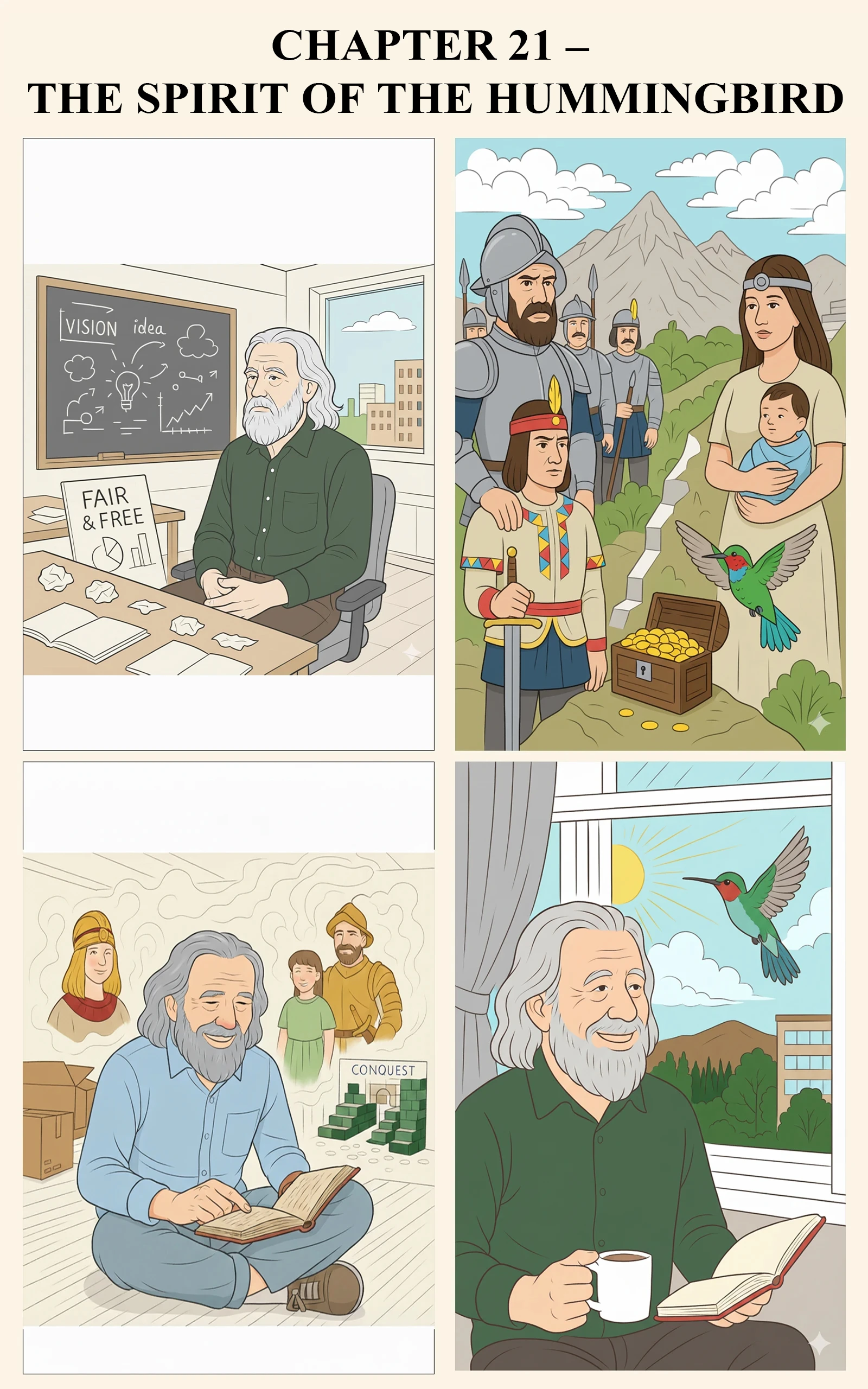
For years the three of us—Tony, Amanda, and I—kept pushing the boulder uphill. We refined concepts, redesigned pitch decks, and rebuilt the vision of Fair & Free a hundred different ways. We brought in Control Union, the Dutch certification group, and even secured brilliant design work from Diana Stanciulescu, who later went on to IBM. Everything looked right. Everything felt close. And still, nothing moved.
It stayed suspended in the air—beautiful, unfinished, unreal.
Those years felt like living inside a long inhale. Possibility surrounded us like oxygen—every meeting, every late-night call, every new diagram pinned to the wall seemed like the moment right before takeoff. But lift never came. Fair & Free became our shared mythology; it shaped the rhythm of our lives. And the strangest part was that no door ever slammed shut. Instead, they all stayed slightly, maddeningly ajar.
Some mornings I woke before dawn and lay staring at the faint blue light on the ceiling, already tired before the day even began. Sustainability had become a circle of buzzwords, a vocabulary that promised transformation but delivered indifference. Amanda held onto faith that the right partnership would unlock everything. Tony believed the path was slow and granular—one farm, one village, one honest handshake at a time. I tried to believe them both. I wanted to believe that hard work alone could bend the world, but some days the weight of it pressed down like weather.
Those mornings were the most honest. Before the screens lit up, before the emails arrived with polite delays, before the phone calls that said “almost” or “soon”—there in the half darkness, I could feel the cost of carrying a dream that refused to land. Still, I got up. I showered. I boiled water. I opened the laptop. The familiar determination crept back in, and I took another swing at the mountain. For years, my life moved in that cycle of hope and exhaustion. The dream was heavier than the world allowed.
A promising opportunity came in Ecuador. The Ministry of Agriculture seemed eager to pilot Fair & Free certification with cacao cooperatives. We met on the rooftop restaurant of the Hotel Quito, high above the city. Clouds wrapped the Andes in white scarves, sliding across the ridgelines in long, steady breaths. The air smelled like rain and eucalyptus. Diana’s presentation glowed on the screen—clean icons, elegant flowcharts, a clear path from seed to export. For a moment, I let myself imagine a breakthrough.
The rooftop itself felt like a stage set for redemption. Quito sprawled far below—yellow houses, green ravines, the distant hum of traffic—and I remember thinking that if anything was going to shift, it would be here, in this altitude-thinned air where everything felt sharper. The ministry team leaned forward as Diana spoke. They asked questions that sounded like genuine curiosity. I let myself feel that flicker—that careful, reluctant, almost-forgotten thing called optimism.
They nodded, smiled, promised a memorandum of understanding.
A week later—silence. Not a no, not a yes. Just the slow evaporation of hope. That was when I first understood the truth: the idea wasn’t flawed. The world simply wasn’t ready. People loved the dream but feared the disruption. Fair & Free was a window into something possible, but possibility can be a frightening thing.
There is a special kind of grief reserved for unfinished work—the kind that never gets a funeral because it never technically dies. It just fades. Every day after that meeting, I checked my email like a man waiting for a letter from someone who had moved on without telling him. At first I rationalized. Maybe they were traveling. Maybe there was a holiday. Maybe they were discussing internally. But eventually, the silence hardened into clarity. The system wasn’t built for what we were offering. Fair & Free didn’t fit their categories. It asked too much.
By 2016, I stepped away. I’d had enough of doors that looked open but weren’t. I returned to writing and filmmaking, supported by Quito—by then thriving as a production designer for Apple, Nike, and the car companies in the world. Tony and Amanda encouraged me too. They knew I needed a different frontier. I had been a farmer, a clown, an activist, a wanderer, a father, a storyteller—now I needed to remember how to dream without waiting for permission.
Stepping away wasn’t a single moment. It was a slow loosening—the grip relaxing, the breath releasing. One morning, I simply felt the truth settle in my bones: I couldn’t pour another year into a world not yet willing to change. And when I stepped back, something unexpected happened. Space opened. My mind, long cramped with logistics and deadlines, softened. Old dreams I’d buried under the architecture of Fair & Free began poking their heads up again like seedlings looking for light.
One afternoon, while rummaging through old boxes, I found a notebook from my teenage years in Ecuador. The cover was worn soft as cloth. Inside were sketches of the Andes and fragments of prayers I’d written at fifteen—longing, hopeful, half-formed, the way only a boy can write. On one page, in fading ink, I had copied a story I’d once heard about Quispe Sisa, the Inca princess who married Francisco Pizarro.
Reading it again fifty years later, something stirred inside me. Memory rose like mist from those same mountains. I could smell Guayaquil’s river air again. I could feel the sun on my neck. I could hear the distant echo of Quechua words spoken by people who had lived through centuries of loss and still carried joy in their bones.
Finding that notebook was like being handed a key to a door I didn’t know was still locked. The ink had faded, but the energy behind those sketches was alive, untouched by time. I remembered the boy I had been—hungry, observant, overwhelmed by the scale of the world—and for a moment I felt him standing beside me, whispering, “Don’t forget who you were before everything got complicated.”
I contacted two gifted Colombian writers—Ana María Londoño and Viviana Galvis. They saw immediately what I saw. What started as a conversation became an outline, and the outline became a living thing. We argued, laughed, rewrote, and somewhere in the creative friction, a pulse returned to my life. Collaborating with them felt like walking back into a room I had forgotten—one filled with the energy of beginnings, of possibility.
Those early calls with Ana María and Viviana were electric. We built worlds, tore them apart, rebuilt them stronger. They pushed me, challenged my assumptions, filled the spaces I didn’t know were empty. It reminded me how much I loved creation for creation’s sake—not the deadlines, not the budgets, not the partnerships, but the raw act of pulling something out of the invisible and giving it form.
I began writing The Spirit of the Hummingbird.
The story opened at the end of the Inca Empire, with Francisco Pizarro—an illiterate soldier of fortune at sixty-eight—marching into the Andes with two hundred mercenaries. He captured Atahualpa, demanded a room of gold, and killed him anyway.
But the soul of the story wasn’t Atahualpa. It was Quispe Sisa—the young Inca woman who married Pizarro and bore him a daughter, Francisca Pizarro Yupanqui. History calls it conquest. I saw a human story braided from impossible contradictions. Love and violence living in the same breath. Tenderness blooming in the shadow of destruction.
Researching Pizarro and Quispe Sisa was like peeling a wound and finding a flower beneath it. Their lives defied narrative logic—yet they happened. And somewhere inside that contradiction, I found a heartbeat. I wanted to explore the impossible spaces between cultures, between power and surrender, between love and survival. History books flatten those spaces. Storytelling opens them.
Within months our team grew to more than twenty people—writers, actors, designers, animators, historians. SAG actors who came off set to help. Marco St. John was going to be in it. My Couchsurfing friend, Peruvian-German actress Andrea Pani Laura became Quispe Sisa. I was Pizarro. Quito was going to design the Inca world. My friend Darnell Williams was going to handle mocap and special effects.
The air buzzed with the electricity of creation, long nights of rewriting scenes that refused to behave. For the first time in years, everything felt alive again.
That period was pure ignition. People joined because they felt something unusual pulsing beneath the script—something ceremonial, something larger than entertainment. We weren’t chasing a blockbuster. We were trying to resurrect a world and let it speak for itself. Every casting session felt like an ancestral calling. Every storyboard had the weight of memory. Every rewrite peeled back another layer of truth.
During that period, hummingbirds began to appear one almost every morning outside my window, its feathers catching green and bronze light in the West Hollywood sun. Their wings were a vibration, not a movement. I remembered them from Erewhon orchards, darting between blossoms at the edge of spring. They always seemed to show up at thresholds, moments of change—birth, endings, reinventions, heartbreak, beginnings. It is one thing to see a hummingbird. It is another to feel it watching you back.
There was something uncanny about their timing. They’d hover at the window just long enough for me to notice, then dart off as if delivering a message I had to decipher. And every time one appeared, I felt a small tightening in my chest—a recognition, as if an old friend were tapping me on the shoulder saying, “Pay attention.”
Andrea asked me once what the hummingbird meant. “It’s the messenger,” I told her. “The bridge between worlds. It can hover, move forward or backward, but it never stops moving. That’s spirit. That’s us.”
In the Andes, they call it Kinti—the being that moves between worlds, carrying the breath of the gods.
When we wrote The Spirit of the Hummingbird, we weren’t making a movie. We were performing a ceremony. We called in musicians, historians, actors, and indigenous voices. We listened more than we spoke. We learned that history is not a straight line but a woven fabric, full of knots and loose threads. Every scene had to live between two worlds—one dying, one being born. At the center of it all was Quispe Sisa: not a victim, not a saint. Her courage was survival. Her legacy was a daughter who carried both worlds inside her—Spain and the Andes, the conqueror and the conquered.
The deeper we went, the more the story demanded humility. We weren’t reconstructing history; we were entering it. There were nights when the writing room felt charged—like we were trespassing into something sacred. When indigenous musicians played ancient songs over early animatics, the air itself shifted. The story became an altar. We were caretakers, not creators.
The hummingbird threaded through everything—a flicker in the corner of vision, a reminder that spirit doesn’t obey borders or history books. It appears, disappears, returns. That little bird became a kind of compass—pointing not north, but inward.
Looking back, I understand that The Spirit of the Hummingbird was never meant to be finished. It was an invocation, an offering to the idea that creation survives collapse. A hummingbird’s wings beat faster than the eye can count, yet its flight is steady. It drinks from one flower, then moves on.
Life is the same. We move from moment to moment, from sweetness to sweetness, sometimes without knowing why. The things we build don’t always materialize, but the spirit we pour into them remains.
That’s how I see my own life now: a string of luminous moments—fragile, fleeting, and feeding whatever comes next.
The film never reached the screen, the pandemic ended it but the spirit behind it still flies. The hummingbird still visits my window. And I take that as a sign that the story, in its own way, continues.
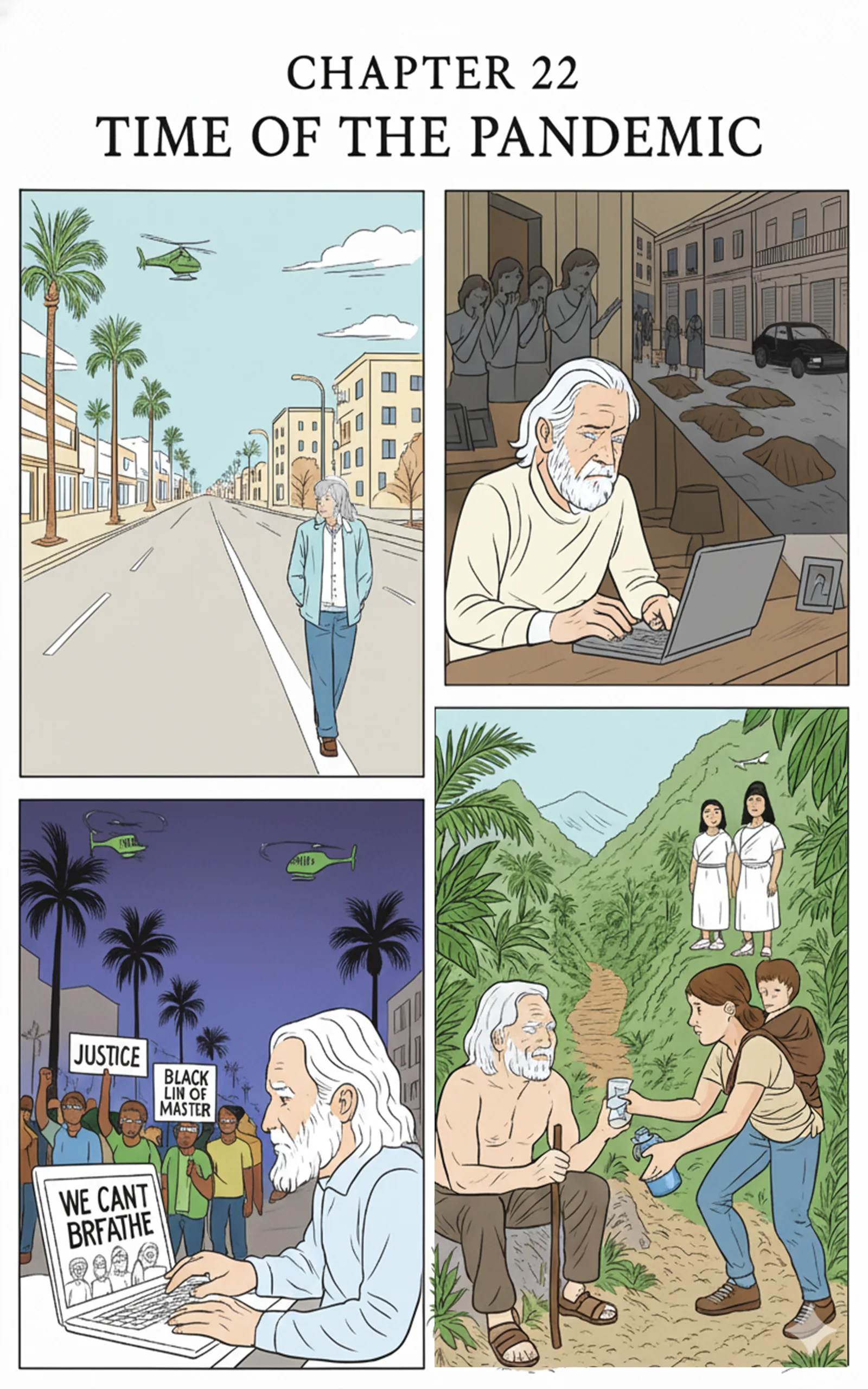
Then the pandemic hit, and everything we’d been building—plans, scripts, hopes for a comeback—fell silent, as if someone had turned down the volume of the entire world.
The news from Ecuador arrived first. Guayaquil collapsed almost overnight. Bodies lay on sidewalks, wrapped in sheets. Families stood beside them, crying for help that never came. I watched it from Los Angeles, helpless, the city where I had once been young and reckless now reduced to a glowing rectangle in my hands. The distance between California and Ecuador had never felt so cruel.
When the first lockdown order came, Quito reacted instantly.
“Stay put, Dad,” he said. “I mean it.”
He dropped off groceries once a week, masked, gloved, distant. He stood at the doorway like a soldier guarding a quarantine post. I could see the fear in his eyes—fear not of the virus itself, but of losing me. I joked to lighten the tension. He didn’t laugh.
The days took on a strange stillness. The streets of West Hollywood—normally a parade of noise, color, and late-night laughter—went empty. Only helicopters crossed the sky. Their low thrum became the soundtrack of the pandemic. Footsteps on the pavement sounded foreign, almost suspicious. The air smelled like bleach, summer heat, and loneliness.
Inside my apartment, time lost shape. Morning slid into night without definition. I’d wake, read the news, feel the dread crawl through my chest, then try to write or meditate or simply sit still—anything to stop my mind from spiraling. Sometimes I’d talk aloud to myself just to hear another human voice.
The silence was not peaceful. It was the silence of waiting—waiting for news, for numbers, for death counts, for some sign that the world still remembered how to breathe.
During those early months, I learned the architecture of isolation. I measured my days by the path of sunlight across the wall. I memorized the creaks of the building. I learned where the pigeons nested on the ledge outside my window. Every small detail became a companion. Every echo mattered.
Quito checked in constantly.
“You okay?”
“I’m fine.”
“You’re lying.”
He was right. There were nights when my chest tightened with anxiety, when I walked circles around the living room just to remind myself I was alive. There were mornings when the weight of uncertainty felt like a physical thing—the heaviness of unmade plans, of dreams paused mid-breath.
Across the world, friends fell sick. Messages trickled in:
“He’s in the ICU.”
“She can’t breathe.”
“We don’t know if he’ll make it.”
Loss became a constant, a background hum as steady as the helicopters.
On the rare nights I ventured to the window, the city felt both abandoned and surveilled. Police loudspeakers echoed through the empty avenues. Sirens punctured the quiet like warnings from another dimension. The boulevard that had once held parades of pride and protest now held its breath.
The hummingbird still came.
In the middle of all that fear and emptiness, it hovered outside my window as if nothing had changed. Its wings blurred, defiant. It drank from the flowers on my balcony with the same insistence as before. Watching it, I remembered what I had told Andrea:
“It’s the messenger. It never stops moving.”
Even in quarantine, even in the collapse of systems and countries, the hummingbird refused silence.
Then came George Floyd.
One night, the air turned thick and electric. Helicopters multiplied. Sirens screamed. Smoke curled up from Fairfax and Hollywood Boulevard. I stood at my window watching the city I loved erupt in grief and fury, orange light rising behind palm trees like a dark sun. Protesters marched past my building—masked, shouting, carrying signs that glowed in the streetlights. I felt the ache of it, the righteousness, the horror, all braided together.
It was the first time in months that the world didn’t feel frozen.
It felt wounded.
It felt awake.
And there I was—alone in my apartment, a man in his seventies watching history crack open again, just as it had cracked open so many times before in my life. I felt the old sorrow, the old hope, and the old question: What comes after this?
The pandemic had turned the world inward. The uprising forced it outward. And somewhere between those two forces—fear and awakening—something in me began to shift.
After about nine months the vaccine came and I got one of the first. I went to Ecuador as soon as they opened up again with my old friend Dan Hester from my early days in Quito with his family. It was still difficult and not back to wholeness. Finishing the completion for the Pizarro movie was not going to happen.
Then came the invitation to visit the KOGI in Colombia. I called Amanda and she said, count me and Theo in, we will come.
In January of 2022, Amanda and I were invited to visit the Kogi in their mountain homeland. It felt like one of those invitations that is less a message and more a calling. Theo came with us, riding on Amanda’s back as we followed the son of one of the Mamos and his wife up a narrow, winding trail. The path was steep, carved into the side of the mountain like a single careful thought. Ferns brushed our legs. The earth was soft and red beneath our feet.
I was seventy-three years old and feeling every bit of the years in my bones, but with their help—steady hands, quiet encouragement—I made it up the mountain. The air thinned as we climbed, turning sweet and cool, carrying the smell of rain long before the clouds arrived. At one point I had to stop and sit on a patch of hillside, holding a walking stick as if it had grown out of my hand. Above me the young Kogi boy stood watchfully, and beside me Amanda climbed with the kind of strength only mothers know, Theo peeking over her shoulder with a face full of curiosity.
After what felt like both an hour and a lifetime, we reached a small village hidden among tall ferns and trees. The people there had prepared food for us—simple, sacred, and alive with meaning. We ate from banana leaves and sat together in a circle while the afternoon light softened over the mountains. We prayed with them, each in our own way, the silence between us speaking more honestly than words ever could.
At one point I asked the son of the Mamo what the Kogi believed about the pandemic—what they saw, what they understood from their place between the visible and invisible worlds. He told me that his father and the other Mamos were higher up the mountain, dancing and praying for answers. Even for them, he said, it was a confusing time. The world had shifted. The balance felt uncertain. Their ceremonies were offerings, inquiries, attempts to listen to whatever the Earth was trying to say.
We spent the night in the village. The sounds were different up there—crickets, wind, the steady breaths of people who live close to the land. In the morning we began the long descent back down to the little town below. My legs shook, and Amanda steadied herself with Theo still on her back, but there was a peace in all of us that hadn’t been there the day before.
Later, Amanda told me that the climb changed her life. Theo, even as a small child, seemed to carry the memory of that mountain in his eyes for days afterward. And for me—well, I’m still learning what it changed. Something settled. Something opened. Something I’m still coming to understand.
The pandemic had shaken the whole world in different ways. But standing with the Kogi, eating their food, hearing their prayers, and feeling their humility in the face of a mystery none of us could quite grasp—it gave me a glimpse of a deeper map. A reminder that even in confusion, there can be meaning. Even in uncertainty, there can be ceremony. And even on the steepest mountains, there can be a hand reaching back to help you climb.
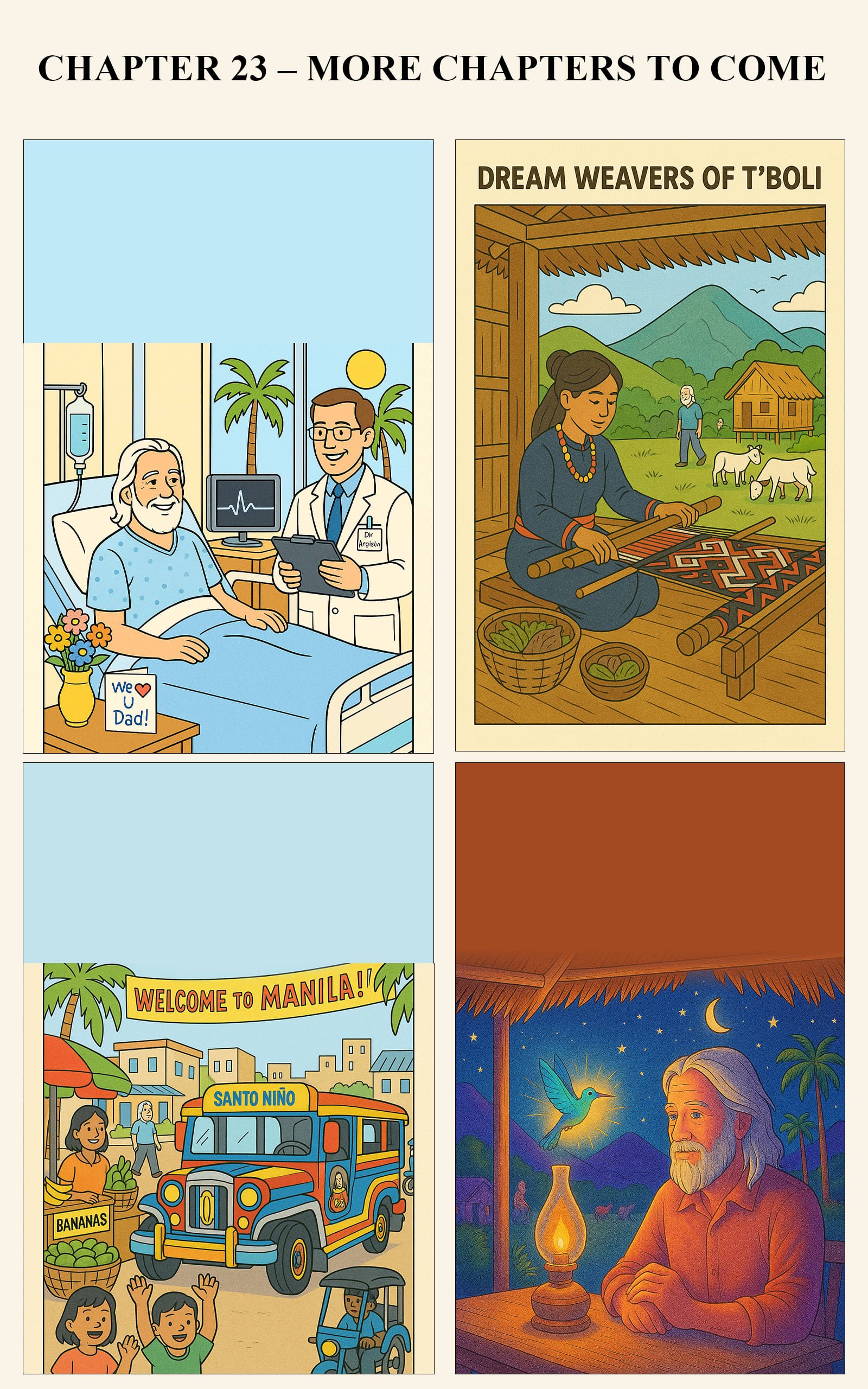
The trip with Amanda and Theo to the Kogi had put everything in perspective for me.
Then came the exam. Routine, the doctor said.
Except that it wasn’t.
Prostate cancer.
The diagnosis shook my family more than me. I thought: I’ve had a good run. There had been so many close calls already—guns, storms, heartbreaks, miracles. If this was the next chapter, so be it. Being a veteran meant I could go to the VA in Westwood, where the hospital smelled of antiseptic and chilled metal, the halls echoing with the steady beep of monitors.
Dr. Aronson, head of urology, walked me through every scan and every X-ray. He was calm, direct, the kind of man who didn’t waste words. Just before surgery I told him, “Whatever you do… don’t remove my sense of humor.”
He laughed. I did too. No fear.
Within a week, I was recovering—stitched, sore, humbled, and strangely grateful to still be breathing. It’s a peculiar thing to realize your body has been opened and altered, and yet you’re still here, blinking under fluorescent lights, still yourself.
Soon after, I flew to the Philippines. From the airplane window, sunrise spilled across the Pacific like molten gold. I thought about how many lives I had already lived, how many times I had begun again. I wondered how many rebirths a person gets in one lifetime.
There had been Filipinos on the Fair & Free team Diana and I had formed years earlier, and I had stayed in touch with them. One was Our Lady of Peace Mission—a Catholic initiative dedicated to education and healthcare in places most of the world overlooks. Their work reminded me of a simple truth: compassion is the most radical form of service.
When I arrived in Manila, the humidity wrapped around me like a welcome. Jeepneys painted with saints, slogans, and chrome angels crowded the streets. Somewhere between the shouting vendors and the diesel haze, I felt an unexpected sensation of returning—not to a place I had known, but to a place that had been waiting for me.
The drive from General Santos Airport to the town of T’boli wound through a patchwork of fields and rising hills. The air shifted as we left the lowlands, heavier with the smell of damp earth and burning wood. Trucks overloaded with coconuts swayed on the narrow roads. Jeepneys painted in bright colors rattled past, their roofs stacked high with sacks of rice and baskets of fruit. Goats grazed by the roadside, children waved from bamboo huts, and the mountains ahead seemed to gather like a great green wall announcing we were entering another world.
The T’boli elders and Mayor Tuan had invited me, and that mattered. You don’t step onto their land without being called. They brought me to the weaving houses, where women worked the T’nalak looms. Their hands moved steady, rhythm like a heartbeat, fibers dyed with roots and leaves. They said each pattern came from dreams. If the dream was clear, the cloth would be strong. If it was clouded, the weaving would knot.
I listened. I carried their words home with me.
From South Cotabato I went to Cebu, to the coast where the markets smelled of salt and dried fish and sugarcane. Vendors shouted prices above the noise of tricycles and jeepneys. On the piers, ferries loaded sacks of coconuts, mangoes, rice—all bound for Manila or Mindanao. Watching it, I could see the old problem in plain sight: the farmers bent over in the fields weren’t the ones who controlled what happened next. Middlemen took the harvest, took the margin, took the life out of the work.
That’s where EcoMama started to take shape—not as a logo, not as an enterprise in full swing, but as a survival strategy we could imagine. The plan was simple: build a field-to-fork chain that didn’t break the farmer in the middle. Flash-freeze fruit near the orchards. Package cacao at the farm instead of shipping beans to some foreign factory. Keep the value local.
But truth was, it stayed in sketches and conversations. We drew packaging designs on scraps of paper. Bright bags of dried mango chips, cacao nibs stamped with EcoMama—Meet the Farmer, QR codes that could take you straight to a story. They never made it past the mock-up stage. We never shipped a single product.
In municipal halls, we pitched the idea. Mayors fanned themselves with manila folders, barangay captains sipped sweet coffee while we explained. Some nodded, some shrugged, some leaned in as if they’d been waiting for someone to say it out loud. But after the nods came silence. No funding, no machinery, no continuity.
In the mornings, we still walked the farms. The smell of cacao fermenting in wooden boxes—sour and sweet at once. Rows of coconut palms bending in the wind. Bananas packed tight, their leaves torn from storms but still alive. The farmers laughed at my boots, too heavy for the mud, and handed me a bolo. I hacked at weeds with them, sweating, slipping, learning how much labor hides inside a kilo of dried coconut.
At night, over rum and tin plates of adobo, the talk turned serious. How to get financing without being swallowed by banks. How to keep the kids from leaving for Manila, for Saudi, for Dubai. How to hold on to land when the paperwork was as tangled as the roots of a mango tree.
We didn’t solve those problems. But the conversations mattered. EcoMama wasn’t execution—it was rehearsal, a fragile hope sketched out in humid air.
It was the start of my last big act, even if it remained only a beginning.
That night, under a thatched roof dimly lit by an oil lamp, a single hummingbird—or maybe it was a dragonfly—hovered near the flickering flame. Its wings caught the firelight like shards of living glass. I took it as a sign that the circle had closed. That the spirit that had followed me from Colorado valleys to Ecuadorian mountains to Los Angeles nights had found me again in the Philippine highlands.
I felt rejuvenated. Reassembled. Hopeful. Once again, I stood at a crossroads in my life—another turning, another beginning.
And I understood something simple and profound: the next chapters would be the best.

Community Stories
This space is for readers to share their own memories, stories, and messages inspired by Appaloosa Andy.